

Anxiety, depression rise as ‘perfect storm’ rages

Advertisement
Read this article for free:
or
Already have an account? Log in here »
To continue reading, please subscribe:
Digital Subscription
One year of digital access for only $1.44 a week*
- Enjoy unlimited reading on winnipegfreepress.com
- Read the E-Edition, our digital replica newspaper
- Access News Break, our award-winning app
- Play interactive puzzles
*Billed as $5.77 plus GST every four weeks. After 52 weeks, price increases to the regular rate of $19.95 plus GST every four weeks. Offer available to new and qualified returning subscribers only. Cancel any time.
To continue reading, please subscribe:
Add Free Press access to your Brandon Sun subscription for only an additional
$1 for the first 4 weeks*
- Enjoy unlimited reading on winnipegfreepress.com
- Read the E-Edition, our digital replica newspaper
- Access News Break, our award-winning app
- Play interactive puzzles
*Your next Brandon Sun subscription payment will increase by $1.00 and you will be charged $17.95 plus GST for four weeks. After four weeks, your payment will increase to $24.95 plus GST every four weeks.
Read unlimited articles for free today:
or
Already have an account? Log in here »
Hey there, time traveller!
This article was published 24/12/2020 (2125 days ago), so information in it may no longer be current.
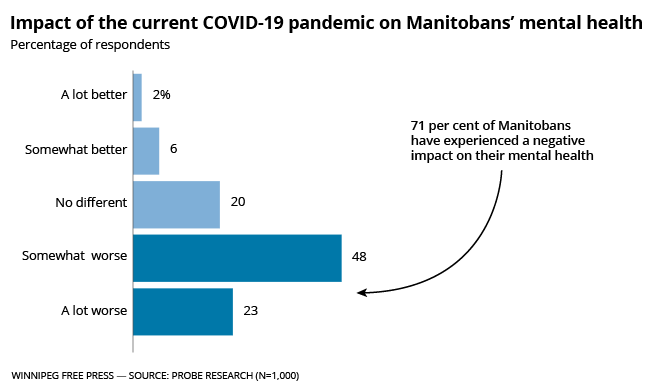
Most Manitobans say the pandemic has damaged their emotional and mental health — experts explain the virus has created a “perfect storm” of factors to heighten anxiety and depression.
In a Probe research poll commissioned by the Free Press, 71 per cent of Manitobans reported their mental well-being had been challenged by the COVID-19 pandemic. Comparatively, one in five Manitobans reported no change in their mental health, and eight per cent reported better mental health as a result of the pandemic.
Dr. Keith Dobson, a clinical psychology professor at the University of Calgary, said social and physical factors brought about by the pandemic have increased anxiety and depression since March.
“People’s biology is generally being thrown off… From a social side, the big risks are things like loss, isolation, diminished opportunity, not having as much physical contact with other people,” Dobson said.
Nicole Chammartin, executive director of Klinic Community Health, said there has been a marked need for the centre’s crisis services throughout the pandemic. Klinic recently announced it has expanded its services to seven days a week with same-day appointments in order to meet the growing need for immediate crisis support.
Across its seven phone crisis lines, Chammartin said the centre is able to answer between 100 and 130 calls per day, up to 160 calls on the busiest days. Approximately 12 per cent of those calls this fall have expressly mentioned COVID-19 as a contributing factor to their crisis, though Chammartin said COVID is “underlying” in most calls.
Dobson noted the main risk factors for stress and anxiety are unpredictability, uncontrollability and salience — or significance — of circumstances.
In the early days of the pandemic, psychologists found a “perfect storm” of those factors contributed to a spike in anxiety rates among the population. That anxiety rate stayed high as questions were raised about vaccines and other unknowns. As relatives and friends have died, depression rates have stayed high, too.
Chammartin explained the heightened risk factors have contributed to “higher levels of distress” among Klinic’s callers.
“If people have been laid off, lost work or housing or they’re alone or more isolated those are things people talk about. People that were struggling before the pandemic of course have found themselves struggling during it, now with an added stressor levels of anxiety and depression are increasing,” she said.
Increased rates of domestic violence, substance use and sleep disturbance have also played a role in overall psychological well-being, Dobson said.
Of those with declined mental health, women were slightly more likely than men to report worsened well-being — 76 per cent of women compared to 67 percent of men. Younger Manitobans, those in the 18 to 34 age bracket, were also more likely to report worsened mental health.
Dobson said those groups tend to be at a higher risk for social losses, often working in health-care, service or other impacted professions.
Though the polling data did not include breakdowns of race, both Dobson and Chammartin noted those from marginalized communities — First Nations people, people of colour and newcomers for example — and those already at a disadvantage financially, would also be likely to report higher rates of stress and anxiety.
“For people who may be marginalized or live in poverty or not have good access to things like computer equipment for example, the world has become very difficult,” Chammartin said.

To combat the COVID blues, Dobson recommended recognizing what factors are being affected, like sleep, food or substance use, and work to regulate and manage those factors. He also recommended regular physical activity, finding ways to create “meaningful social contact,” and creating both long and short-term goals that provide a sense of success and accomplishment.
“This is a chance for people to stop and think about what is important to them and rejig their life to some extent,” Dobson said. “We strongly recommend every day pick some activity both that makes them feel good… and also start thinking about something bigger that they might enjoy and can’t do right now, and start to plan for it.”
The poll was taken between Nov. 24 and Dec. 4, sampling 1,000 adults living in Manitoba through live phone polling and online questionnaires. Probe has determined with 95 per cent certainty that the results are within 3.1 percentage points of what they would have been if all Manitobans had been surveyed. That margin of error increases for specific subgroups.
julia-simone.rutgers@freepress.mb.ca
Twitter: @jsrutgers
Julia-Simone Rutgers is an investigative reporter who joined the Free Press in 2020. Read more about Julia-Simone.
Every piece of reporting Julia-Simone produces is reviewed by an editing team before it is posted online or published in print — part of the Free Press‘s tradition, since 1872, of producing reliable independent journalism. Read more about Free Press’s history and mandate, and learn how our newsroom operates.
Our newsroom depends on a growing audience of readers to power our journalism. If you are not a paid reader, please consider becoming a subscriber.
Our newsroom depends on its audience of readers to power our journalism. Thank you for your support.
Crisis resources:
Manitoba Suicide Prevention & Support Line (24/7) – Toll free: 1-877-435-7170
reasontolive.ca
Klinic Crisis Line (24/7) – Phone: (204) 786-8686 – Toll free: 1-888-322-3019
Methodology
Probe research polled 1,000 adult Manitobans between Nov. 24 and Dec. 4, of whom 277 were randomly selected from an existing panel and the rest were recruited through random phone call. These results would normally have a 95 per cent certainty within a 3.1 per cent margin of error, though this metric is not applied to online surveys.
Julia-Simone Rutgers is an investigative reporter who joined the Free Press in 2020. Read more about Julia-Simone.
Every piece of reporting Julia-Simone produces is reviewed by an editing team before it is posted online or published in print — part of the Free Press‘s tradition, since 1872, of producing reliable independent journalism. Read more about Free Press’s history and mandate, and learn how our newsroom operates.
Our newsroom depends on a growing audience of readers to power our journalism. If you are not a paid reader, please consider becoming a subscriber.
Our newsroom depends on its audience of readers to power our journalism. Thank you for your support.
Advertisement Advertise With Us
Advertisement Advertise With Us
History
Updated on Thursday, December 24, 2020 1:16 PM CST: Fixes typo in graphic