

Grief, outrage linger in aftermath of PS752
Airliner loaded with Canadian residents shot down by Iran

Advertisement
Read this article for free:
or
Already have an account? Log in here »
To continue reading, please subscribe:

Digital Subscription
One year of digital access for only $205*
- Enjoy unlimited reading on winnipegfreepress.com
- Read the E-Edition, our digital replica newspaper
- Access News Break, our award-winning app
- Play interactive puzzles
*First annual payment billed as $205.00 + GST for one year. This annual subscription will automatically renew at $233.00 + GST every 52 weeks (10% off the regular annual price of $259.35). Offer available to new and qualified returning subscribers only. Cancel any time.
To continue reading, please subscribe:
Add Free Press access to your Brandon Sun subscription for only an additional
$1 for the first 4 weeks*
- Enjoy unlimited reading on winnipegfreepress.com
- Read the E-Edition, our digital replica newspaper
- Access News Break, our award-winning app
- Play interactive puzzles
*Your next Brandon Sun subscription payment will increase by $1.00 and you will be charged $17.95 plus GST for four weeks. After four weeks, your payment will increase to $24.95 plus GST every four weeks.
Read unlimited articles for free today:
or
Already have an account? Log in here »
Hey there, time traveller!
This article was published 29/12/2020 (2084 days ago), so information in it may no longer be current.
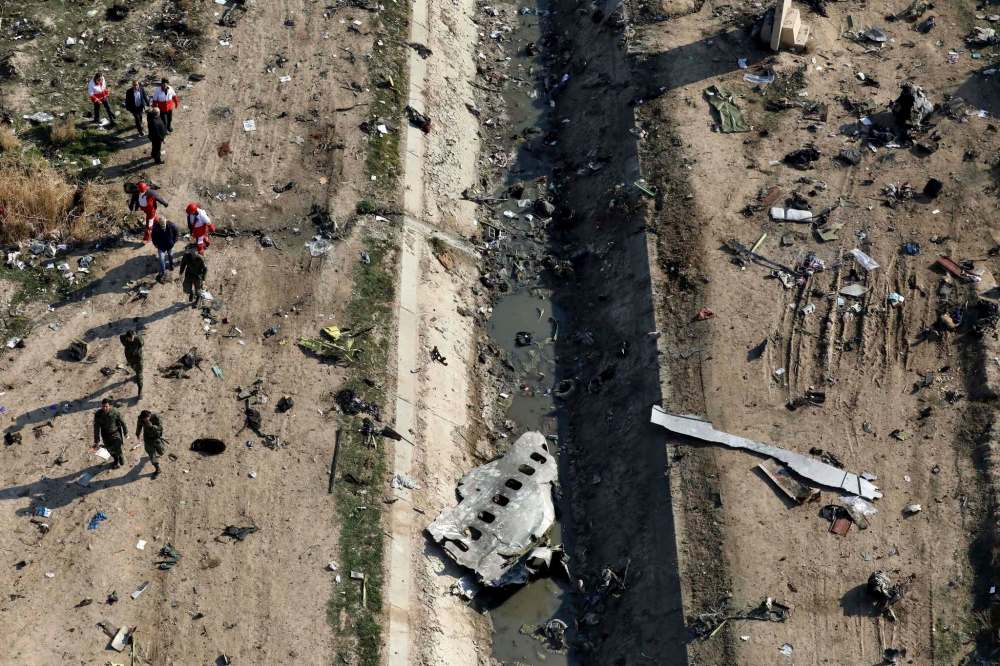
It’s better not to think of the last moments of Ukrainian International Airlines Flight 752, climbing away from Tehran in the early morning hours of Jan. 8. It’s better not to think about what the passengers must have felt and thought when the first missile struck, followed 23 seconds later by a second and, then, a final, fatal plunge.
There were 176 people aboard. Nearly eight in 10 of them lived in Canada, including citizens, university students and permanent residents; at least 20 Canadian universities lost faculty, students or recent graduates.
The route they were taking is well-known to Iranian-Canadians, one of the few affordable links between here and there.
In that way, the cruelty of geopolitics was stamped on the flight, right from the start.
It’s haunting how similar the victims’ stories were. Many were doctors and dentists, engineers and physicists, young scientists and old. They’d taken advantage of the December holidays to fly to Iran for a family wedding, or to spend precious time with an ailing parent, or to get engaged, or simply to be with those they loved.
They were just trying to live. To nourish bonds that traversed the world. And, on that day, to come home.
In some cases, whole families died together, parents and children. What is almost worse to think about are the cases where one parent stayed home: in Ontario, Hamed Esmaeilion lost his beloved wife, Parisa Eghbalian, and their only child, nine-year-old Reera. He is not the only father to have lost his whole family when PS752 was shot down.
Across Canada, grief poured through neighbourhoods and laboratories and schools.
Nine of the victims were from Winnipeg; that week, a memorial service at Centro Caboto was filled to the brim with mourners. Classmates of 10-year-old victim Anisa Sadeghi stood up to talk about their friend and share a video they’d made for her.
It was hard to think about their young hearts having to bear such a loss. Not just a death, and not just a tragedy: the destruction of PS752, shot down by the Iranian military during a time of high-tension sabre-rattling between the United States and Iran, was totally avoidable, a complete waste of life, and an insult to humanity.
So was the aftermath.
For three days after the crash, the Iranian government denied any role, even as officials in Canada and elsewhere had rightly surmised from available radar evidence it had likely been shot down, and even as videos surfaced showing the fiery trail of two missiles and the blinding flash of the plane’s demise.
Even after Iran President Hassan Rouhani admitted what had happened, calling it an “unforgivable mistake,” some officials ran apologetics: one Iranian politician said the plane’s movement was “suspicious.” The plane was following a standard flight path that had been approved by the military and by civil aviation authorities.
As protests broke out in a grieving Iran, there were reports of families being pressured to make public declarations of support for the government. While Canada and other countries that lost citizens sought a full investigation and access to evidence about what transpired, Iranian officials have remained less than transparent.
If it had happened in any other year, PS752 might have been one of the defining Canadian news stories of 2020, a subject of ongoing coverage.
But just as Canada was coming to grips with the incident, a worrisome new virus was circulating in central China; within weeks, it would consume most of our lives and almost all of our news.
The families haven’t forgotten, though. They will not forget. Many say they will not forgive.
So they started an organization, the Association of Families of Flight 752 Victims, and a website (ps752justice.com). They held small rallies across the world in October, and are planning a livestreamed memorial for the anniversary of the crash Jan. 8, 2021. They have developed a list of requests to get them a semblance of justice.

There will be legacies, both at home and abroad. In February, Canada announced the Safer Skies Strategy, a plan to bring together a coalition of civil aviation authorities to share information and better co-ordinate closing airspaces around conflict zones to help protect civilian flights.
In December, the prime minister’s special adviser on PS752, former cabinet minister Ralph Goodale, released a 74-page report reviewing Canada’s response and the challenges of investigating the incident. The report emphasized the fact current international rules are insufficient to adequately respond to a military shooting down a civilian aircraft.
The University of Manitoba launched a fellowship in memory of the victims with ties to the school; it will support graduate students in a STEM field. There is also a U of M scholarship named in memory of recent graduate Dr. Forough Khadem, a brilliant immunologist who perished in the crash.
And young Anisa Sadeghi, who loved hockey and dreamed of doing something special for Winnipeg someday, her name will go on, too. Her aunt fundraised for a scholarship, Anisa’s Dream, which will subsidize programs for low-income students at Henry G. Izatt Middle School, where Anisa spent many happy days.
The victims will not soon be forgotten. It is too early to say if their families will ever get the justice they seek.
When tragedies of this magnitude happen there is, often, an urge to look for some good that can come out of it, for some lesson, some way to believe the victims died for a reason. In this case, there may not be one.

All we know for certain: they died because it is the innocent who suffer the price of power games between nations.
So it always is, so it always was. Despite these periodic oceans of grief, so it always will be.
Now, as a nightmare 2020 comes to a close, we must take a moment to remember the Manitobans who are not here to mark it with us.
This one’s for Forough. It’s for Anisa and her parents, Mahdi Sadeghi and Bahareh Haj Esfandiari. For Amirhossein Ghorbani. For Farzaneh Naderi and her son, Noojan Sadr, and for Amirhossein Ghasemi.
melissa.martin@freepress.mb.ca
Melissa Martin
Reporter-at-large
Melissa Martin reports and opines for the Winnipeg Free Press.
Every piece of reporting Melissa produces is reviewed by an editing team before it is posted online or published in print — part of the Free Press‘s tradition, since 1872, of producing reliable independent journalism. Read more about Free Press’s history and mandate, and learn how our newsroom operates.
Our newsroom depends on a growing audience of readers to power our journalism. If you are not a paid reader, please consider becoming a subscriber.
Our newsroom depends on its audience of readers to power our journalism. Thank you for your support.
Melissa Martin
Reporter-at-large
Melissa Martin reports and opines for the Winnipeg Free Press.
Every piece of reporting Melissa produces is reviewed by an editing team before it is posted online or published in print — part of the Free Press‘s tradition, since 1872, of producing reliable independent journalism. Read more about Free Press’s history and mandate, and learn how our newsroom operates.
Our newsroom depends on a growing audience of readers to power our journalism. If you are not a paid reader, please consider becoming a subscriber.
Our newsroom depends on its audience of readers to power our journalism. Thank you for your support.
Advertisement Advertise With Us
Advertisement Advertise With Us