

Moving mission
Pilates instructor challenges stereotypes to engage disability community

Advertisement
Read this article for free:
or
Already have an account? Log in here »
To continue reading, please subscribe:
Digital Subscription
One year of digital access for only $1.44 a week*
- Enjoy unlimited reading on winnipegfreepress.com
- Read the E-Edition, our digital replica newspaper
- Access News Break, our award-winning app
- Play interactive puzzles
*Billed as $5.77 plus GST every four weeks. After 52 weeks, price increases to the regular rate of $19.95 plus GST every four weeks. Offer available to new and qualified returning subscribers only. Cancel any time.
To continue reading, please subscribe:
Add Free Press access to your Brandon Sun subscription for only an additional
$1 for the first 4 weeks*
- Enjoy unlimited reading on winnipegfreepress.com
- Read the E-Edition, our digital replica newspaper
- Access News Break, our award-winning app
- Play interactive puzzles
*Your next Brandon Sun subscription payment will increase by $1.00 and you will be charged $17.95 plus GST for four weeks. After four weeks, your payment will increase to $24.95 plus GST every four weeks.
Read unlimited articles for free today:
or
Already have an account? Log in here »
Hey there, time traveller!
This article was published 06/01/2021 (1983 days ago), so information in it may no longer be current.
When Norah Myers discovered Pilates over a decade ago, a whole new world opened up for her.
Myers, 34, has cerebral palsy, and her massage therapist urged her to find a form of exercise she’d actually like doing. Myers was feeling burned out by her desk job, which was also doing her body no favours.
“There happened to be a Pilates studio right up the street, so I decided to go there — and I’ve kind of never looked back,” she says. “Pilates is my main form of exercise, and part of my rehabilitation for my disability — so managing pain, helping with my balance, helping get me stronger, helping with my posture in terms of standing straighter, walking straighter, feeling more grounded, feeling more balanced in my body.”

As of September, Myers is now a certified instructor in STOTT Pilates, a modern method based on the original, full-body, low-impact exercise invented by the late Joseph Pilates, a German-born physical trainer, in the early 20th century. Joseph Pilates famously trained Balanchine’s ballerinas in New York City following his immigration to the U.S.; his method is all about intense mind-body connection, with a series of moves that build stability, flexibility, strength and stamina. Pilates is now practised all over the world.
Through her own experience, Myers identified a major gap she could help fill as a teacher. So, when she approached Monique Lavoie, owner and master instructor trainer at Pilates Winnipeg about pursuing her STOTT instructor certification, she was a woman on a mission.
“I went to her and said, ‘Hi, I’m a person with a disability and I want to teach other people with disabilities. I want to open Pilates up more to the disability community and serve people who don’t think that they can do Pilates,” Myers says. “And then I want to show them that they can do Pilates.”
‘People with disabilities aren’t being told that they can do Pilates. And they don’t even believe that they can’– Norah Myers, on her drive to make Pilates available to all
According to Statistics Canada, one in five Canadians over the age of 15 had one or more disabilities in 2017. That works out to roughly 6.2 million people and yet, people with disabilities remain chronically under-represented in almost every space — including fitness and wellness.
Myers, who now has the distinction of being the only STOTT-certified teacher with cerebral palsy, wants to change that. Pilates is both a preventative and rehabilitative exercise, and Myers believes it should be more widely recommended by health care professionals to people with disabilities. Pilates moves, she notes, can be adapted, and, as an instructor, Myers meets people where they’re at.
“People with disabilities aren’t being told that they can do Pilates,” she says. “And they don’t even believe that they can. I have a client who has very severe arthritis in her hips… she was just so scared that because of her arthritis, she couldn’t do it. And I said, ‘Well, because of your arthritis, you should do it, because it’s going to help you.’ And it did.”
Intimidation can be a real barrier, so Myers actively works to challenge some of the stereotypes about Pilates. “(People) think that it’s only for people who are flexible,” she says. “It’s only for people who already have a certain amount of strength, or a certain amount of ability, or a certain amount of body control.”
Or, for that matter, that it’s only for people who already have a certain body. Somewhere along the way, Pilates became associated with the long, lean A-listers and dancers who name-checked it in the pages of grocery-store checkout magazines.
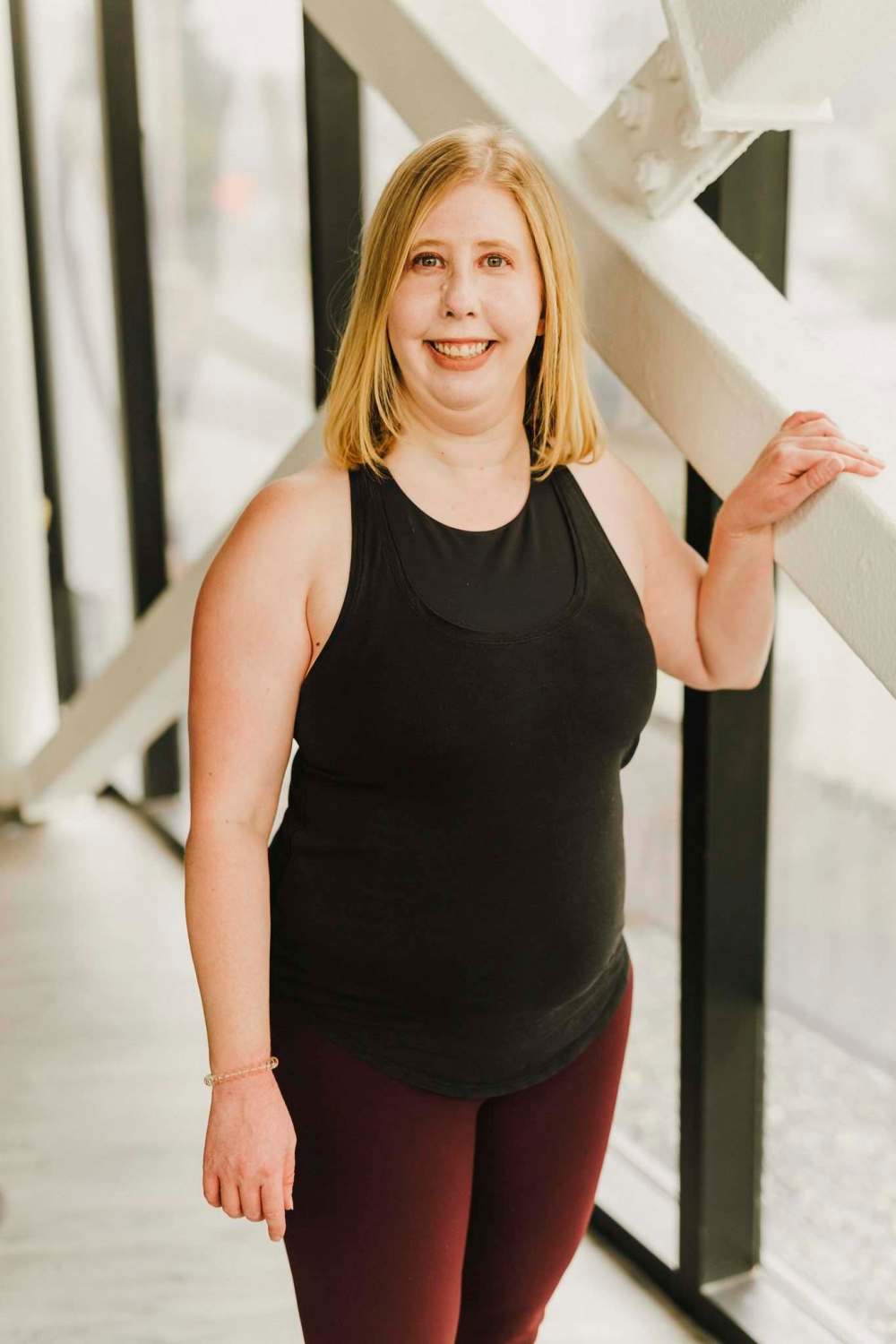
That’s why representation and visibility are so important; it’s easier to believe that bodies of all kinds can do Pilates if you can actually see bodies of all kinds doing Pilates. To that end, Myers is also intentional about how she presents herself on her friendly, approachable Instagram page. Her goal is to make Pilates less intimidating and more accessible, so she doesn’t post photos of herself doing advanced acrobatics.
“We need not only more visibly disabled fitness instructors, Pilates teachers, yoga teachers — we need more visibly disabled doctors and nurses and surgeons,” she says.
“I was recently speaking to a massage therapist, and she has a visual impairment. And I’ve known of a few people who have visual impairments who become massage therapists; it gives them a certain intuitiveness relying on what they feel in somebody’s body, rather than what they see in somebody’s body.”
Myers is currently teaching virtually, offering private and semi-private classes via Zoom due to pandemic restrictions. She has received positive feedback from her clients on her inclusive, calm, gentle teaching style, which she credits to Lavoie’s mentorship.
As for Lavoie, “I am so proud of Norah’s success in achieving her goal to become a STOTT Pilates certified instructor who is knowledgeable, caring and relatable,” she says. “Her achievements are a great example of what you can accomplish with hard work and passion for health and wellness.”Those interested in classes can visit wellnessbynorah.com.
jen.zoratti@freepress.mb.ca
Twitter: @JenZoratti
Jen Zoratti is a columnist and feature writer working in the Arts & Life department, as well as the author of the weekly newsletter NEXT. A National Newspaper Award finalist for arts and entertainment writing, Jen is a graduate of the Creative Communications program at RRC Polytech and was a music writer before joining the Free Press in 2013. Read more about Jen.
Every piece of reporting Jen produces is reviewed by an editing team before it is posted online or published in print – part of the Free Press‘s tradition, since 1872, of producing reliable independent journalism. Read more about Free Press’s history and mandate, and learn how our newsroom operates.
Our newsroom depends on a growing audience of readers to power our journalism. If you are not a paid reader, please consider becoming a subscriber.
Our newsroom depends on its audience of readers to power our journalism. Thank you for your support.
Jen Zoratti is a columnist and feature writer working in the Arts & Life department, as well as the author of the weekly newsletter NEXT. A National Newspaper Award finalist for arts and entertainment writing, Jen is a graduate of the Creative Communications program at RRC Polytech and was a music writer before joining the Free Press in 2013. Read more about Jen.
Every piece of reporting Jen produces is reviewed by an editing team before it is posted online or published in print – part of the Free Press‘s tradition, since 1872, of producing reliable independent journalism. Read more about Free Press’s history and mandate, and learn how our newsroom operates.
Our newsroom depends on a growing audience of readers to power our journalism. If you are not a paid reader, please consider becoming a subscriber.
Our newsroom depends on its audience of readers to power our journalism. Thank you for your support.
Advertisement Advertise With Us
Advertisement Advertise With Us