

Mi’kmaq dub of animated film ‘Chicken Run’ helps keep Indigenous language alive
Advertisement
Read this article for free:
or
Already have an account? Log in here »
To continue reading, please subscribe:

Digital Subscription
One year of digital access for only $205*
- Enjoy unlimited reading on winnipegfreepress.com
- Read the E-Edition, our digital replica newspaper
- Access News Break, our award-winning app
- Play interactive puzzles
*First annual payment billed as $205.00 + GST for one year. This annual subscription will automatically renew at $233.00 + GST every 52 weeks (10% off the regular annual price of $259.35). Offer available to new and qualified returning subscribers only. Cancel any time.
To continue reading, please subscribe:
Add Free Press access to your Brandon Sun subscription for only an additional
$1 for the first 4 weeks*
- Enjoy unlimited reading on winnipegfreepress.com
- Read the E-Edition, our digital replica newspaper
- Access News Break, our award-winning app
- Play interactive puzzles
*Your next Brandon Sun subscription payment will increase by $1.00 and you will be charged $17.95 plus GST for four weeks. After four weeks, your payment will increase to $24.95 plus GST every four weeks.
Read unlimited articles for free today:
or
Already have an account? Log in here »
Hey there, time traveller!
This article was published 31/01/2021 (2082 days ago), so information in it may no longer be current.
HALIFAX – Ten years after two Nova Scotians decided to dub the popular animated film “Chicken Run” into the Mi’kmaq language,their version of the adventure comedy has become a cult hit that continues to spark learning.
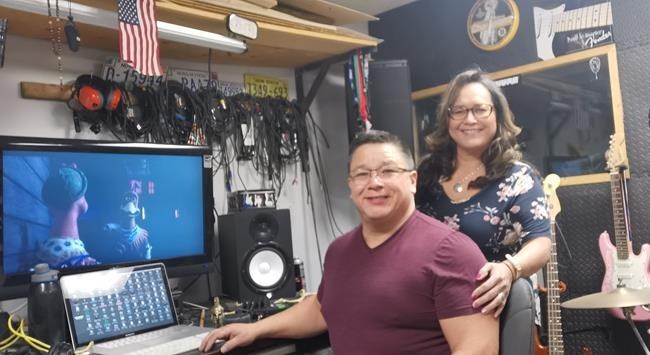
Tom Johnson said it was in 2011 that he and his wife Carol Anne Johnson first began playing with the idea of translating the tale of a chicken escape into the Indigenous language. It was a do-it-yourself venture without any official sanction from the studio.
“We’re a decade (into) hiding because we thought we were pirates,” Tom Johnson said with a laugh in a recent interview.
A tweet this month from Peter Lord, the British co-director of “Chicken Run,” suggests they have nothing left to fear. “What a wonderful story!” Lord wrote after reading a media report on the Mi’kmaq version.
Johnson said they were initially inspired to tackle the project by his brother, who had previously made a Mi’kmaq version of the 1995 Disney film, “Gordy.” His brother proposed they tackle “Chicken Run,” first released in 2000.
In a studio housed in the garage of their home on Cape Breton’s Eskasoni First Nation, Johnson said he started with a single line of the film. He later called his wife over, and it wasn’t long before they were spending several hours a night over the course of six weeks, translating and taking on the voices of the barnyard characters.
Carol Anne Johnson took the lead on translation, which presented its challenges. “If we were to use the same idioms, (it) wouldn’t come out the same way, and they wouldn’t get the same laugh if we were to translate it literally,” she said.
When they were done, they emailed DreamWorks Pictures, the international distributor of the film, to seek permission for the dub. When they never heard back, they took that as a good sign and began selling DVD copies to recover their costs.
“From there, everyone in our community wanted one,” said Carol Anne Johnson, an administrator at the local elementary and middle school. Parents used the movie to introduce the Mi’kmaq language to their children, who would repeat lines from the film and try to make the same jokes. Today, the Johnsons give away digital versions.
Tom Johnson, who works for the local fish and wildlife commission, said they’ve had requests for copies from as far away as British Columbia and Los Angeles.
One early viewer was John T. Johnson, a cousin of Tom Johnson, who said he got a disc as soon as he heard about the dub.
“That night I went home and played it for my wife, and my daughter listened to it. (I was) happy to see something in Mi’kmaq,” he said. “You get goosebumps watching it.”
He said the family speaks Mi’kmaq fluently at home, but he did get the chance to teach his daughter a few words while she watched the dubbed version of the film. “I think we saw ‘Chicken Run’ in the English version before, but then we watched (the dub) and she was in awe … to hear the chickens speak in Mi’kmaq,” he said.
For Bernie Francis, a linguist specialized in the Mi’kmaq language, exposing children to sound of the language is crucial to its preservation. “It’s not the elders that carry the language, it’s the children,” he said. Efforts like the dubbed movie are invaluable resources to engage children with the language, Francis added.
Another Eskasoni resident, Mi’kmaq language immersion teacher Starr Paul, said she first saw the film during a viewing at the local high school when she was an immersion teacher.
“I didn’t expect it to be that good,” Paul said during a recent interview. “I haven’t even seen the English version of it. I just know the whole storyline in Mi’kmaq.”
Paul said she has since used the movie in her own classes and found it helped the students engage with the language, but she would like to see more resources.
“The language is really struggling and it’s really difficult to have kids be enthusiastic about the language,” she said, adding that in her Mi’kmaq immersion school of about 130 students, only a handful speak it fluently.
The decline of the language dates back to the late 1980s, Francis said. In 1989, when Eskasoni had a population of about 2,400, roughly 80 per cent of the population spoke the language, he said. Today, the population has grown to about 4,000, but only 20 per cent of residents speak Mi’kmaq, he added.
“We have to make it so that it’s interesting to the child, and that they will actually pay attention,” Francis said.

Carol Anne Johnson sees the dubbed film as part of a larger movement to preserve the language, which she describes as an important part of Mi’kmaq identity. But she realizes there is still work to be done.
“Our language, realistically, is in a very vulnerable state,” she said. Still, she and her husband see their translation as part of “leaving a legacy of keeping the language strong and making sure that we’ve done our part.”
This report by The Canadian Press was first published Jan. 31, 2021.
— — —
This story was produced with the financial assistance of the Facebook and Canadian Press News Fellowship.




