Poll finds overwhelming support for new travel restrictions
Advertisement
Read this article for free:
or
Already have an account? Log in here »
To continue reading, please subscribe:

Digital Subscription
One year of digital access for only $205*
- Enjoy unlimited reading on winnipegfreepress.com
- Read the E-Edition, our digital replica newspaper
- Access News Break, our award-winning app
- Play interactive puzzles
*First annual payment billed as $205.00 + GST for one year. This annual subscription will automatically renew at $233.00 + GST every 52 weeks (10% off the regular annual price of $259.35). Offer available to new and qualified returning subscribers only. Cancel any time.
To continue reading, please subscribe:
Add Free Press access to your Brandon Sun subscription for only an additional
$1 for the first 4 weeks*
- Enjoy unlimited reading on winnipegfreepress.com
- Read the E-Edition, our digital replica newspaper
- Access News Break, our award-winning app
- Play interactive puzzles
*Your next Brandon Sun subscription payment will increase by $1.00 and you will be charged $17.95 plus GST for four weeks. After four weeks, your payment will increase to $24.95 plus GST every four weeks.
Read unlimited articles for free today:
or
Already have an account? Log in here »
Hey there, time traveller!
This article was published 02/02/2021 (2029 days ago), so information in it may no longer be current.
OTTAWA – The vast majority of Canadians support tighter restrictions on international travel imposed by the federal government, a new poll suggests.
Eighty-six per cent of respondents agree with stricter measures that suspend flights to most sun destinations and require quarantining at a hotel at the passenger’s expense upon arrival in Canada, according to an online survey by Léger and the Association for Canadian Studies.
The poll also found that 87 per cent of respondents think the government should go further by banning international travel until there are several consecutive days of reduced COVID-19 numbers.
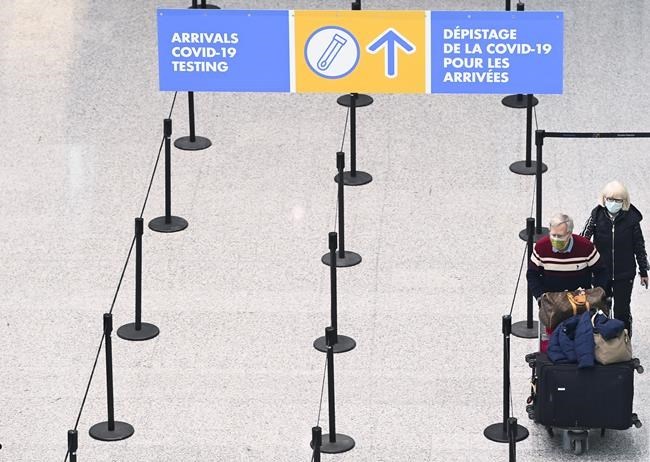
The wariness of foreign trips stems in part from more transmissible — and possibly more lethal — variants of the virus emerging abroad as well as homegrown politicians jetting off to far-flung beaches during the holidays, says Léger executive vice-president Christian Bourque.
“We probably would not have gotten such high numbers before the whole talk about the South African variant, the Brazil variant,” Bourque said in an interview. “I think this probably jolted Canadians in a way.
“And then when you see people coming back with a very nice tan, you’re thinking, ‘Why am I making the effort and you’re not?’ And in certain cases it was MLAs and even (provincial) cabinet ministers,” senators and MPs, he noted.
Prime Minister Justin Trudeau announced last Friday that Canadian airlines have suspended flights to Mexico and the Caribbean until April 30 and that returning passengers will soon have to self-isolate at a federal facility for up to three days after taking a PCR test at the airport.
The reaction differed depending on geography, with 91 per cent of respondents from Quebec and Atlantic Canada in favour of the new restrictions but just three out of four Albertans backing the clampdown, the poll found.
The possibility of even stricter rules such as an outright ban on international travel raises questions around the flow of essential goods, many of which enter the country in the bellies of passenger planes, and around freedom of movement as guaranteed in the Canadian Constitution.

Section 6 of the Charter of Rights and Freedoms states that “every citizen of Canada has the right to enter, remain in and leave Canada,” though all rights are subject to reasonable limits.
The urge for tougher travel rules comes as Canadians find their mental health on the wane, with just 29 per cent of survey respondents rating it as very good or excellent, the lowest since the pandemic began.
“We’re getting into the doldrums of February, and things are not improving. If you look from November to today, it’s a steady decline in self-perception of the state of your mental health,” Bourque said.
Conducted Jan. 29 to 31, the online poll surveyed 1,559 Canadians. It cannot be assigned a margin of error because internet-based polls are not considered random samples.
This report by The Canadian Press was first published Feb. 2, 2021.