

Providing hope for refugees
Pandemic causes organizations to alter approaches to helping newcomers

Advertisement
Read this article for free:
or
Already have an account? Log in here »
To continue reading, please subscribe:

Digital Subscription
One year of digital access for only $205*
- Enjoy unlimited reading on winnipegfreepress.com
- Read the E-Edition, our digital replica newspaper
- Access News Break, our award-winning app
- Play interactive puzzles
*First annual payment billed as $205.00 + GST for one year. This annual subscription will automatically renew at $233.00 + GST every 52 weeks (10% off the regular annual price of $259.35). Offer available to new and qualified returning subscribers only. Cancel any time.
To continue reading, please subscribe:
Add Free Press access to your Brandon Sun subscription for only an additional
$1 for the first 4 weeks*
- Enjoy unlimited reading on winnipegfreepress.com
- Read the E-Edition, our digital replica newspaper
- Access News Break, our award-winning app
- Play interactive puzzles
*Your next Brandon Sun subscription payment will increase by $1.00 and you will be charged $17.95 plus GST for four weeks. After four weeks, your payment will increase to $24.95 plus GST every four weeks.
Read unlimited articles for free today:
or
Already have an account? Log in here »
Hey there, time traveller!
This article was published 08/03/2021 (2025 days ago), so information in it may no longer be current.
Benon Tumusiime had only a few months of pandemic-free life in Winnipeg after arriving as a refugee from Uganda in November 2019.
He’d already started to hear news about COVID-19, but he was skeptical the virus would affect his life.
“I wasn’t even sure about the virus, at first. For a while I thought it would be easy, but then seeing how people were staying at home, and how it was harder to even take the bus,” he said. “But I ended up understanding the pandemic was serious.”
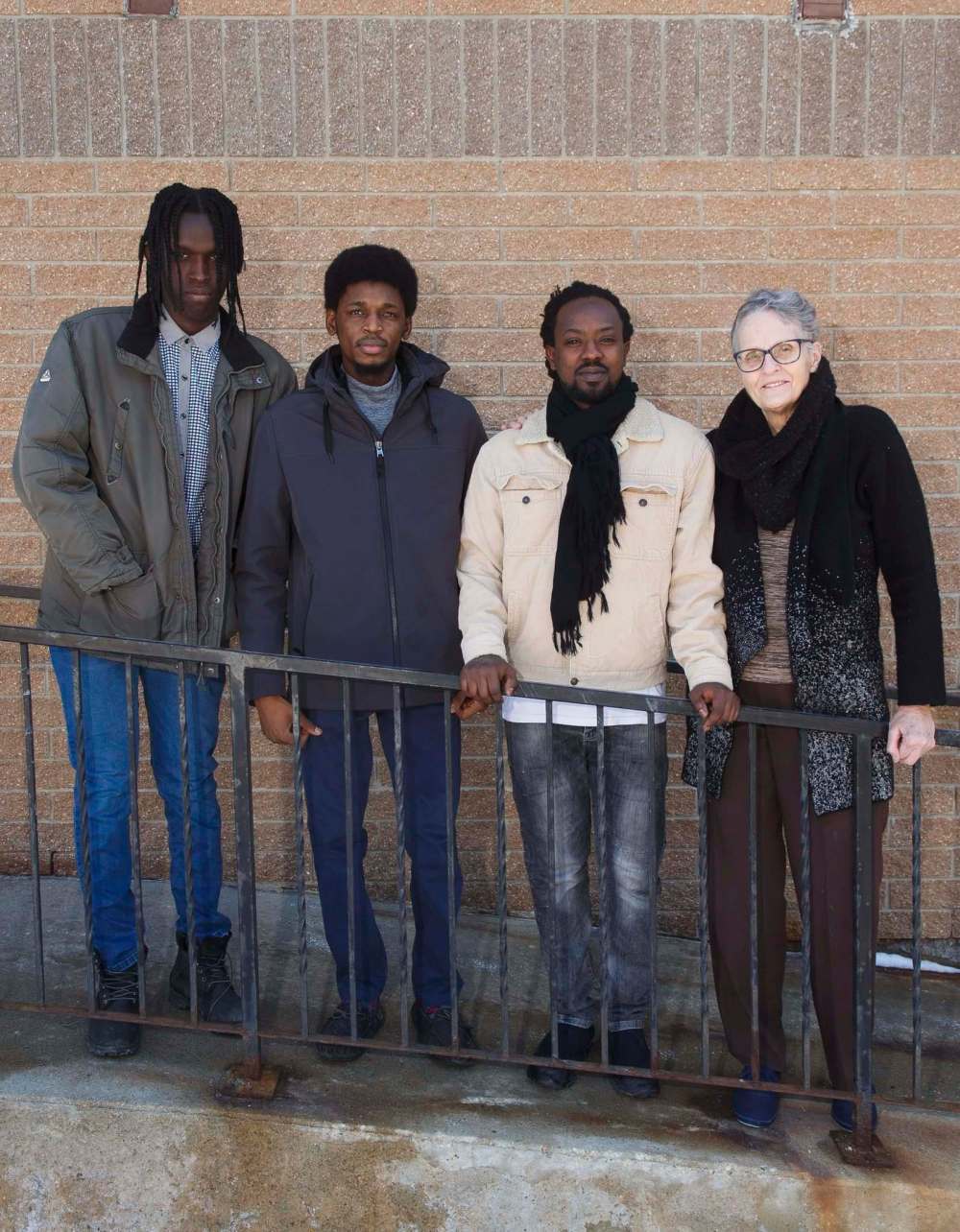
He found it impossible to get a job as a welder after completing his certification in January and was forced to halt his pursuit of a Grade 12 equivalency program.
Tumusiime, who was privately sponsored, was one of the last refugees to make it to Canada before it enacted border restrictions to limit the spread of COVID-19. Canada had promised to take in 30,000 refugees in 2020, including those sponsored by the government and private groups. Only 9,000 made it here.
That number comes as no surprise to Karin Gordon, the executive director of Hospitality House Refugee Ministry.
Gordon has spent her retirement supporting hundreds of refugees a year, but has met with a “tiny fraction” of the people sponsored by the non-profit organization.
Currently, Hospitality House can sponsor 100 refugees a year, along with 10 nominated for sponsorship by the federal government. In 2020, it was only able to sponsor 25 people. Even so, the pandemic has made it increasingly difficult to budget for its sponsors because donations have dropped.
“We’re not seeing as much funding coming in. I have to be very, very careful how I spend any money on groceries and rent and anything not essential,” she said. “We’re not government-funded, we rely on donations, so that has been a point of difficulty, as it is for most charitable organizations. Hopefully, this is temporary.”
It’s difficult to find your way in a new country during normal times, but the pandemic has made it more of a struggle for refugees because they cannot socialize and learn about their new home.
Gordon said many of the people she helps feel isolated.
“It has made it much more difficult in terms of connecting our newcomers to opportunities for integration into the city. There are very few in-person… English learning classes. Places where we used to take people to meet and learn about Winnipeg are no longer available. Churches have closed their doors to service, and many people come here with very strong faith.”
Tumusiime echoes that sentiment as he talks about what he most misses from the brief time before restrictions took effect.
“I hope that things will be better when we come to normal, because from the time I came, there was some mild COVID here, I couldn’t even go out or socialize, I didn’t get out to places. Since I’ve come, you don’t know exactly where you are. I used to go out, I used to connect with friends … no one wants to increase their bubble of who they are meeting.”
The pandemic has affected the way organizations provide support to refugees, and the quality of the programming has taken an inevitable hit, said Aurora Family Therapy Centre executive director Abdikheir Ahmed.
“We’re used to supporting people first-hand, in person, face-to-face, providing support around the clock. This has been severely affected,” he said.
At Aurora, therapy, community development, youth and mental health programs have all been made virtual. Ahmed said they often work with people who are not used to relying on technology. As a result, some programs that may have taken days to complete, stretch into weeks due to technical issues.
“There are a lot of people who are not used to using technology to access services, and they don’t know, or don’t even trust how,” he said. “To be able to support someone, you have to develop trust. You can only develop trust if you work with the person in-person.”
Aurora usually provides therapy services on a sliding scale based on income. But in the last year, they’ve been offered them for free. Ahmed said many of the clients are distrustful and afraid because they endured traumatic experiences in their home country.
The lack of face-to-face support has been a concern.
“Our hope is that many of the people we work with are resilient,” he said. “They’ve been through worse circumstances and worse situations, and come out like everybody else in this country who hasn’t had to deal with the kind of challenges they’ve dealt with.”
In the meantime, Ahmed said, Aurora tries to ensure virtual meetings are set up in the recipient’s first language, that it provided socially distant support, and advocates on the community’s behalf. It wants the province to consider data that shows racialized communities are most affected by COVID-19, as it rolls out its vaccine plan.
“The data shows there are certain communities that are disproportionately affected. We need to look into these communities and why they are affected… the government needs to look at this and pay attention to how they dole out the vaccine,” he said.
Tumusiime wants to finish his Grade 12 equivalency as soon as possible to increase his chance of getting a job once the pandemic winds down.

“My first goal was to go to school, because back home I had to stop before I finished my studying,” he said.
Gordon said she can’t wait to get back to the in-person support that defined much of her pre-pandemic life — and the many events that come with her work.
“One of the great pleasures of this work is being invited to graduations — high school, university — marriages, store openings … we are very, very happy to add to the fabric of Canada,” she said.
malak.abas@freepress.mb.ca
Twitter: malakabas_
Malak Abas is a city reporter at the Free Press. Born and raised in Winnipeg’s North End, she led the campus paper at the University of Manitoba before joining the Free Press in 2020. Read more about Malak.
Every piece of reporting Malak produces is reviewed by an editing team before it is posted online or published in print — part of the Free Press‘s tradition, since 1872, of producing reliable independent journalism. Read more about Free Press’s history and mandate, and learn how our newsroom operates.
Our newsroom depends on a growing audience of readers to power our journalism. If you are not a paid reader, please consider becoming a subscriber.
Our newsroom depends on its audience of readers to power our journalism. Thank you for your support.
Malak Abas is a city reporter at the Free Press. Born and raised in Winnipeg’s North End, she led the campus paper at the University of Manitoba before joining the Free Press in 2020. Read more about Malak.
Every piece of reporting Malak produces is reviewed by an editing team before it is posted online or published in print — part of the Free Press‘s tradition, since 1872, of producing reliable independent journalism. Read more about Free Press’s history and mandate, and learn how our newsroom operates.
Our newsroom depends on a growing audience of readers to power our journalism. If you are not a paid reader, please consider becoming a subscriber.
Our newsroom depends on its audience of readers to power our journalism. Thank you for your support.
Advertisement Advertise With Us
Advertisement Advertise With Us