No link between colonialism and vaccine hesitancy among Indigenous people: expert
Advertisement
Read this article for free:
or
Already have an account? Log in here »
To continue reading, please subscribe:

Digital Subscription
One year of digital access for only $205*
- Enjoy unlimited reading on winnipegfreepress.com
- Read the E-Edition, our digital replica newspaper
- Access News Break, our award-winning app
- Play interactive puzzles
*First annual payment billed as $205.00 + GST for one year. This annual subscription will automatically renew at $233.00 + GST every 52 weeks (10% off the regular annual price of $259.35). Offer available to new and qualified returning subscribers only. Cancel any time.
To continue reading, please subscribe:
Add Free Press access to your Brandon Sun subscription for only an additional
$1 for the first 4 weeks*
- Enjoy unlimited reading on winnipegfreepress.com
- Read the E-Edition, our digital replica newspaper
- Access News Break, our award-winning app
- Play interactive puzzles
*Your next Brandon Sun subscription payment will increase by $1.00 and you will be charged $17.95 plus GST for four weeks. After four weeks, your payment will increase to $24.95 plus GST every four weeks.
Read unlimited articles for free today:
or
Already have an account? Log in here »
Hey there, time traveller!
This article was published 19/03/2021 (2001 days ago), so information in it may no longer be current.
OTTAWA – There is no evidence that Canada’s history of colonialism has made Indigenous people any more hesitant to get vaccinated against COVID-19 than the general population, says an Indigenous studies professor casting a critical eye on the oft-repeated theory.
The federal government is among those who have suggested colonialism and systemic racism have fostered mistrust in vaccines. But Veldon Coburn, an assistant professor at the University of Ottawa’s Institute of Indigenous Research and Studies, says available data on vaccine hesitancy suggest that is not the case.
“The historic events that were bad and unethical … didn’t have the same or the effect that’s being claimed and maybe it’s just naive good intentions but it doesn’t stand up,” Coburn said in an interview with The Canadian Press.
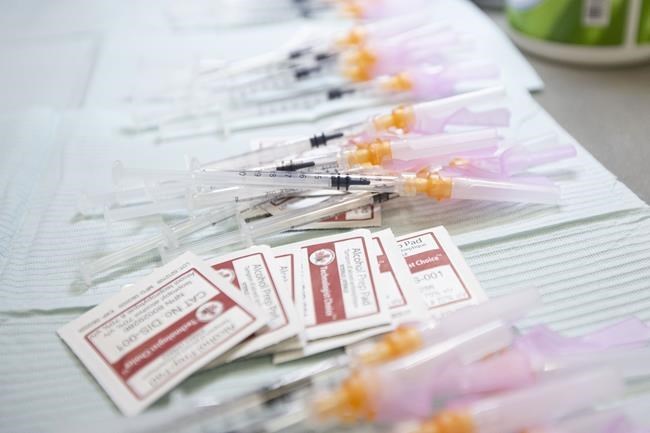
Coburn says there’s no evidence of a causal link between vaccine hesitancy and the historical and intergenerational trauma Indigenous people live with because of residential schools and other colonialist practices.
Nutrition experiments that were performed on Indigenous children at several Ontario residential schools in the mid-1940s are unlikely to have any effect on Indigenous people who are alive now, said Coburn. He is a member of the Algonquins of Pikwàkanagàn First Nation, located about 150 kilometres west of Ottawa.
“I’m Indigenous,” he said. “My grandparents went to Indian residential school. None of this was sort of transmitted.”
Coburn noted newborns in Indigenous communities get vaccinated routinely.
“We get needles all the time,” he said. “It is not a traumatic experience.”
But while acceptance of COVID-19 vaccines is surprisingly high in some Indigenous communities, Dr. Evan Adams, deputy chief medical officer at Indigenous Services Canada, said there is some hesitation in other places.
“We’re hearing a number of issues. Some as mundane as ‘I felt a little tired after the first vaccine’ … to experimentations happening on them or there are some really unsavoury products within the vaccine,” he told a virtual news conference Wednesday.
Rebecca Kudloo, president of Pauktuutit Inuit Women of Canada, said some Inuit might be hesitant because of their historic mistreatment by the government.
“Even in the present day, systemic racism that Inuit experience in the health-care system — that might be the reason,” she said.
Indigenous Services Minister Marc Miller said he understood the point that Coburn was making about how this view could be a way of “infantilizing” Indigenous people.
Miller said one lesson from the COVID-19 pandemic is that if the government empowers Indigenous communities to do what they know is best to protect themselves, they will.
“People are smart and they will choose the right thing,” Miller said Friday in Ottawa.
He added it is important to make sure information is given in a culturally sensitive way and in Indigenous languages when needed, which is also a matter of respect.
“There are colonial legacies that have created a health-care system that has systemic racism throughout it and people that approach the health-care system with great hesitation,” he said. “But that can be softened with a better approach that we have seen in communities and I think it’s something that our teams do deal with.”
Yet the available data suggest that vaccine hesitancy is not more pronounced in Indigenous communities than non-Indigenous communities.
In 2010, Health Canada surveyed First Nations on reserve and Inuit after the H1N1 pandemic and found that about 97 per cent of reserve residents and nearly 94 per cent of Inuit said childhood vaccinations were important.
“If there were any effects from residential schools, it would’ve showed up in 2010 during the same conditions. There was none,” said Coburn, who also recently shared his views in an article published by The Conversation and distributed by The Canadian Press.
Coburn said there isn’t much of a difference in vaccination acceptance between Indigenous and non-Indigenous people when it comes to getting flu shots.
The 2017-18 Canadian Community Health Survey showed that 55 per cent of Indigenous people had a seasonal flu vaccine compared to 59 per cent of non-Indigenous people, he said.
He said the World Health Organization, through its strategic advisory group of experts on immunization, vaccine hesitancy and acceptance after H1N1, has noted that vaccination is a very complex decision that people make individually and not at the population level.
Coburn said there’s a “cultural zeitgeist” at the moment that’s made many people think Indigenous people are “very delicate” and need others to care for them.
“It’s sort of a self-flagellation from certain segments of the population: … We’ve got to be very gentle with (Indigenous Peoples) because very bad things happen to them in the past and it’s going to hinder our pandemic response,” he said.
“They sort of invented an injury that didn’t exist, and they want to be the crutch.”
An online survey by Angus Reid in British Columbia earlier this month suggested Indigenous people are more willing to get the vaccine than the general population.
Sixty-eight per cent of respondents who self-identified as Indigenous said they would get the COVID-19 vaccine when available and 16 per cent said they would wait awhile at first but would eventually get the shot.
That was slightly higher than the survey results among the general population, in which 66 per cent of the respondents said they will get a COVID-19 vaccine when available and 17 per cent said they would eventually get it.
More than 166,000 doses of COVID-19 vaccines were administered in 538 First Nations, northern and Inuit communities as of March 12, according to Indigenous Services Canada.
“This represents 54 doses administered per 100 adults in First Nations and Inuit communities in provinces, and adult residents in the territories,” Vaupshas said.
Coburn said the majority of Indigenous people want to get vaccinated as soon as possible.
“My friends and family, even on my reserve, they can’t wait to get that needle, and they’re like, ‘Bring it right now, I’ll inject myself,'” he said.
This report by The Canadian Press was first published March 19, 2021.
———
— with files from Emma Tranter.
This story was produced with the financial assistance of the Facebook and Canadian Press News Fellowship.