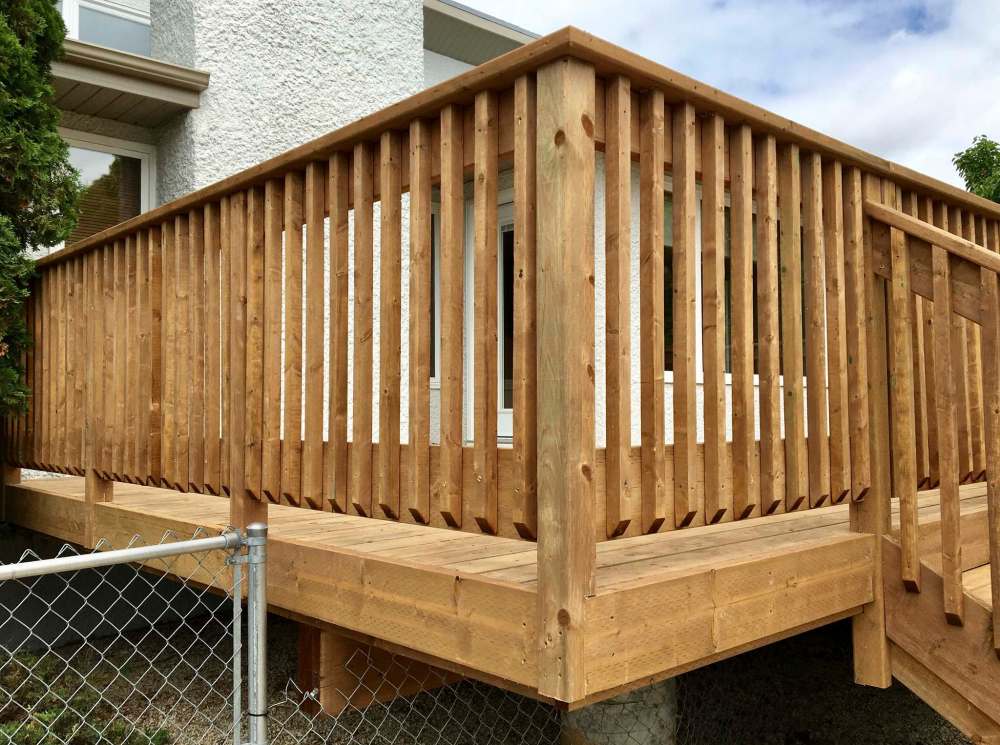
Blank deck
Railings should be determined before project begins
Advertisement
Read this article for free:
or
Already have an account? Log in here »
To continue reading, please subscribe:
Digital Subscription
One year of digital access for only $1.44 a week*
- Enjoy unlimited reading on winnipegfreepress.com
- Read the E-Edition, our digital replica newspaper
- Access News Break, our award-winning app
- Play interactive puzzles
*Billed as $5.77 plus GST every four weeks. After 52 weeks, price increases to the regular rate of $19.95 plus GST every four weeks. Offer available to new and qualified returning subscribers only. Cancel any time.
To continue reading, please subscribe:
Add Free Press access to your Brandon Sun subscription for only an additional
$1 for the first 4 weeks*
- Enjoy unlimited reading on winnipegfreepress.com
- Read the E-Edition, our digital replica newspaper
- Access News Break, our award-winning app
- Play interactive puzzles
*Your next Brandon Sun subscription payment will increase by $1.00 and you will be charged $17.95 plus GST for four weeks. After four weeks, your payment will increase to $24.95 plus GST every four weeks.
Read unlimited articles for free today:
or
Already have an account? Log in here »
Hey there, time traveller!
This article was published 10/04/2021 (1880 days ago), so information in it may no longer be current.
Homeowners often assume the type and style of railings they want can be chosen once the deck is built. That is the case in some instances, but most times the railings must be determined before a deck build can begin.
The most straight-forward railings are the ones constructed using treated lumber on a deck built solely with treated lumber. In this instance, 4×4 posts cut to the proper height and notched at the bottom are mounted snuggly to the face of the exposed joist cap once the deck structure is sound and the top decking has been installed, whereby sections of 2×8 lumber are interlaced between every post creating a finished look of flush fascia and posts. Top and bottom supports are then mounted between each post, along within a 2×6 cap on the flat along the tops. This provides the rigid upper and lower surfaces on which the wooden 2×2 balusters can be side-mounted.
A slight upgrade from this exclusively wooden look is the substitution of wooden balusters for side-mount metal balusters. Side-mounts can either be perfectly straight, or exhibit a stylish profile. Furthermore, metal balusters are also offered in a variety of color choices. For a slightly higher price, balusters can also be custom-made to showcase not only the desired profile, but to your colour of choice — the sky is the limit provided your budget allows it.
Although these two examples detail decks made from treated lumber, either scenario works nicely with a deck finished with composite top-decking, provided the fascia remains treated between every post. If however the composite deck is topped with an over-edge top-decking design and finished with composite fascia, the treated 4×4 posts will stick out like a sore thumb.
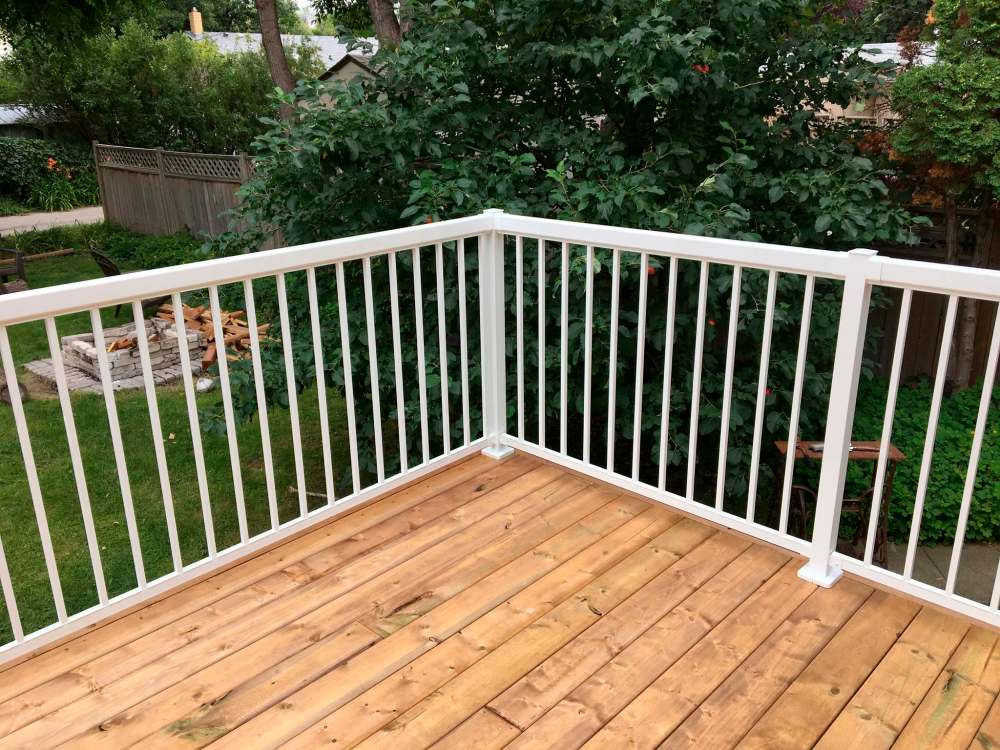
For a completely composite deck design, top-mount railing systems are the solution. Pre-fab aluminum railing systems are sold in a variety of post denominations and brackets, to satisfy most typical deck plans. Top-mount railings systems also work well for decks built using treated lumber, but are definitely a must for decks topped and fascia’d with composite. It is necessary to reinforce the joisting below every intended post location, to provide a solid sub-surface onto which each post can be affixed to ensure rigidity. There is a sleeve at the top and near bottom of every end post, corner post, and middle post, into which a top and bottom support can slide. The pickets are then placed into the upper and lower grooves of these supports. Pre-fab spacers ensure that the pickets are evenly spaced throughout the runs of each railings section. Available in white, black, dark brown and sometimes charcoal grey, these railings offer a beautiful alternative to fully treated lumber railings, but expect to spend a bit more.
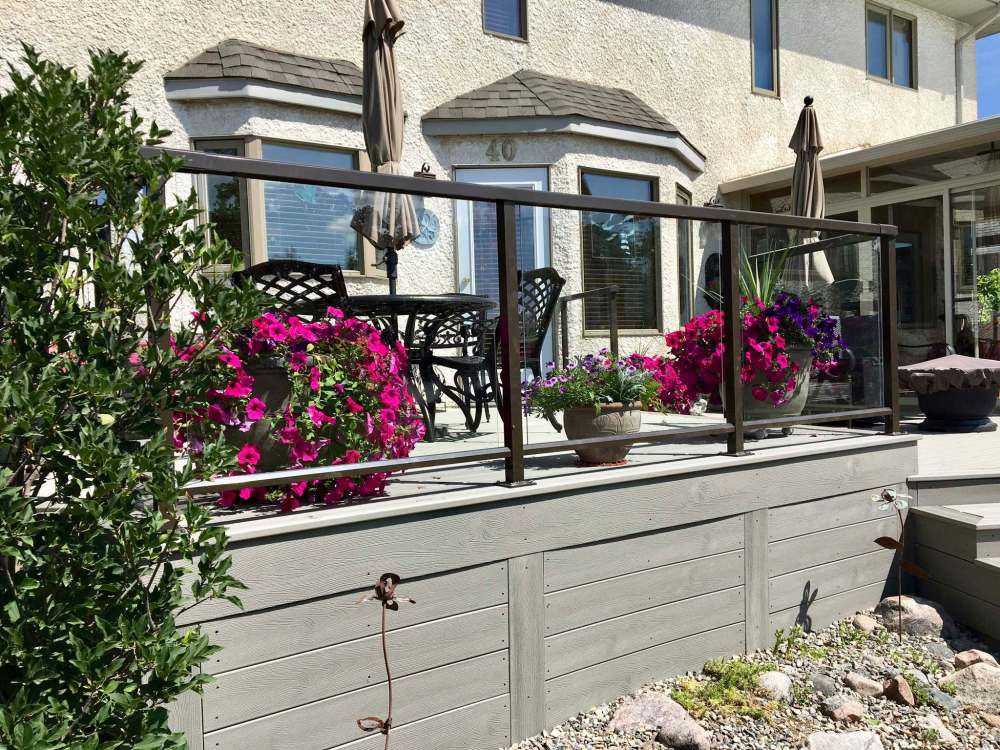
The most expensive railings are custom ordered to fit the exact specifications of a deck’s footprint, and often include glass panels set between every post. The mounting systems for these railings are easy to install, and the top-mount posts are secured to the deck’s surface much like the aluminum railing system mentioned earlier. The latest trend is to introduce railings that reveal horizontal metal cabling. Much like glass railings, horizontal cable railings offer an unobstructed view when gazing or peering through, without the on-going nuisance of having to clean glass panels. These two high-end options can be very costly.
No matter the sought-after ‘look’, a properly built deck railing will serve its utilitarian purpose. Because it is often the type and style of deck railings that tops a client’s priority list, it is best to weigh the pros and cons before choosing a railings system that best suits your project — budget is the great decider. Although treated lumber costs continue to soar, price increases seem to be prevalent in most facets of the building and construction industries.
As such, ensure to get a detailed quote with a ‘valid for number of days’ guarantee. During these times of industry volatility, a well-informed decision will allow you to place an order sooner, thereby increasing your chances of avoiding further pricing increases.
BossEnterprise@outlook.com