

Crafts that tell a story
Museum collects works from Manitoba, not just for display but also to document what they say about province's history

Advertisement
Read this article for free:
or
Already have an account? Log in here »
To continue reading, please subscribe:

Digital Subscription
One year of digital access for only $205*
- Enjoy unlimited reading on winnipegfreepress.com
- Read the E-Edition, our digital replica newspaper
- Access News Break, our award-winning app
- Play interactive puzzles
*First annual payment billed as $205.00 + GST for one year. This annual subscription will automatically renew at $233.00 + GST every 52 weeks (10% off the regular annual price of $259.35). Offer available to new and qualified returning subscribers only. Cancel any time.
To continue reading, please subscribe:
Add Free Press access to your Brandon Sun subscription for only an additional
$1 for the first 4 weeks*
- Enjoy unlimited reading on winnipegfreepress.com
- Read the E-Edition, our digital replica newspaper
- Access News Break, our award-winning app
- Play interactive puzzles
*Your next Brandon Sun subscription payment will increase by $1.00 and you will be charged $17.95 plus GST for four weeks. After four weeks, your payment will increase to $24.95 plus GST every four weeks.
Read unlimited articles for free today:
or
Already have an account? Log in here »
Hey there, time traveller!
This article was published 02/05/2021 (1968 days ago), so information in it may no longer be current.
This Sunday we’re kicking off a series from inside the vaults and storage rooms of some of the city’s smaller museums to understand what they collect and how they portray — and represent — Winnipeggers and Manitobans.
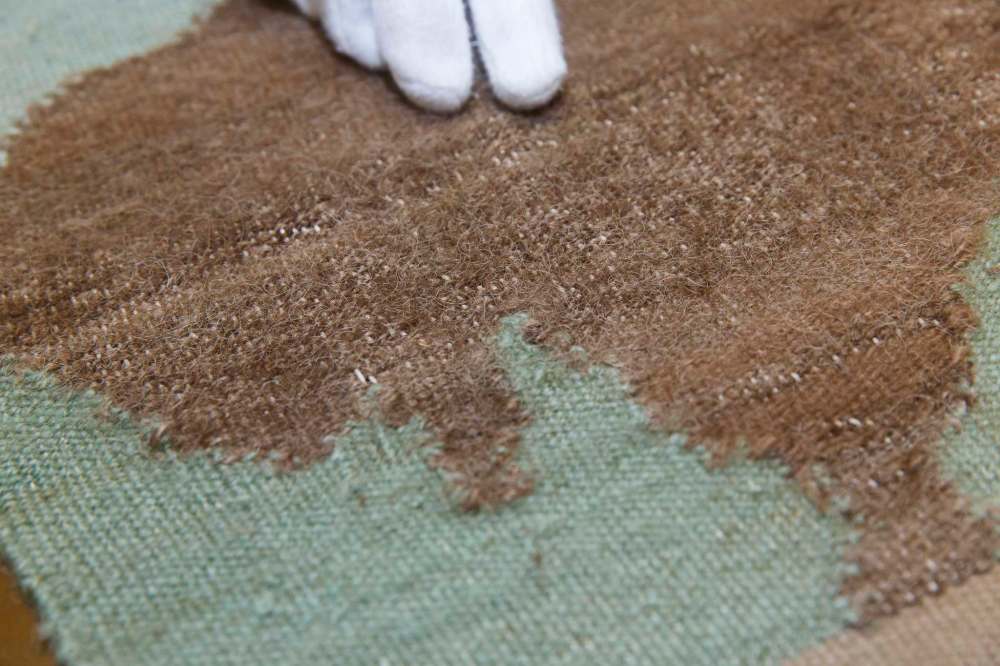
If you need the exact shade of brown to represent a bison, it makes sense to hunt for materials close to the source.
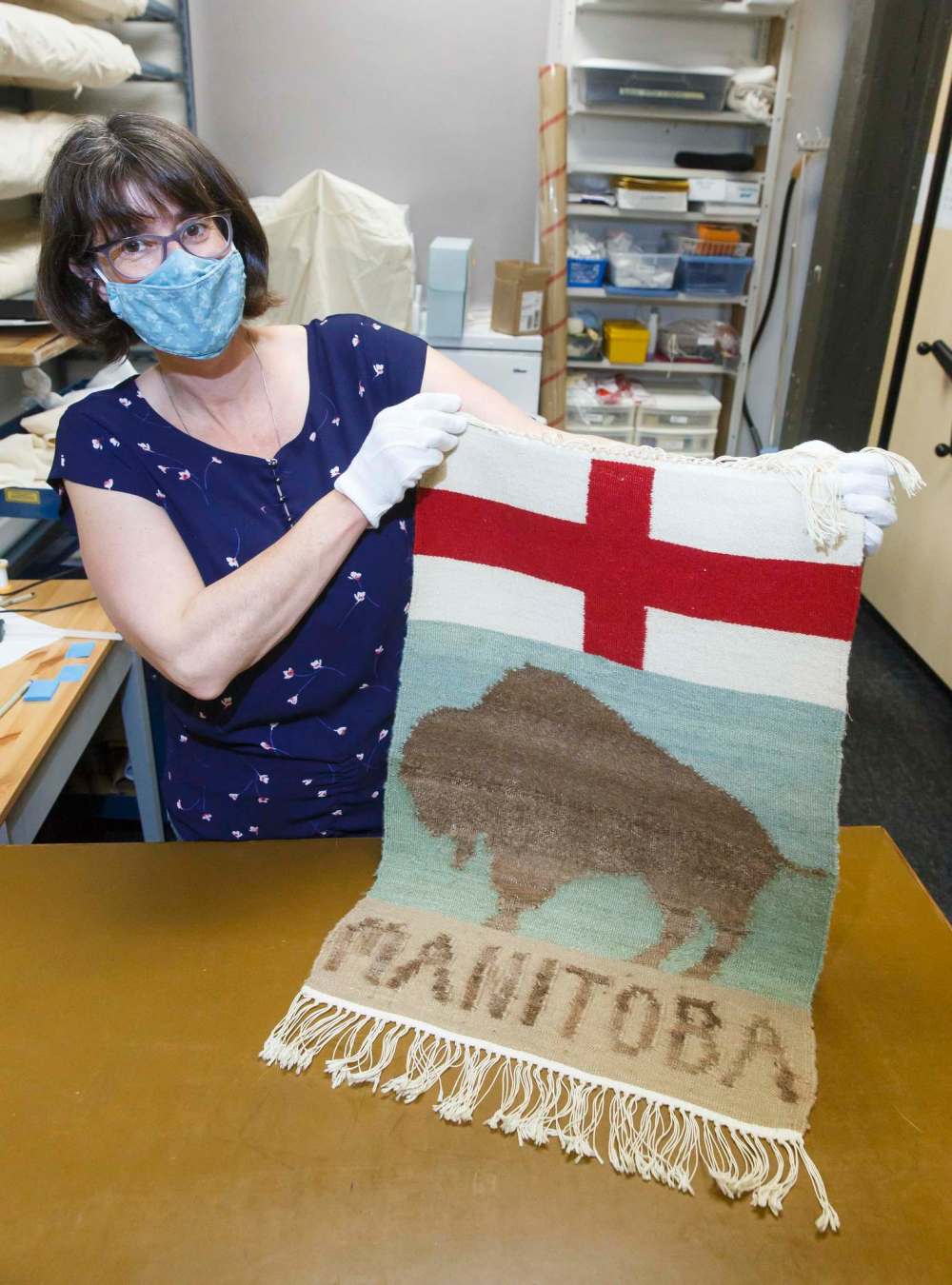
Using buffalo hair gathered from fences at the Assiniboine Park Zoo, weaver and artisan Kitty Churchill created an outline of a bison in a woven adaptation of the original Manitoba coat of arms.
Measuring 49 by 72 centimetres, Campbell’s wall hanging is one of several overtly Manitoba-themed pieces in the collection of the Manitoba Crafts Museum and Library, located in the C2 Centre for Craft at 329 Cumberland Ave.
Mandated to collect and preserve the works of the province’s artisans and craftspeople, the museum’s collection also evokes stories like that of Churchill picking bison hair from the zoo’s bison enclosure in 1942, says curator Andrea Reichert.
“Museum collections as a whole are a memory of a material culture,” she says of the 10,000 artifacts, collected over the past century.
“Having those tangible actual pieces made by that community provides a window into what the community was.”

In honour of Manitoba Day on May 12, Reichert gathered some of uniquely Manitoban artifacts just for Free Press readers.
Some came from deep within the museums’ 450-sq.-ft vault, fitted with rolling shelves to maximize storage capacity, and a few were displayed in a recent Handmade in Manitoba exhibit, honouring the province’s 150th anniversary, which came down last week after six months in the gallery.
Most of the artifacts in the museum’s collection will likely never be seen by the public, gathered over the years to preserve these handmade works, first by the Crafts Guild of Manitoba and now by the museum, which inherited the artifacts and library after the guild folded in 1997.
“Some items are not collected for display. They are collected for documentation, for studying,” Reichert says about the role of artifacts.
With only two small galleries in the ground level space the museum shares with the Manitoba Craft Council, Reichert says it is impossible — and impractical — to display the entire collection.
A few pieces are too delicate for prolonged exposure to light and air, and others may be better suited for research, showcasing the development of an artist and their craft.
“It you displayed everything all the time, they would deteriorate,” she says, adding that changing up the exhibits frequently attracts repeat visitors and eliminates the possibility of museum fatigue.
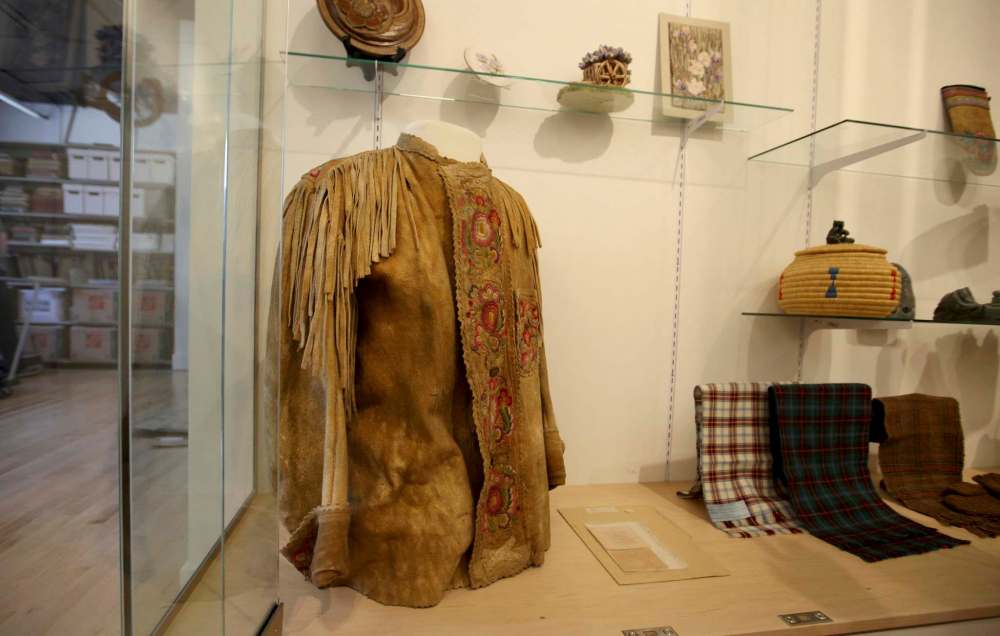
When it comes to pieces evoking Manitoba, the collection has the expected pieces, includes lengths of the Manitoba tartan, designed by Hugh Rankin and hand woven by Elsie Ogston, and heavy handknit zippered sweater jackets made from kits sold by Mary Maxim, a mail order company originally based in Sifton, Man.
There’s also a ceramic bouquet of purple and yellow prairie crocuses, incongruously growing out of a out-of-scale Red River cart, hand modelled by artist Dorothy Campbell in the 1960s. The Craft Guild sold crocus-themed carts, trivets and ashtrays for years at their annual sales, says Reichert.
“It’s very kitschy but it’s also a Manitoba symbol,” she says of the 14-centimetre-high ceramic piece.
A large woven and embroidered landscape with a big sky, rolling hills, canola fields and Prairie grasses also speaks to Prairie sensibilities. Made by Myrna Harris about two decades ago, the framed piece measuring 44 by 79 centimetres portrays one perspective of Manitoba while showcasing a mixture of wool felting, machine quilting, weaving, beading and embroidery.
“It’s a more contemporary piece, it’s multimedia, it speaks to the Prairie,” says Reichert.
A strong decorative thread is also evident in another wall hanging depicting the Winnipeg skyline. Less representational than the crocuses-in-cart sculpture, the piece by June Cameron includes recognizable buildings such as the Manitoba Legislative Building, interspersed with less identifiable structures. Cameron wove it on a tapestry loom with wool yarns in greys, wines and pink, hand-dyed with pigments from lichens.
“I like this because it’s so different and it’s subtle,” Reichert says of the muted tones and ambiguous buildings.
Less ambiguous are handcrafted garments like a black velveteen vest covered in beaded flowers, made by an unknown Métis artisan, representing the people who lived here before Manitoba officially became a province. A multi-coloured men’s shirt made by Kay Seng on a backstrap loom she brought from Myanmar to Canada 15 years ago reflects the handmade tradition of Karen people, who use hand-dyed yarns to create intricate patterns for clothing, scarves and shoulder bags.

“This is representing newer Canadians who don’t have that settler background from the homestead,” says Reichert, referring to people such as Seng who have shorter but equally valid histories in Manitoba.
Whatever the origin of the artifacts, all demonstrate fine work and just a bit of ingenuity when supplies were scarce. Churchill exercised her artistic licence when weaving the Manitoba coat of arms from bison hair and sheep’s wool, but also used the yarn partly from necessity, says Reichert.
“During the Second World War (crafters) were looking for replacement of sheep’s wool because the sheep’s wool was being used for military uniform,” she explains.
So in 1942, members of the Crafts Guild of Manitoba asked zoo staff for permission to pick bison hair off the zoo fences, and then experimented with carding, dyeing and spinning it.

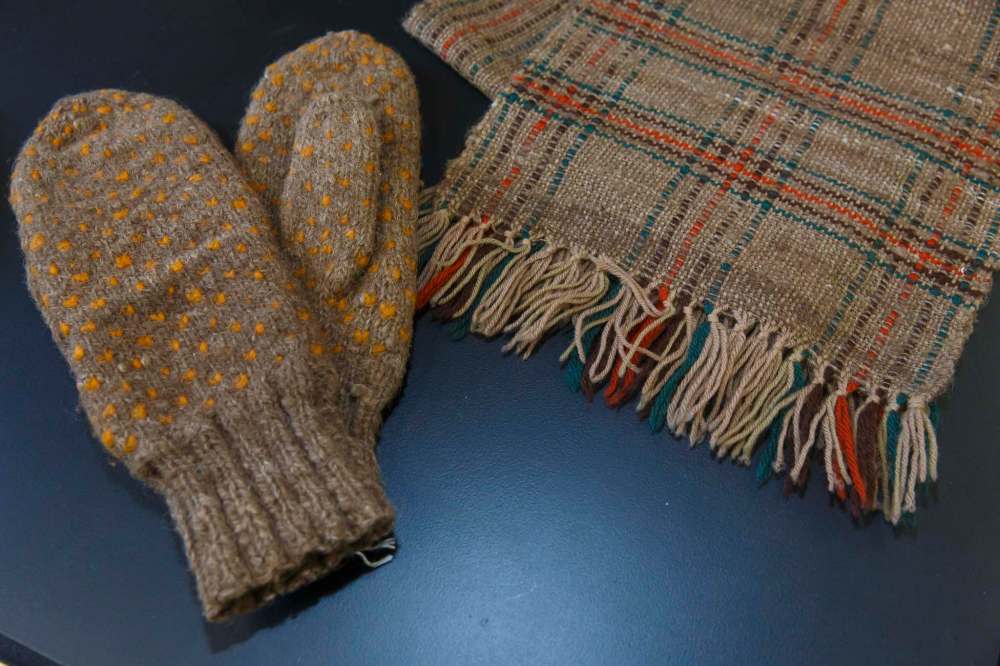
The resulting yarn worked as a sheep’s wool replacement except for one crucial fact: the bison hair would not accept dye well, so crafters had to work with whatever shades of brown were naturally produced by the bison.
That meant every project made from the bison yarn was essentially the same colour, including a knitted scarf and pair of mittens also in the museum’s collection.
The bison yarn story has a recent epilogue. Last summer, Reichert made a trip to a bison farm in Stonewall to collect a garbage bag full of bison hair to use in needle felting workshops. Some of the hair is curly, some wiry, but all of it is brown.
“We did take inspiration from those people (in 1942) and decided that it would be interesting to do something with it,” says Reichert of the bison hair hunting expedition.
brenda@suderman.com
Brenda Suderman has been a columnist in the Saturday paper since 2000, first writing about family entertainment, and about faith and religion since 2006.
Our newsroom depends on a growing audience of readers to power our journalism. If you are not a paid reader, please consider becoming a subscriber.
Our newsroom depends on its audience of readers to power our journalism. Thank you for your support.
Brenda Suderman has been a columnist in the Saturday paper since 2000, first writing about family entertainment, and about faith and religion since 2006.
Our newsroom depends on a growing audience of readers to power our journalism. If you are not a paid reader, please consider becoming a subscriber.
Our newsroom depends on its audience of readers to power our journalism. Thank you for your support.
Advertisement Advertise With Us
Advertisement Advertise With Us