

Focus on second doses: experts
Advertisement
Read this article for free:
or
Already have an account? Log in here »
To continue reading, please subscribe:
Monthly Digital Subscription
$1 per week for 24 weeks*
- Enjoy unlimited reading on winnipegfreepress.com
- Read the E-Edition, our digital replica newspaper
- Access News Break, our award-winning app
- Play interactive puzzles
*Billed as $4.00 plus GST every four weeks. After 24 weeks, price increases to the regular rate of $19.95 plus GST every four weeks. Offer available to new and qualified returning subscribers only. Cancel any time.
Monthly Digital Subscription
$4.99/week*
- Enjoy unlimited reading on winnipegfreepress.com
- Read the E-Edition, our digital replica newspaper
- Access News Break, our award-winning app
- Play interactive puzzles
*Billed as $19.95 plus GST every four weeks. Cancel any time.
To continue reading, please subscribe:
Add Free Press access to your Brandon Sun subscription for only an additional
$1 for the first 4 weeks*
*Your next subscription payment will increase by $1.00 and you will be charged $16.99 plus GST for four weeks. After four weeks, your payment will increase to $23.99 plus GST every four weeks.
Read unlimited articles for free today:
or
Already have an account? Log in here »
Hey there, time traveller!
This article was published 15/06/2021 (1774 days ago), so information in it may no longer be current.
A flood of Moderna COVID-19 vaccine — more than 250,000 shots — will arrive in Manitoba over the next two weeks, but how the province intends to use its now abundant supply is unclear.
Manitoba’s COVID-19 vaccine task force said Monday it will receive a delivery of 105,280 doses of Moderna mRNA vaccine this week, in addition to a confirmed delivery of 87,750 Pfizer shots.
Vaccine supply will grow again the following week, with another 153,000 Moderna doses confirmed to arrive in Manitoba between June 21 and 27, on top of the usual shipment of 87,750 Pfizer shots.
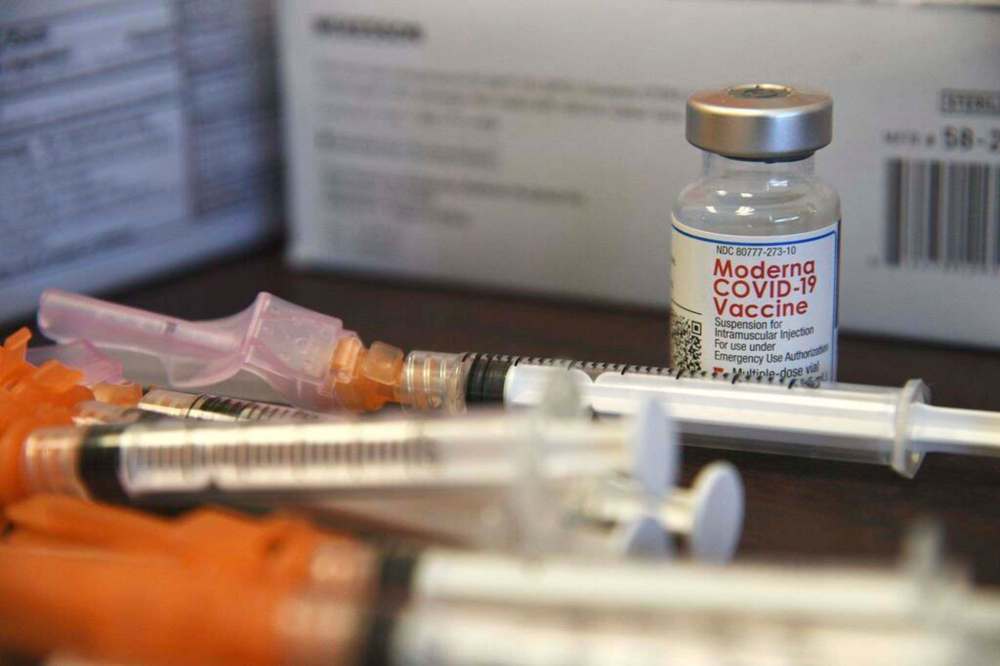
With vaccine supply nearly doubling in the final weeks of June, experts say the task force has an opportunity to accelerate second doses to get ahead of the troublesome Delta (B.1.617.2) variant, and perform meaningful outreach in communities where uptake is lower.
“It will be crucial to implement innovative approaches as much as possible. For example, 24-7 clinics, walk-in access, and mobile units that can go into particular spaces, such as workplaces, large residential areas like apartment blocks, quickly to bring the vaccine to those that require it,” said Souradet Shaw, an assistant professor at the University of Manitoba and the Canada Research Chair in Program Science and Global Public Health.
“It will become increasingly important to continue to be flexible in terms of where and to whom we target, and having appropriate and timely situational awareness to act accordingly.”
Emerging data on vaccine effectiveness against the Delta variant — which fuelled a deadly COVID-19 surge in India and is more transmissible than the Alpha (B.1.1.7) variant — has shown a single dose of vaccine is less protective against symptomatic illness when compared to Alpha, prompting calls for second-dose campaigns to ramp up and target high-risk populations.
Early data continue to show a single dose of vaccine offers protection against hospitalization caused by the Delta variant, though two shots are better than one.
The Free Press requested an interview with Johanu Botha, operations and planning lead for the task force, Monday. A government spokesman said Botha was unavailable.
“In coming days there will be further information and details shared with (the) public, regarding the arrival of Moderna shipments,” the spokesman said in a statement to the Free Press.
As part of its enhanced vaccine accessibility program, the province has sent doses out to pharmacists and medical clinics, a mobile vaccine team is reaching out to people experiencing homelessness in Winnipeg, and the Leila Avenue vaccine clinic in Winnipeg will accept walk-ins for first-dose clients June 15-17.
Dr. Anand Kumar, a professor of medicine and an intensive care physician in Winnipeg, said the task force should continue to target high-risk populations for both first and second doses, in light of increased supply.
However, if there is new evidence that shows a single dose of vaccine is not enough to protect against the Delta variant, that strategy needs to shift quickly to get second shots into arms, Kumar said.
“Those groups that we thought were high risk in the first place, essentially if they’ve only gotten one dose of vaccine, they’re still high risk, because there is no question that Delta is going to become dominant in the very near future,” Kumar said.
“Speed is of the essence. But for the moment, my inclination would be to go with what we were planning… get vaccine into as many arms as possible.”
In the past week, Manitoba has vaccinated an average of 13,240 people a day, in part due to previous challenges with Moderna supply.
The province’s COVID-19 vaccine task force has said despite having capacity to deliver thousands more shots, it must receive more than 100,000 doses a week to make good on its long-stated goal of immunizing 20,000 people a day.

“We can confidently state that these shipments will be used to drive towards our reopening plan dates, which still remain on target,” the government spokesman said in a statement.
But as the second-dose campaign continued to expand in Manitoba, with appointments opened to people first immunized on or before May 10, some Winnipeggers wanting their second Pfizer shot were initially told they’d have to wait five weeks.
However, appointments for Moderna vaccines were available in Winnipeg as early as June 20; by Monday evening, Pfizer appointments were again available in Winnipeg as soon as June 26.
danielle.dasilva@freepress.mb.ca