EXPLAINER: What Olympic host Japan’s COVID ‘emergency’ means

Advertisement

Advertise with us

TOKYO (AP) — Japan is playing host to the Tokyo Olympics. But the capital, as well as other populous areas, are in the middle of a government-declared “state of emergency” to curb surging COVID-19 infections. What does that state of emergency mean? How is it enforced? We break it down here.

Read this article for free:

or

Already have an account? Log in here »

To continue reading, please subscribe:

Subscribe and receive a limited-edition Free Press branded hat or tote.

Digital Subscription

One year of digital access for only $205*

  • Enjoy unlimited reading on winnipegfreepress.com
  • Read the E-Edition, our digital replica newspaper
  • Access News Break, our award-winning app
  • Play interactive puzzles

*First annual payment billed as $205.00 + GST for one year. This annual subscription will automatically renew at $233.00 + GST every 52 weeks (10% off the regular annual price of $259.35). Offer available to new and qualified returning subscribers only. Cancel any time.

To continue reading, please subscribe:

Add Free Press access to your Brandon Sun subscription for only an additional

$1 for the first 4 weeks*

  • Enjoy unlimited reading on winnipegfreepress.com
  • Read the E-Edition, our digital replica newspaper
  • Access News Break, our award-winning app
  • Play interactive puzzles
Start now

*Your next Brandon Sun subscription payment will increase by $1.00 and you will be charged $17.95 plus GST for four weeks. After four weeks, your payment will increase to $24.95 plus GST every four weeks.

Hey there, time traveller!
This article was published 05/08/2021 (1825 days ago), so information in it may no longer be current.

TOKYO (AP) — Japan is playing host to the Tokyo Olympics. But the capital, as well as other populous areas, are in the middle of a government-declared “state of emergency” to curb surging COVID-19 infections. What does that state of emergency mean? How is it enforced? We break it down here.

HOW LONG HAS THIS STATE OF EMERGENCY BEEN GOING ON?

Japan is now in its fourth state of emergency. Tokyo has been in that state much of this year. People are getting resigned to it, no longer alarmed by a situation that’s “critically urgent,” which is how the Japanese term translates, but accepting it as a new normal. So even as the nation celebrates medal winners, blaring ambulance sirens can be heard regularly. Tokyo has been racking up record daily cases, totaling several thousand, tripling since the Olympics opened July 23. Experts say that could reach 10,000 people in a couple of weeks.
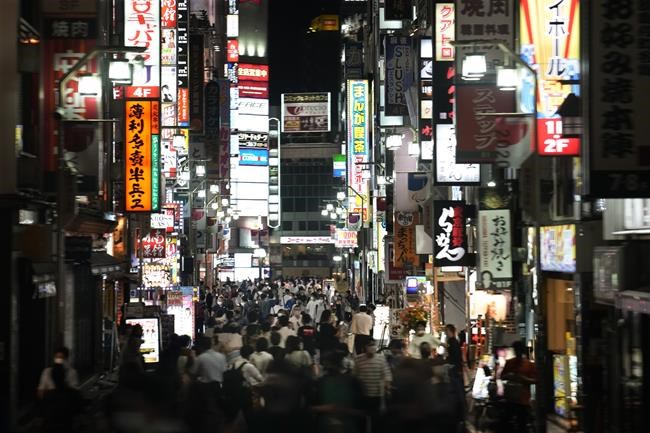
FILE - In this July 16, 2021, file photo, people crowd the street in the Kabukicho area, Tokyo's entertainment district. Japan is now in its fourth state of emergency. Restaurants and bars are asked to close early and can’t serve alcohol. (AP Photo/Jae C. Hong, File)

WHAT IS THIS STATE OF EMERGENCY — OR WHAT ISN’T IT?

One thing it’s not is a lockdown. Restaurants and bars are asked to close early and can’t serve alcohol. The idea is that people who consume alcohol and are influenced by it talk in loud voices, and that spreads infections. But some medical experts say that’s unfairly targeting eateries when airborne variants can spread anywhere.

The states of emergency have varied slightly, with earlier ones not banning alcohol. Last year, schools were closed temporarily. The regions affected have also differed. Other areas have periodically been under a less stringent measure.

IS IT REALLY WORKING?

Some would say not. Tokyo’s streets are bustling with people, commuter trains are packed and, despite government-mandated requests for people to work from home, salarymen and salarywomen say their bosses demand they come into the office.

WHAT HAS IT MEANT FOR THE OLYMPICS?

The events are being held without spectators, although the stands aren’t totally empty because team and Olympic officials, as well as reporters, are there. Athletes are tested daily for COVID-19, and others involved with the Games are also regularly tested. Those tests are free. That’s in contrast to the general public, for whom such tests have been hard to get and cost hundreds of dollars each.

The Olympic “bubble” hasn’t been perfect, with about 30 people, almost all non-athlete Japanese workers, testing positive a day. Taisuke Nakata, a University of Tokyo professor who has been studying the effects of the emergency measures on the economy, says that number is insignificant compared to the movement of 126 million Japanese people and how that potentially spreads infections. Nakata believes people’s actions may finally change if the cases keep surging, but he isn’t sure.

AREN’T JAPANESE VACCINATED BY NOW?

Japan has among the slowest vaccine rollouts in the developed world, with about a third of the adult population now fully vaccinated. Although the elderly get priority, people have complained that signing up for the shots, by phone or online, has been frustrating, like winning coveted concert tickets with slots getting filled almost as soon as they open.

One may think Japan, home to the likes of Toyota Motor Corp. and Sony Corp., would be a production powerhouse. But it’s totally dependent on imported vaccines. A Made in Japan vaccine likely won’t arrive until next year, perhaps 2023. Critics say strict drug approval regulations, especially for vaccines, prevent speedy decision-making. The problem is also about the money. Former President Donald Trump’s Project Warp Speed totaled $2 billion. Japan has earmarked some 50 billion yen ($500 million) toward vaccine development.

Philippe Fauchet, who has two decades of experience in the pharmaceutical industry in Japan, serving as head of GlaxoSmithKline and Sanofi-Aventis, says the nation’s conservative risk-averse “insular culture” hurt its response to the pandemic.

ARE PEOPLE WORRIED?

Although Japan tends to be an orderly and conformist place, protesters have taken to the streets to oppose the Olympics. They say gathering tens of thousands of people from all over the world sends the wrong message during a pandemic about valuing human life. Dissatisfaction with the political leadership lies deep, with support ratings for Prime Minister Yoshihide Suga nose-diving. The sentiment among regular Japanese, apparent in the quiet defiance of those revelers crowding Tokyo bars in the middle of an emergency, might go something like this: If you’re risking your health to go to work anyway, why not party a little?

___

Follow Yuri Kageyama on Twitter at https://twitter.com/yurikageyama. More AP Olympics: https://apnews.com/hub/2020-tokyo-olympics and https://twitter.com/AP_Sports

Report Error Submit a Tip

More Stories

WestJet, CUPE reach tentative deal as passengers scramble amid flight disruptions

The Canadian Press 6 minute read Preview

WestJet, CUPE reach tentative deal as passengers scramble amid flight disruptions

The Canadian Press 6 minute read Updated: Yesterday at 3:44 PM CDT

CALGARY - WestJet and the union representing some 4,400 flight attendants reached a tentative deal Monday to resume work after a brief work stoppage, but neither side is sharing specifics yet.

The airline had said Sunday it had proposed a 13 per cent pay increase starting in October, and then a 2.5 per cent increase in each of the next three years until 2029.

The airline also said it offered a new duty pay premium, equivalent to another 12 per cent salary increase, which WestJet said is designed to solve the cabin crew's claim of unpaid work.

In a news conference in Calgary on Monday, CUPE local 8125 president Alia Hussain said the flight attendants have 30 days to ratify the agreement, and the union will spend the coming days preparing a slide show to present to the members.

Read
Updated: Yesterday at 3:44 PM CDT

What’s open, what’s closed, what’s up in Winnipeg on Terry Fox Day

Free Press staff 4 minute read Preview

What’s open, what’s closed, what’s up in Winnipeg on Terry Fox Day

Free Press staff 4 minute read Friday, Jul. 31, 2026

The first Monday in August marks Terry Fox Day in Manitoba, honouring the legendary Canadian who was born in Winnipeg in 1958. 

Read
Friday, Jul. 31, 2026

Kevin Gausman traded by Toronto Blue Jays to Chicago Cubs

The Canadian Press 3 minute read Preview

Kevin Gausman traded by Toronto Blue Jays to Chicago Cubs

The Canadian Press 3 minute read Sunday, Aug. 2, 2026

TORONTO - Kevin Gausman's time with the Toronto Blue Jays has come to an end.

The veteran right-hander was traded by the Blue Jays to the Chicago Cubs on Sunday in return for outfielder Brett Bateman and infielder Ty Southisene.

Bateman, a 24-year-old outfielder, hit .312 with three homers, 20 steals and 33 RBIs in 82 games for triple-A Iowa this season. Southisene, a 21-year-old shortstop, hit .326 in 44 games for High-A South Bend.

Gausman signed a five-year, US$110-million deal with the Blue Jays on Dec. 21, 2021 and has been one of Toronto's most reliable starters for five seasons.

Read
Sunday, Aug. 2, 2026

Giant Tiger decision creates giant void for desperate population

Niigaan Sinclair 5 minute read Preview

Giant Tiger decision creates giant void for desperate population

Niigaan Sinclair 5 minute read Friday, Jul. 31, 2026

A lot of Winnipeggers may shrug, but the end of Giant Tiger’s downtown store is a giant problem for many of the people living in the centre of the city.

It would have been difficult for anyone going into or passing by the Canadian discount chain’s Donald Street and Ellice Avenue location Thursday to miss the red notices posted on the store’s windows advising it will close on Nov. 7.

According to a 2024 Downtown Winnipeg BIZ report, about 18,000 people live in Winnipeg’s downtown.

More than 60,000 people work there, and some days — when there’s a big concert or the Jets play at Canada Life Centre, for example — the number of people spending time in the area increases significantly.

Read
Friday, Jul. 31, 2026

Hydro CEO needs to reckon with winds of change

Dan Lett 5 minute read Preview

Hydro CEO needs to reckon with winds of change

Dan Lett 5 minute read Yesterday at 3:28 PM CDT

Methinks Hydro CEO Allan Danroth protests too much.

At a recent hearing in front of the Public Utilities Board, Danroth suggested Hydro’s plan to build a $3-billion natural-gas-powered generating plant near Brandon was being subjected to unfair criticism. The gas turbines are meant to bolster Hydro’s grid in the event that drought lowers output from hydro-generating stations.

After hearing submissions from interveners concerned about the gas-turbine plan, Danroth lashed out at the “constant, uninformed criticism” that has not only shaken trust in Hydro but also triggered threatening responses from the public.

Danroth said Hydro is monitoring “eight credible threats” against employees, five of which targeted the CEO himself. Although Danroth cited some specific incidents — employees being threatened with guns, and one where a homeowner set his dogs on a meter reader — he refused to elaborate on the circumstances.

Read
Yesterday at 3:28 PM CDT

Travellers in Winnipeg scramble to rebook flights as WestJet attendants reach tentative deal

By Melissa Martin 4 minute read Preview

Travellers in Winnipeg scramble to rebook flights as WestJet attendants reach tentative deal

By Melissa Martin 4 minute read Yesterday at 4:21 PM CDT

WestJet flights were back in the skies Monday after a brief flight-attendant strike grounded planes across the country. But even as their cancelled flights were rebooked, many travellers spent the holiday scrambling to adapt to new, altered plans.

By 11:30 a.m. about 200 people were queued up in front of WestJet’s check-in booths at Winnipeg Richardson International Airport. Many were there to check in for an afternoon flight to Toronto, which, along with most other WestJet flights for the day, was now listed on the departure board as proceeding as planned.

Others, unable to reach someone on WestJet’s apparently overburdened customer service hotline, were hoping to find a solution to altered travel plans that had delayed their travel by days, or in some cases rerouted them through other cities.

Dan Schenkeveld was among them. The Kamloops resident spent most of the past month on a deep wilderness canoe trip in Nunavut. When he got back in cellular service range, he learned that a WestJet flight attendant strike was looming: “We’re aware of the issues around unpaid work, and we’re compassionate to that,” he said.

Read
Yesterday at 4:21 PM CDT