Iran sees highest daily virus case, death counts in pandemic

Advertisement

Advertise with us

TEHRAN, Iran (AP) — Iran, grappling with its most severe surge of the coronavirus to date, reported more new infections and deaths across the country on Sunday than any other single day since the pandemic began.

Read this article for free:

or

Already have an account? Log in here »

To continue reading, please subscribe:

Subscribe and receive a limited-edition Free Press branded hat or tote.

Digital Subscription

One year of digital access for only $205*

  • Enjoy unlimited reading on winnipegfreepress.com
  • Read the E-Edition, our digital replica newspaper
  • Access News Break, our award-winning app
  • Play interactive puzzles

*First annual payment billed as $205.00 + GST for one year. This annual subscription will automatically renew at $233.00 + GST every 52 weeks (10% off the regular annual price of $259.35). Offer available to new and qualified returning subscribers only. Cancel any time.

To continue reading, please subscribe:

Add Free Press access to your Brandon Sun subscription for only an additional

$1 for the first 4 weeks*

  • Enjoy unlimited reading on winnipegfreepress.com
  • Read the E-Edition, our digital replica newspaper
  • Access News Break, our award-winning app
  • Play interactive puzzles
Start now

*Your next Brandon Sun subscription payment will increase by $1.00 and you will be charged $17.95 plus GST for four weeks. After four weeks, your payment will increase to $24.95 plus GST every four weeks.

Hey there, time traveller!
This article was published 08/08/2021 (1802 days ago), so information in it may no longer be current.

TEHRAN, Iran (AP) — Iran, grappling with its most severe surge of the coronavirus to date, reported more new infections and deaths across the country on Sunday than any other single day since the pandemic began.

Health authorities logged over 39,600 new cases and 542 deaths from the virus. The fatality count shatters the previous record set during Iran’s deadliest coronavirus surge that gripped the country last November, signaling the current wave will likely only get worse. The new all-time highs push Iran’s total number of infections over 4.1 million and death toll over 94,000 — the highest in the Middle East.

The crush of new cases, fueled by the fast-spreading delta variant, have overwhelmed hospitals with patients too numerous to handle. The country has never seen so many COVID-19 patients in critical condition, with 6,462 more severe cases reported Sunday.
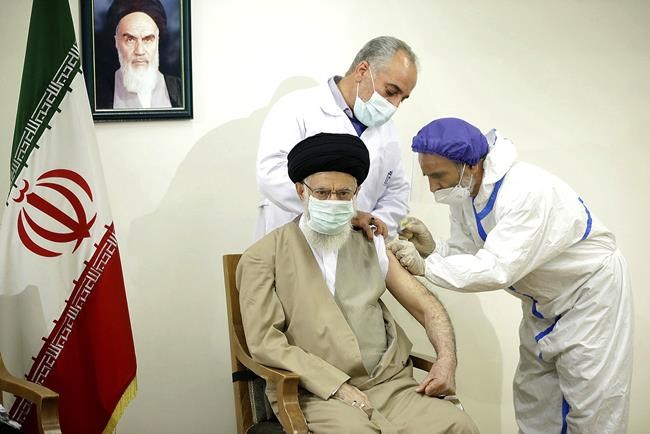
FILE - In this June 25, 2021 file photo, released by the official website of the Office of the Iranian Supreme Leader, Supreme Leader Ayatollah Ali Khamenei receives a shot of the Coviran Barekat COVID-19 vaccine in Tehran, Iran. On Sunday, Aug. 8, 2021, Iran reported more new infections and deaths across the country than on any other single day since the pandemic began. Khamenei, who has the final say on all state matters, last week ordered officials to discuss the possibility of a total national shutdown — something the government has been loath to enforce, fearing the damage it would do to an economy reeling from years of American sanctions. (Office of the Iranian Supreme Leader via AP, File)

Supreme Leader Ayatollah Ali Khamenei, who has the final say on all state matters, last week ordered officials to discuss the possibility of a total national shutdown. The government has been loath to enforce such a lockdown, fearing the damage it would do to an economy reeling from years of American sanctions.

Iran’s sputtering vaccination campaign hasn’t helped matters. Only 3.3% of the total population of some 80 million has been fully vaccinated, according to data compiled from government sources by the Our World in Data project at the University of Oxford.

In the face of U.S. sanctions that complicate banking transactions and deep-rooted suspicion of the West, Iran has vigorously promoted the local production of coronavirus vaccines, doling out the experimental COVIran Barekat vaccine to most healthcare workers. Iran’s government announced that its domestic vaccine provides 85% protection from the coronavirus, without disclosing data or details.

The country’s newly inaugurated hard-line president, Ebrahim Raisi, publicly received his first dose of the COVIran Barekat shot on Sunday. He urged public health officials to speed up vaccinations before winter weather sets in, state-run media reported.

In this photo released by the official website of the office of the Iranian Presidency, President Ebrahim Raisi receives his first shot of the Covid-19 COVIran Barekat vaccine, in Tehran, Iran, Sunday, Aug. 8, 2021. On Sunday, Iran reported more new infections and deaths across the country than on any other single day since the pandemic began. In the face of U.S. sanctions that complicate banking transactions and deep-rooted suspicion of the West, Iran has vigorously promoted the local production of coronavirus vaccines, doling out the experimental COVIran Barekat vaccine to most healthcare workers. (Iranian Presidency Office via AP)
Report Error Submit a Tip

More Stories

Manitoba workplaces becoming increasingly violent

Maggie Macintosh 5 minute read Preview

Manitoba workplaces becoming increasingly violent

Maggie Macintosh 5 minute read Updated: Yesterday at 7:16 PM CDT

A middle school student file documenting more than 40 violent outbursts in a single year.

A gun kept under the pillow of a home-care patient who has dementia.

A drug-fuelled rage during which a man suffering from a contagious disease spat on and wrapped his hands around the throat of a first responder.

These are among the hazards that front-line employees in health care, education and other public sector positions are navigating when they clock in for a shift.

Read
Updated: Yesterday at 7:16 PM CDT

Would-be mayors respond to extreme heat

Marsha McLeod 3 minute read Preview

Would-be mayors respond to extreme heat

Marsha McLeod 3 minute read Yesterday at 7:00 AM CDT

With Winnipeg in the midst of an intense heat wave, the city has yet to introduce maximum heat legislation for rental housing.

In 2023, the Free Press and the Narwhal reported on calls by tenants and environmental advocates to enact a law that would require indoor temperatures in rental units not exceed 26 C. It would be similar to how Winnipeg landlords, under the city’s neighbourhood livability bylaw, must maintain a minimum daytime temperature of 21 C during cold weather.

On Sunday, the Free Press emailed all nine registered mayoral candidates asking for their policy plans to tackle the dangers of extreme heat, and specifically, whether they would support a change to the city’s bylaw to create heat protections for renters.

Eight candidates responded, and of them, six — Noah Redden, Don Woodstock, Mazher Alam, Christopher Clacio, Michael Vogiatzakis and Umar Hayat — said they would support (or support exploring) a bylaw amendment to establish a maximum indoor temperature threshold.

Read
Yesterday at 7:00 AM CDT

Winnipeg’s first pro women’s team will be in the Northern Super League

Joshua Frey-Sam 8 minute read Preview

Winnipeg’s first pro women’s team will be in the Northern Super League

Joshua Frey-Sam 8 minute read 5:22 PM CDT

Desiree Scott made a name for herself on the pitch as The Destroyer. Now, she’s continuing her legacy as a builder.

On Tuesday, the Olympic gold medalist helped announce the Northern Super League’s expansion to Winnipeg, the seventh franchise in Canada’s rapidly growing professional women’s soccer league.

It’s also the first pro women’s sports team in the city.

Scott, a Winnipeg native, had been vocal about her desire for a pro women’s team in her hometown during her playing days, and has spearheaded the movement for it to come to fruition in the last year.

Read
5:22 PM CDT

Bisons’ Neill carries lead into final round of men’s amateur

Joshua Frey-Sam 3 minute read Preview

Bisons’ Neill carries lead into final round of men’s amateur

Joshua Frey-Sam 3 minute read 7:44 PM CDT

RORY Neill woke up Tuesday with a share of the lead in the 115th edition of the Golf Manitoba men’s amateur championship.

He went to bed with the solo lead.

The Glendale member rests at 2-under for the 54-hole event and will take a one-stroke advantage into Wednesday’s final round at St. Boniface Golf Club after firing a one-over 73 on Tuesday.

The University of Manitoba Bisons’ golfer got out of the gates much slower than he did in Monday’s opening round, bogeying four of his first six holes, but stuck with it, finding birdies on four of the last 10 holes to salvage his round.

Read
7:44 PM CDT

Mom spearheads fight for rehab services

Zoe Pierce 4 minute read Preview

Mom spearheads fight for rehab services

Zoe Pierce 4 minute read Yesterday at 2:01 AM CDT

Four years ago, a car crash permanently changed Will Castor’s life.

The 28-year-old suffered a traumatic brain injury that required a long recovery as he worked to relearn skills many people take for granted, such as eating, speaking and getting out of bed.

A key part of that journey was First Steps Wellness Centre, a Winnipeg rehabilitation facility, where Will worked with therapists to regain independence and connect with others facing similar challenges.

But on June 5, financial constraints forced First Steps to close, leaving families without the specialized therapy they had come to rely on.

Read
Yesterday at 2:01 AM CDT

If it works in Ontario, why not in Manitoba?

James Wilt 5 minute read Preview

If it works in Ontario, why not in Manitoba?

James Wilt 5 minute read Yesterday at 2:00 AM CDT

Grid-scale battery storage has fundamentally changed the global energy landscape — and Manitoba needs to get on board.

Battery systems store large amounts of excess electricity for when it’s most needed. While they can be charged from any generation source, they are especially beneficial for integrating wind and solar power, which vary with weather and time of day. Batteries allow electrical grids to meet the need for firm, dispatchable and affordable capacity using renewable energy, rather than relying on coal, nuclear and fossil gas. They also provide numerous other benefits, including reducing overloading of transmission infrastructure and helping to regulate the grid’s frequency and voltage.

Average costs for grid-scale batteries plummeted by more than half between 2023 and 2025 and installations have skyrocketed in China, the U.S., Australia and Europe. Texas now has 16,500 megawatts (MW) of battery storage, while California has 15,200 MW. Closer to home, Ontario recently awarded 640 MW of contracts to three battery storage projects in a competitive auction, with batteries beating out fossil gas-fired power plants on cost every time. One of these projects will be built near Dryden, only four hours east of Winnipeg.

Each battery system will provide eight hours of capacity but will cost considerably less than Ontario’s previous battery procurements, which provide only four hours of capacity. With this latest auction, Ontario has now secured 3,600 MW of battery storage capacity, including the operational Oneida (250 MW), Hagersville (300 MW) and Napanee (250 MW) projects. Almost all have significant Indigenous participation, with the latest procurements boasting 50 per cent First Nations ownership.

Read
Yesterday at 2:00 AM CDT