‘Cheering for the mammoth’: Scientists retrace the steps of 17,000 year-old animal

Advertisement

Advertise with us

More than 17,000 years ago, a woolly mammoth roamed enough of the Alaskan landscape to circle the Earth twice.

Read this article for free:


or

Already have an account? Log in here »

To continue reading, please subscribe:

Subscribe and receive a limited-edition Free Press branded hat or tote.

Digital Subscription

One year of digital access for only $205*

  • Enjoy unlimited reading on winnipegfreepress.com
  • Read the E-Edition, our digital replica newspaper
  • Access News Break, our award-winning app
  • Play interactive puzzles

*First annual payment billed as $205.00 + GST for one year. This annual subscription will automatically renew at $233.00 + GST every 52 weeks (10% off the regular annual price of $259.35). Offer available to new and qualified returning subscribers only. Cancel any time.

To continue reading, please subscribe:

Add Free Press access to your Brandon Sun subscription for only an additional

$1 for the first 4 weeks*

  • Enjoy unlimited reading on winnipegfreepress.com
  • Read the E-Edition, our digital replica newspaper
  • Access News Break, our award-winning app
  • Play interactive puzzles
Start now

*Your next Brandon Sun subscription payment will increase by $1.00 and you will be charged $17.95 plus GST for four weeks. After four weeks, your payment will increase to $24.95 plus GST every four weeks.

Hey there, time traveller!
This article was published 12/08/2021 (1889 days ago), so information in it may no longer be current.

More than 17,000 years ago, a woolly mammoth roamed enough of the Alaskan landscape to circle the Earth twice.

That’s according to a new paper from an international team of researchers who retraced the lifetime of one of the extinct ancient Arctic creatures.

The mammoth’s story is written in its tusk through tiny isotopes, which are tiny atoms, said Mat Wooller, a paleoecologist at the University of Alaska.
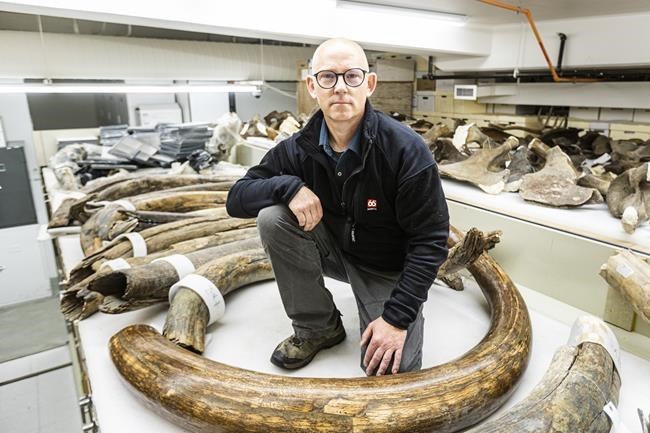
Mat Wooller, director of the Alaska Stable Isotope Facility, kneels among a collection of some of the mammoth tusks at the University of Alaska Museum of the North. THE CANADIAN PRESS/HO-JR Ancheta, University of Alaska Fairbanks MANDATORY CREDIT

“Isotopes are like a little chemical GPS (global positioning system) recorder,” Wooller said.

Looking at the isotopes, researchers analyzed 400,000 microscopic data points in a two-metre long woolly mammoth tusk found in Alaska in 2018. They were able to determine the animal was a male who lived to be 28 years old, he said.

The way the tusk grows makes it easier to analyze, said Clement Bataille, a University of Ottawa researcher who also worked on the project.

Each year, new layers grow on the mammoth’s tusk, “as if we you were stacking a bunch of ice cream cones on top of each other,” he said.

The isotopes found in the mammoth’s tusk were matched with maps created by analyzing the teeth of hundreds of small rodents across Alaska. That data set was then used as a baseline to trace the mammoth’s movements across Alaska.

“It’s like a video game that helps us reconstruct the possible paths of the mammoth,” said Bataille.

“When the mammoth drinks water, the oxygen from this water is transmitted to its tissue and preserved because the tusk is constantly growing and reporting its diet and movements,” he added.

Bataille said his team was surprised to learn the mammoth’s movements shifted abruptly around the age of 15. Researchers think that’s likely when the animal was kicked out of its herd to head out on its own, the same way elephants treat their young.

During that time, the mammoth would sometimes travel 500 or more kilometres over a few months, Bataille said.

“There were some moments where he would just take off.”

The researchers learned that the mammoth had a much larger range than expected, covering most of Alaska in its lifetime. They also determined the mammoth had some favourite spots where he would stay put, such as river valleys and tundra plains where food was plentiful, said Bataille.

“At the end, you’re just staring at your computer, cheering for the mammoth,” he said. “It’s almost like being there with him on the landscape.”

The mammoth’s death at 28 is also a bit of a tragedy, Bataille said, because the animals were known to live into their 80s.

Battaille said its nitrogen isotopes spiked during the final winter of its life, which points to starvation.

Researchers still know very little about woolly mammoths, but the new data provides a baseline for the mammal to be studied more.

“We don’t know anything about mammoths. I had all this bias from my kids watching ‘Ice Age,'” Bataille said.

“Up until this point, we had very little information about how mammoths moved over the landscape,” added Wooller. “It’s a big technical leap forward.”

He said it’s only the beginning of the research into the life history of mammoths. He also wants to find out exactly why the creatures went extinct, a mystery that has puzzled scientists for a long time.

“That is a detective story that scientists have argued about for many years,” said Wooller.

The disappearance of mammoths in the past also raises questions about what other species are at risk of extinction now and in the future.

“The climate is changing very rapidly. The Arctic is changing. What in the ecology will influence extinction?” Bataille said.

This report by The Canadian Press was first published Aug. 12, 2021.

—

This story was produced with the financial assistance of the Facebook and Canadian Press News Fellowship.


Report Error Submit a Tip

More Stories

Gang member who shot rival, bystander back in prison after release revoked

Erik Pindera 4 minute read Preview

Gang member who shot rival, bystander back in prison after release revoked

Erik Pindera 4 minute read Monday, Oct. 12, 2026

A Winnipeg man who shot a rival teenage gangster and an innocent 11-year-old bystander at the crowded Red River Exhibition more than four years ago has been sent back to prison.

Mocree Chuck Scatch-Dubour, now in his early 20s, left prison in April on statutory release on his 5 1/2-year federal sentence for the 2022 shooting. Scatch-Dubour was sentenced to the prison term as an adult in the spring of 2023 after pleading guilty to discharge of a firearm with intent to wound, aggravated assault and possession of a restricted firearm.

By law, most federal inmates automatically receive statutory release after two-thirds of their sentence, if they have not already been paroled.

Parole Board of Canada officials formally revoked Scatch-Dubour’s release this month after he unlawfully left his halfway house in June.

Read
Monday, Oct. 12, 2026

Letters, Oct. 13

7 minute read Preview

Letters, Oct. 13

7 minute read Updated: Yesterday at 8:14 AM CDT

The major assumption Manitoba Hydro undertakes is the weather. Hydro projected a $214 million profit for the 2025-26 fiscal year. On Sept. 29, it reported a $446 million loss. It took on additional debt due to $751 million in operating losses. In addition, Hydro stated the fiscal results for 2025-26 were “significantly influenced by circumstances largely beyond Hydro’s control.”

Read
Updated: Yesterday at 8:14 AM CDT

‘We know we’re not going to beat Mother Nature’: Ice prep begins at Princess Auto Stadium for Heritage Classic

Mike McIntyre 6 minute read Preview

‘We know we’re not going to beat Mother Nature’: Ice prep begins at Princess Auto Stadium for Heritage Classic

Mike McIntyre 6 minute read Yesterday at 5:56 PM CDT

Derek King typically has ice in his veins.

But the Manitoban admits there may be a few more butterflies than usual as he prepares for the ultimate home game — the 2026 Heritage Classic between the Winnipeg Jets and Montreal Canadiens.

“This is so exciting to be back,” King, the NHL’s vice-president of hockey operations and facilities operations, said Tuesday afternoon.

“It’s definitely going to be a fun event to be part of.”

Read
Yesterday at 5:56 PM CDT

Elder day care closure frustrates families

Carol Sanders 5 minute read 2:01 AM CDT

A day program that helps older adults in Charleswood stay connected to their community is closing at the end of the month, causing concern for participants and their families now trying to fill the void.

Kathy Brett James said her elderly mom was on a wait list for more than a year before getting into the Charleswood Adult Day Program this summer and said she looks forward to attending every week.

“It has been great for her,” James said. “She’s having conversations instead of being by herself all day.”

For more than 30 years, the program provided a welcoming place for connection, companionship and support for older adults and their families. It helped participants remain active, engaged and connected to their community while also providing respite and support for caregivers.

Every few years, a sword over the baby

Hersh Seth 5 minute read Preview

Every few years, a sword over the baby

Hersh Seth 5 minute read 2:00 AM CDT

On Oct. 19, people in Alberta will answer 10 referendum questions. Nine are about things such as immigration, voter ID, judges and the Senate. The other asks if Alberta should remain in Canada or begin the legal steps toward a binding vote on leaving.

I want to share a perspective, as a patriotic Canadian, which I feel is lacking from the discourse.

Many of us who read those nine complaints can understand where Alberta is coming from. Ottawa kept control of the Prairies’ Crown lands and resources until 1930, allowing the East to grow at the West’s expense. The national energy program of the 1970s is still a sore spot west of Kenora, nearly 50 years later. Ontario and Quebec have almost 60 per cent of the seats in the House of Commons, so you can win everywhere from the Lakehead to the Pacific and still not change anything. Decisions are made about us, not with us. That frustration is real and being a Manitoban shouldn’t mean having to be Ottawa’s lawyer in this case. We are the original West, born in 1870 from Métis resistance to the same kind of treatment Alberta is protesting now.

So yes, we can understand how truly frustrated they are with the state of things in this country. But what bothers us even more is seeing someone threaten our children’s future every few years and call it leadership in their province.

Read
2:00 AM CDT

White-supremacist highway sign casts pall on Steinbach city council campaign

Matthew Frank 4 minute read Preview

White-supremacist highway sign casts pall on Steinbach city council campaign

Matthew Frank 4 minute read Yesterday at 7:41 PM CDT

The RCMP is investigating a white-nationalist sign near Steinbach with racist messaging and alleged links to a known Canadian far-right group.

A sign hanging on a overpass at the intersection of Highways 1 and 12 read: “STEINBACH VOTES WHITE NOT BROWN,” according to photos posted on social media.

Also written was the name Nationalist-13, a men’s-only neo-Nazi group, also known as NS-13, primarily based in Hamilton, Ont. The Free Press couldn’t independently verify if the group is associated or who hung the sign.

“On Oct. 13, the Steinbach RCMP were made aware of this sign and have opened an investigation,” a spokesperson said in an email statement. They also said the sign has been removed.

Read
Yesterday at 7:41 PM CDT