WEATHER ALERT

Drawing on the past

Singaporean cartoonist chronicles traumathrough generations of women

Advertisement

Advertise with us

Let’s Not Talk Anymore is the ambitious followup to Weng Pixin’s critically acclaimed Sweet Time. Here, the Singaporean-born cartoonist uses her signature watercolour and pastel paintings to trace her lineage back (and forward), as she explores intergenerational trauma through the women in her family. Blending history with autobiography with speculative fiction, Pixin’s narrative spans 100 years while remaining timeless in its depiction of how family bonds are formed and broken.

Read this article for free:

or

Already have an account? Log in here »

To continue reading, please subscribe:

Subscribe and receive a limited-edition Free Press branded hat or tote.

Digital Subscription

One year of digital access for only $205*

  • Enjoy unlimited reading on winnipegfreepress.com
  • Read the E-Edition, our digital replica newspaper
  • Access News Break, our award-winning app
  • Play interactive puzzles

*First annual payment billed as $205.00 + GST for one year. This annual subscription will automatically renew at $233.00 + GST every 52 weeks (10% off the regular annual price of $259.35). Offer available to new and qualified returning subscribers only. Cancel any time.

To continue reading, please subscribe:

Add Free Press access to your Brandon Sun subscription for only an additional

$1 for the first 4 weeks*

  • Enjoy unlimited reading on winnipegfreepress.com
  • Read the E-Edition, our digital replica newspaper
  • Access News Break, our award-winning app
  • Play interactive puzzles
Start now

*Your next Brandon Sun subscription payment will increase by $1.00 and you will be charged $17.95 plus GST for four weeks. After four weeks, your payment will increase to $24.95 plus GST every four weeks.

Hey there, time traveller!
This article was published 14/08/2021 (1809 days ago), so information in it may no longer be current.

Let’s Not Talk Anymore is the ambitious followup to Weng Pixin’s critically acclaimed Sweet Time. Here, the Singaporean-born cartoonist uses her signature watercolour and pastel paintings to trace her lineage back (and forward), as she explores intergenerational trauma through the women in her family. Blending history with autobiography with speculative fiction, Pixin’s narrative spans 100 years while remaining timeless in its depiction of how family bonds are formed and broken.

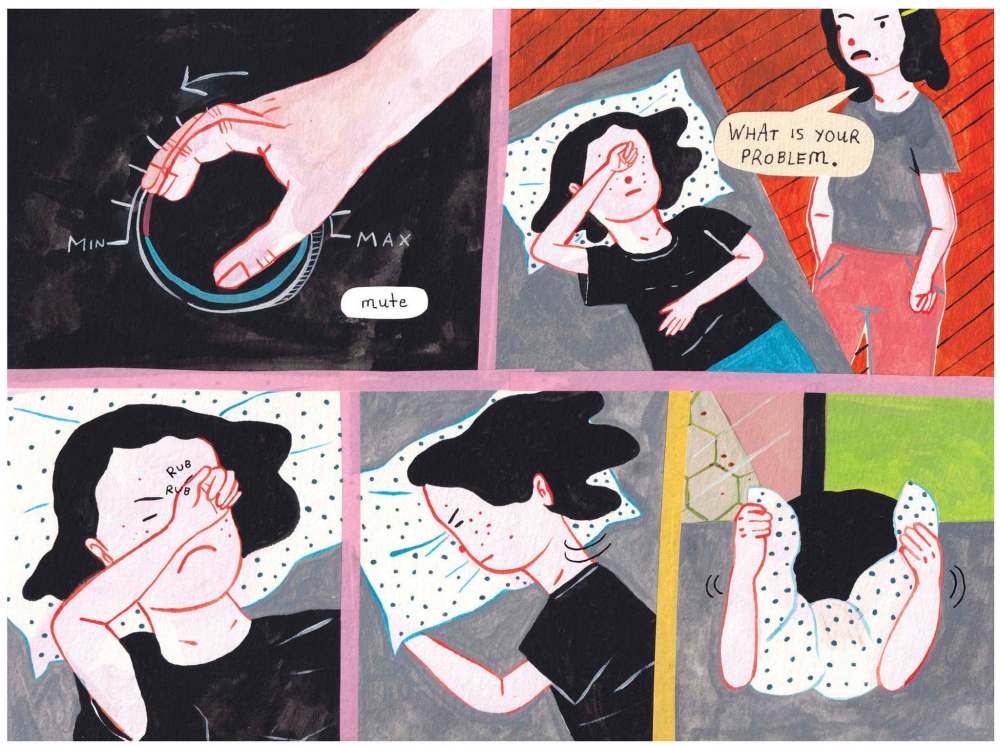
Pixin artfully explores generational gaps and shared desires through a series of vignettes depicting her great-great grandmother Kuan, her grandmother Mei, her mother Bing, Bi (Pixin’s character-surrogate) and her hypothetical future daughter Rita, all at age 15. The experience of being a teenage girl, when emotions are high and independence is hard-won, drives most of the narrative as Pixin weaves in and out of different timelines, establishing traces and echoes of loneliness, longing, guilt and love that are passed down through each generation.
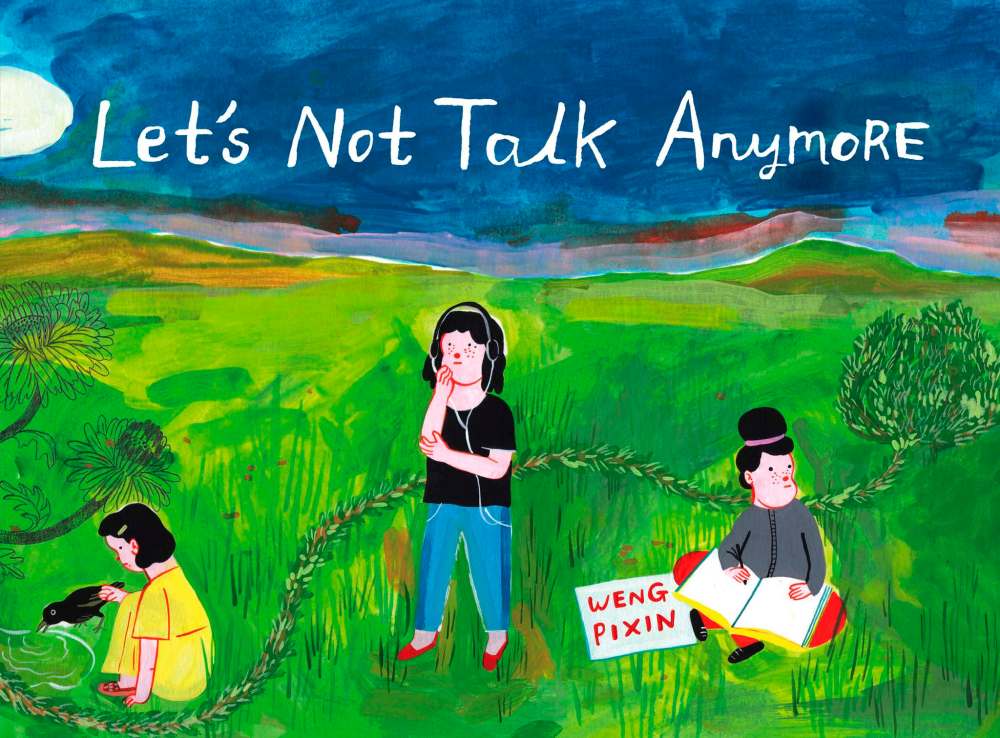
Let’s Not Talk Anymore thrives in the spaces between her characters’ interiority and their relationships. Dialogue is direct and conversational, and most of Pixin’s character development occurs visually; each section ends with rich, full-page tableaus that encapsulate the book’s bittersweet mood.

In the first few pages, Bi’s great-grandmother, Kuan, is shown with her own mother as two tiny figures working in the middle of a vast field. The landscape is overwhelming, as Pixin makes evident the necessity of their bond not only for love, but for survival. Soon thereafter, Kuan is sent abroad to America, gifting her mother a small hand-woven basket as a token of remembrance.
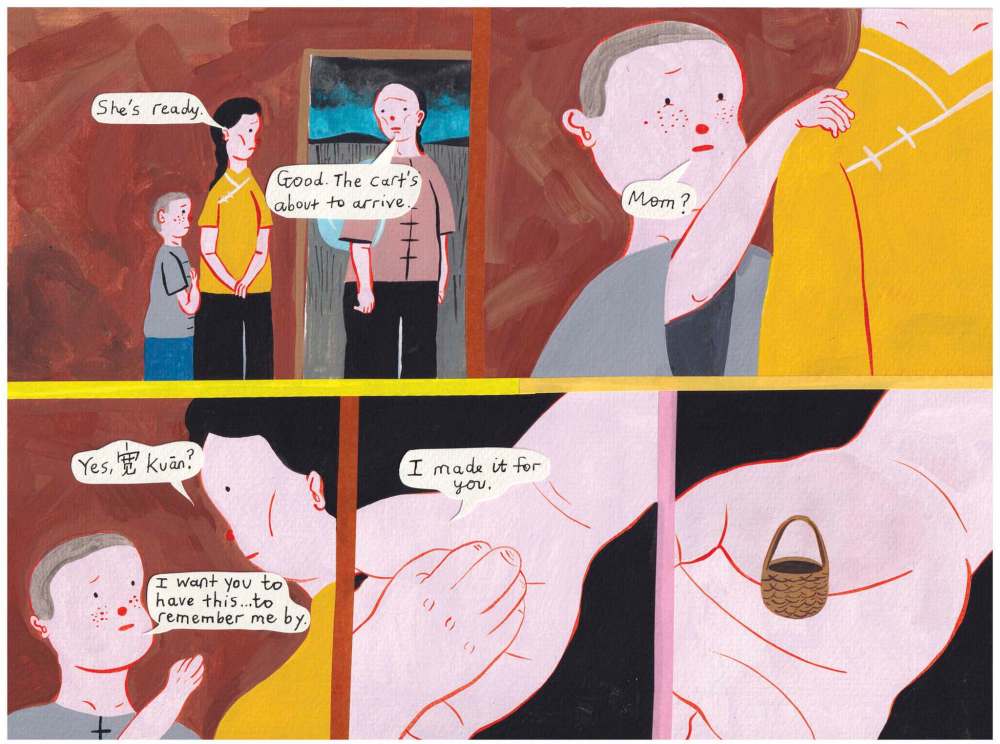
The women are all visual artists in some way, and this “quiet” medium allows for a covert form of resistance and self-expression amidst the pervasive attitude that it is better to be seen and not heard. The issue of women’s silence and struggle for agency bubbles under the book’s surface until a frustrated Bi, accused of rudeness by her mother, screams obscenities denouncing the importance of having “manners.” In contrast, she later remarks to Rita how Kuan likely “grew to quiet her voice, just so she could survive.”
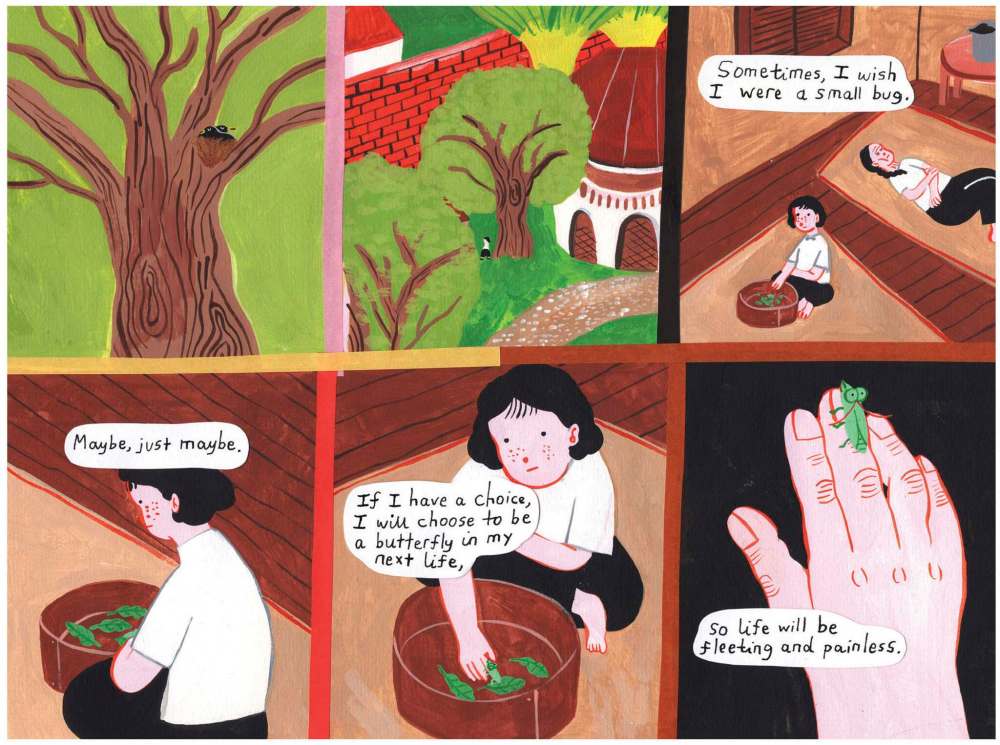
Instead of by voice, the women’s emotions emerge through visual art. This trait also serves as a thematic thread for Pixin, from Kuan and her baskets, to Mei’s embroidery on scrap fabric, to Bing’s painting classes, Bi’s cartooning and finally to Rita’s penchant for nature sketches.

Although Bi is the most vocally defiant, and Rita the most vocally curious, visual storytelling as a matrilineal coping mechanism is an apt metaphor here, especially given the medium of Pixin’s work.
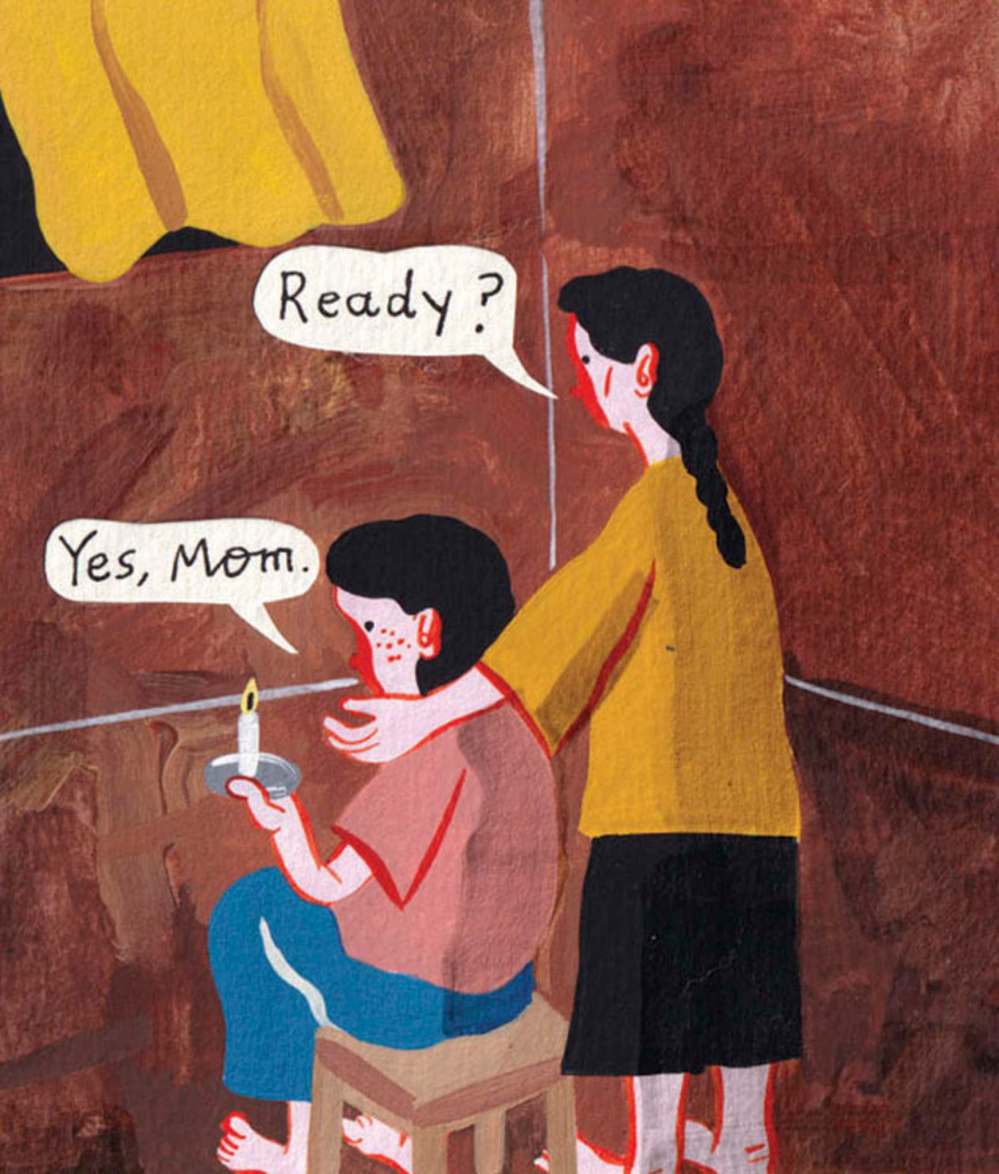
While filling in the gaps of her history, men are either absent, peripheral, serve as sources of conflict or trauma, or provide a bridge between the mothers and daughters. Kuan adopts Mei, an orphan, and her suitor disapproves, likely unaware of Kuan’s own experience of being separated from her family. Bing mourns an absent father, and has little time to pursue her painting owing to twin brothers frequently left in her care. Bi’s relationship with Bing is difficult, with Bi’s gentle father often serving as a mediator between the two. Rita remembers her grandfather fondly, and their brief scenes together are especially affecting.

For Pixin, there is hope amid “the missing pieces and stories,” as Let’s Not Talk Anymore crafts new bonds out of old family wounds by visually honouring the women who were not afforded the space to heal theirs.

Nyala Ali writes about race and gender in contemporary narratives.
Report Error Submit a Tip

More Stories

Manitoba Hydro’s energy plan set to be scrutinized

Chris Kitching 6 minute read Preview

Manitoba Hydro’s energy plan set to be scrutinized

Chris Kitching 6 minute read Yesterday at 6:00 AM CDT

Manitoba Hydro is set to face questions and concerns over its plan for the province’s future energy needs, which includes proposed natural gas-powered turbines in Brandon and Indigenous-owned wind farms.

The Public Utilities Board, an arm’s-length regulator, will begin six weeks of hearings Monday into the 10-year blueprint and potential ways to satisfy electricity demand, while Hydro grapples with a projected energy shortfall, debt of $25 billion and aging infrastructure.

“The development plan reflects the best available information and analysis of how Manitoba Hydro can meet growing energy demand, while balancing factors we know are important to our customers, including cost, reliability and the environment,” Peter Chura, a spokesman for the Crown corporation, told the Free Press.

“We are confident in our analysis and that we’ve appropriately balanced reliability, affordability, safety and risk.”

Read
Yesterday at 6:00 AM CDT

New councillors can bring new approach

Loren Remillard 5 minute read 2:00 AM CDT

Winnipeg city councillors John Orlikow (River Heights – Fort Garry), Janice Lukes (Waverley West), Brian Mayes (St. Vital), and Markus Chambers (St. Norbert — Seine River) recently announced they will not seek re-election on Oct. 28.

That guarantees new faces around the council table. It does not guarantee a new council culture and direction.

Four new councillors represent one quarter of the 16-member council chamber. They will vote on whether Winnipeg modernizes permitting, improves public safety, attracts investment and creates a more competitive business environment.

New councillors can open the door to new conversations, but only if they arrive at the door ready to think beyond ward boundaries and the next controversy. Only if they see a modern city council for what it is: the governing body of a multi-billion-dollar organization responsible for setting policy and providing direction to a professional administration that carries it out.

Letters, July 28

6 minute read Preview

Letters, July 28

6 minute read 2:00 AM CDT

Thank you for sharing the news of Blizzard’s passing. I walked the path (near the bison enclosure) many early mornings and was always compelled to say “Salaamelykun” (“Peace be with you’) to him. He would often walk to the wire fence, and we would just look at each other.

Read
2:00 AM CDT

RCMP searching for woman last seen in Winnipeg

1 minute read Yesterday at 2:04 PM CDT

Police are asking for help locating a 36-year-old woman missing for approximately 10 days.

Last seen on July 18, Dixie Richard was reported missing Saturday evening to Cross Lake RCMP, said a news release from Mounties Monday, with both police and her family concerned for her well-being. 

She was in Winnipeg for an appointment, but it’s unclear if she made it and nobody has seen her since, said RCMP. It’s believed she’s still in the city.

Richard is described as five-foot-one with a thin build and black hair. RCMP said she was last seen wearing a black tank top and leggings, black Nike shoes and had a black cross-body bag. She may also be wearing a black baseball hat.

Russia: home of Potemkin nuclear bombs?

Gwynne Dyer 5 minute read Preview

Russia: home of Potemkin nuclear bombs?

Gwynne Dyer 5 minute read 2:00 AM CDT

There’s a lot of performative militarism in Russia at the moment, which is unsurprising. given that the Russian invasion of Ukraine is still stalled halfway through the fifth year of the war. The style is more Mussolini than Hitler, however, and the effect is more tacky than terrifying.

Read
2:00 AM CDT

Anishinaabe Days teepee poles vandalized

Nicole Buffie 5 minute read Preview

Anishinaabe Days teepee poles vandalized

Nicole Buffie 5 minute read Sunday, Jul. 26, 2026

An act of vandalism to a teepee at the Treaty One Development Corp’s Anishinaabe Days did not stop the celebrations from continuing over the weekend.

Someone deliberately cut the poles used to erect the site’s teepee before the event began, Treaty One executive director Jason Whitford said Sunday.

The family responsible for overseeing the teepee and its construction at the site, Naawi-Oodena  on Kenaston Boulevard, went to the site on Friday to erect the teepee when they noticed someone had taken a saw and cut all 15 of its poles in half.

“They were stored in a safe place, and they were stored properly as per protocol,” Whitford said. “They were in an area where there was no construction so they were isolated from any activity.”

Read
Sunday, Jul. 26, 2026