

Online survey puts personal bias to test
Psychologist hopes to help average Joe examine, change unconscious tendencies

Advertisement
Read this article for free:
or
Already have an account? Log in here »
To continue reading, please subscribe:
Monthly Digital Subscription
$1 per week for 24 weeks*
- Enjoy unlimited reading on winnipegfreepress.com
- Read the E-Edition, our digital replica newspaper
- Access News Break, our award-winning app
- Play interactive puzzles
*Billed as $4.00 plus GST every four weeks. After 24 weeks, price increases to the regular rate of $19.95 plus GST every four weeks. Offer available to new and qualified returning subscribers only. Cancel any time.
Monthly Digital Subscription
$4.99/week*
- Enjoy unlimited reading on winnipegfreepress.com
- Read the E-Edition, our digital replica newspaper
- Access News Break, our award-winning app
- Play interactive puzzles
*Billed as $19.95 plus GST every four weeks. Cancel any time.
To continue reading, please subscribe:
Add Free Press access to your Brandon Sun subscription for only an additional
$1 for the first 4 weeks*
*Your next subscription payment will increase by $1.00 and you will be charged $16.99 plus GST for four weeks. After four weeks, your payment will increase to $23.99 plus GST every four weeks.
Read unlimited articles for free today:
or
Already have an account? Log in here »
Hey there, time traveller!
This article was published 25/09/2021 (1662 days ago), so information in it may no longer be current.
Picture this: four unfamiliar and diverse faces — each person dressed in clothes considered “typical” for their race, ethnicity, gender or religion — stare out from the screen. Users are asked a series of questions — such as which person is secretly royalty? — and are expected to answer on instinct alone.
The answer may not seem obvious — and that’s the point.
In a new online tool dubbed “Bias outside the box,” Winnipeg psychologist Dr. Rehman Abdulrehman hopes to push participants to examine their unconscious biases in an effort to shift the culture and people’s perspectives. The online tool has been adapted into an art exhibit for Nuit Blanche in Winnipeg this month.

“Being mindful of our biases is critically important to systemic change because we understand our role and our impact in those systems, and how our biases sustain those systems,” Abdulrehman said.
As a clinical and consulting psychologist, Abdulrehman said he works to illicit change in individuals, companies and organizations. He has spent the better part of the past year preparing an anonymous online tool with a range of portraits and questions designed to prompt users to discover their own biases.
“The issue of diversity, equity and inclusion is important to me very personally. As a former immigrant, as a person of colour, as a religious minority — and a Muslim, particularly — I face a great deal of discrimination,” Abdulrehman explained.
In his practice, he has noticed many people tackle diversity, equity and inclusion with a “tick-box” approach, where hiring choices and small issues become the central focus. While those measures can be temporarily helpful, Abdulrehman said sustainable change takes greater insight.
Racist behaviour can come in several forms. While some people may be overtly racist, he explained the subtle actions of “very well-meaning individuals” can be “much more psychologically impactful” to marginalized people.
“Those well-meaning people are perpetuating a lot of racist systems and ideologies,” he noted.
“Trauma is not just about the large burning crosses… but there’s an insidious element of bias that really causes people of colour and marginalized people to consistently doubt themselves. That’s what this is really about.”
Abdulrehman explained the first iteration of the diversity bias tool was presented to people of colour, who felt “uncomfortable” faced with their own biases and “internalized racism.”
Feedback from white people who have used the bias tool (participants are given the option to identify their ethnicity and race before starting the test) has taken a different tone, Abdulrehman said. Some said the tool “does not apply” to them because they are not racist. Some respondents have directed “ignorant” rhetoric at Abdulrehman.
“I get it — there’s a lot of tension. There’s a great fear of being labelled as a racist,” said Abdulrehman. “But what they don’t recognize is that when they stay quiet, people assume that the quietness means that they’re complicit.”
The test is directed at people who are willing to confront their biases and is unlikely to work for those who try to “beat” the test, or assert they have no bias.
“The hope is that this tool allows people to have a very private journey, and to come face to face with their biases,” he said.
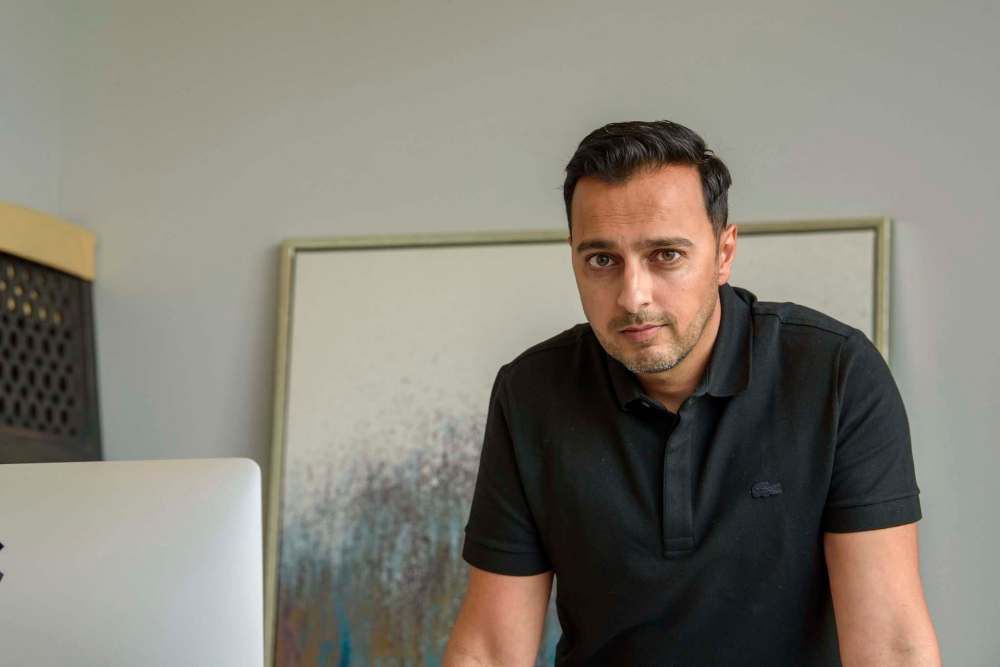
In an ad campaign focused primarily on LinkedIn, the bias test had more than 1,800 views in 36 hours, with responses from around the world, said Abdulrehman.
The project will remain up permanently as a teaching and anonymous data-collection tool.
During Nuit Blanche, which runs from Sept. 24 to Oct. 24, four displays across the city will portray at least one of the project’s portraits with the tagline ‘How do you see me?’ Abdulrehman explained.
Two banners will be featured at the downtown Robertson College, one will hang long-term at St. Boniface Hospital, the largest exhibit will be displayed at the Winnipeg Chamber of Commerce, and two will be displayed at Abdulrehman’s parents’ business: the Halal Meat Centre in West Broadway.

“It made sense to have a venue that reflected me,” he said, adding the store has been the target of systemic racism.
The photos will have a link to the online tool.
“Art is meant to change the way we think,” said Abdulrehman. “Part of my goal is to move Winnipeg from the most racist city to the most inclusive one.” He was referring to a Maclean’s magazine article in January 2015 that labelled the city the most racist in Canada.
julia-simone.rutgers@freepress.mb.ca
Twitter: @jsrutgers
Julia-Simone Rutgers is the Manitoba environment reporter for the Free Press and The Narwhal. She joined the Free Press in 2020, after completing a journalism degree at the University of King’s College in Halifax, and took on the environment beat in 2022. Read more about Julia-Simone.
Julia-Simone’s role is part of a partnership with The Narwhal, funded by the Winnipeg Foundation. Every piece of reporting Julia-Simone produces is reviewed by an editing team before it is posted online or published in print — part of the Free Press‘s tradition, since 1872, of producing reliable independent journalism. Read more about Free Press’s history and mandate, and learn how our newsroom operates.
Our newsroom depends on a growing audience of readers to power our journalism. If you are not a paid reader, please consider becoming a subscriber.
Our newsroom depends on its audience of readers to power our journalism. Thank you for your support.
Julia-Simone Rutgers is the Manitoba environment reporter for the Free Press and The Narwhal. She joined the Free Press in 2020, after completing a journalism degree at the University of King’s College in Halifax, and took on the environment beat in 2022. Read more about Julia-Simone.
Julia-Simone’s role is part of a partnership with The Narwhal, funded by the Winnipeg Foundation. Every piece of reporting Julia-Simone produces is reviewed by an editing team before it is posted online or published in print — part of the Free Press‘s tradition, since 1872, of producing reliable independent journalism. Read more about Free Press’s history and mandate, and learn how our newsroom operates.
Our newsroom depends on a growing audience of readers to power our journalism. If you are not a paid reader, please consider becoming a subscriber.
Our newsroom depends on its audience of readers to power our journalism. Thank you for your support.
Advertisement Advertise With Us
Advertisement Advertise With Us