Exacerbated by pandemic, child care crisis hampers economy

Advertisement

Advertise with us

SEATTLE (AP) — After Bryan Kang’s son was born in July, the occupational therapist and his wife, a teacher, started looking for child care in the Los Angeles area. The couple called eight day care centers: Some didn't have spots for months; others stopped taking their calls and some never answered at all.

Read this article for free:


or

Already have an account? Log in here »

To continue reading, please subscribe:

Subscribe and receive a limited-edition Free Press branded hat or tote.

Digital Subscription

One year of digital access for only $205*

  • Enjoy unlimited reading on winnipegfreepress.com
  • Read the E-Edition, our digital replica newspaper
  • Access News Break, our award-winning app
  • Play interactive puzzles

*First annual payment billed as $205.00 + GST for one year. This annual subscription will automatically renew at $233.00 + GST every 52 weeks (10% off the regular annual price of $259.35). Offer available to new and qualified returning subscribers only. Cancel any time.

To continue reading, please subscribe:

Add Free Press access to your Brandon Sun subscription for only an additional

$1 for the first 4 weeks*

  • Enjoy unlimited reading on winnipegfreepress.com
  • Read the E-Edition, our digital replica newspaper
  • Access News Break, our award-winning app
  • Play interactive puzzles
Start now

*Your next Brandon Sun subscription payment will increase by $1.00 and you will be charged $17.95 plus GST for four weeks. After four weeks, your payment will increase to $24.95 plus GST every four weeks.

Hey there, time traveller!
This article was published 27/10/2021 (1761 days ago), so information in it may no longer be current.

SEATTLE (AP) — After Bryan Kang’s son was born in July, the occupational therapist and his wife, a teacher, started looking for child care in the Los Angeles area. The couple called eight day care centers: Some didn’t have spots for months; others stopped taking their calls and some never answered at all.

So with no viable options, Kang scrambled to find a new job that would allow him to work remotely.

“I told my manager, ‘Hey, by the end of the month, I have to transition out,’” Kang said. “They were very supportive and very understanding because they’re all mothers. But now there’s one less body to see patients.”

Preschoolers eat lunch at a day care center, Monday, Oct. 25, 2021, in Mountlake Terrace, Wash. Child care centers once operated under the promise that it would always be there when parents have to work. Now, each teacher resignation, coronavirus exposure, and day care center closure reveals an industry on the brink, with wide-reaching implications for an entire economy's workforce. (AP Photo/Elaine Thompson)

Kang said he’s fortunate he found a job teaching online classes, but the unexpected career pivot forced him to take an 11% pay cut.

The truth is, even if he could find a day care spot for his now 3-month-old son, the $2,500 monthly cost of infant care is so high that taking a lower-paying job so he can work from home and care for the baby is the most financially sensible thing to do.

The child care business has for years operated in a broken, paradoxical market: low wages for workers and high costs for consumers. Yet the critical service somehow managed to limp along.

Now, the pandemic has made clear what many experts had long warned: The absence of reliable and affordable child care limits which jobs people can accept, makes it harder to climb the corporate ladder and ultimately restricts the ability of the broader economy to grow.

“Early learning is no longer seen as just a women’s issue or a children’s issue. It’s really seen as an economic issue. It’s about workforce participation,” said Mario Cardona, policy chief for Child Care Aware of America. “It’s about employers who don’t have to worry about whether they’ll be able to rely upon employees.”

Child Care Aware estimates 9% of licensed child care programs have permanently closed since the pandemic began, based on its tally of nearly 16,000 shuttered centers and in-home day cares in 37 states between December 2019 and March 2021.

Now, each teacher resignation, coronavirus exposure and day care closure reveals an industry on the brink, with wide-reaching implications for an entire economy’s workforce.

The national crisis has forced many people — mostly women — to leave their jobs, reshaping the child care crisis as not just a problem for parents of young children, but also anyone who depends on them. It has contributed to a labor shortage, which in turn has hurt businesses and made it more difficult for customers to access goods and services.
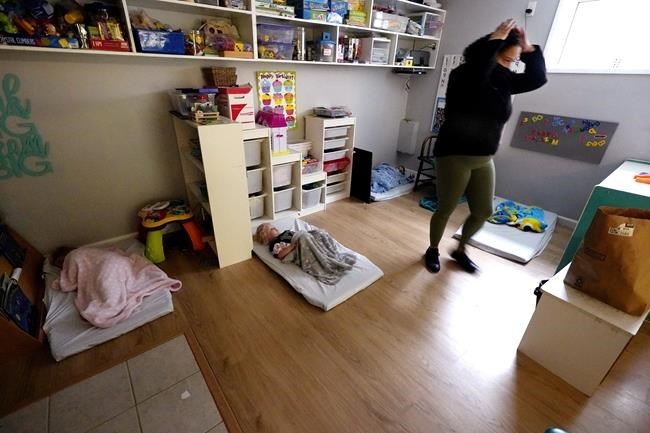
Teacher's assistant Brooklynn Bailey, right, walks away after tucking a child in for a nap behind at Forever Young Daycare facility, Monday, Oct. 25, 2021, in Mountlake Terrace, Wash. Child care centers once operated under the promise that it would always be there when parents have to work. Now, each teacher resignation, coronavirus exposure, and day care center closure reveals an industry on the brink, with wide-reaching implications for an entire economy's workforce. (AP Photo/Elaine Thompson)

“The decisions we make about the availability of child care today will shape the U.S. macroeconomy for decades to come by influencing who returns to work, what types of jobs parents take and the career path they are able to follow,” said Betsey Stevenson, an economist at the University of Michigan.

President Joe Biden has pledged an unprecedented burst of federal spending in hopes of fixing the child care market. At a recent town hall in Baltimore, he assured parents they would “not have to pay more than 7% of your income for child care.” Federal money would go directly to care centers to cover costs in excess of the 7% cap. This means the median U.S. family earning $86,372 would pay $6,046 annually for child care.

Biden’s plan also includes universal pre-kindergarten, which could further reduce child care expenses for families. The expanded monthly payments from the child tax credit approved in Biden’s $1.9 trillion coronavirus relief package would be extended for another year. The president also proposed increasing the size of a tax credit for the cost of child care, all of which should help improve access for families.

The Congressional Budget Office has yet to score the costs as the measures are still being negotiated ahead of Biden’s departure Thursday for the G-20 conference in Rome. But Donald Schneider, a former chief economist for the House Ways and Means Committee who now works for the consultancy Cornerstone Macro, estimates the child care and pre-kindergarten support would cost $465 billion over 10 years. The one-year price-tag of the expanded child tax credit would be around $120 billion. The credit would cost an additional $940 billion if renewed for nine more years.

It remains to be seen what survives in the brutal negotiations in Congress for Biden’s broad family services agenda, but the pandemic is proving to be a make-or-break catalyst for the future of the child care industry.

At Forever Young Daycare in the Seattle suburb of Mountlake Terrace, Amy McCoy is burning out fast.

She’s spent half of this year trying to hire a new assistant for her in-home child care, but until then, the former public school teacher works 50 hours a week caring for children herself, and more doing the cooking, cleaning and administrative work needed to run her business.
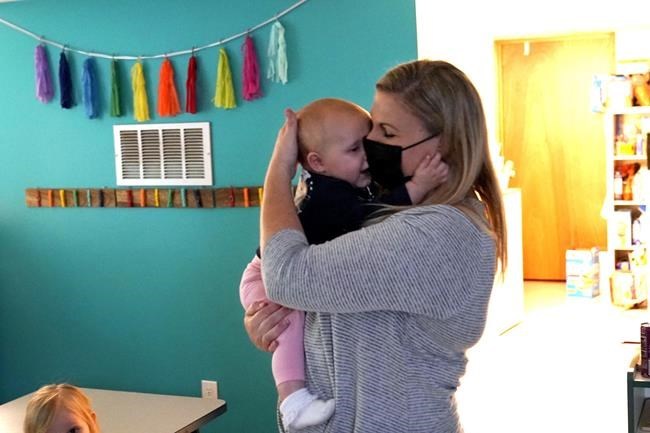
Amy McCoy cuddles a seven-month old baby at her Forever Young Daycare facility, Monday, Oct. 25, 2021, in Mountlake Terrace, Wash. Child care centers once operated under the promise that it would always be there when parents have to work. Now, each teacher resignation, coronavirus exposure, and day care center closure reveals an industry on the brink, with wide-reaching implications for an entire economy's workforce. (AP Photo/Elaine Thompson)

“At what point is my day care more important than my own family?” McCoy asked.

One of McCoy’s assistants, who worked there for five years, quit the $19-an-hour job in April for a $35-an-hour job nannying. McCoy has posted the opening for an entry-level assistant on Indeed and Facebook, offering $16 per hour — nearly 20% more than the state minimum wage. She’s gotten few responses and all turned her down over pay, making hiring impossible without a tuition increase.

“Nobody wants to work for what I can afford to pay right now,” McCoy said. “I absolutely believe these are $20-an-hour employees, but I hate that, most likely, I will have to raise tuition.”

The U.S. Treasury Department noted in a September report that child care workers earn on average $24,230. More than 15% of the industry’s workers live below the poverty line in 41 states and half need public assistance. The sector has high levels of turnover, with 26% to 40% leaving their job each year. Nor is there much room to give among child care centers that tend to operate on profits of 1% or less.

In nearby Edmonds, Briana McFadden shuttered her business, Cocoon Child Care Center, last month due to the stress of the pandemic, though McFadden thinks she would have stayed open if there were government subsidies to stabilize the industry.

In 12 years in business, McFadden said she never raised tuition and was the rare day care in the affluent northern Seattle suburbs to accept low-income families on a state subsidy. In pre-pandemic times, Cocoon employed seven people to care for 37 children. Now McFadden plans to open a convenience store.

“It really wasn’t worth it to continue,” McFadden said, her voice quivering with emotion. “Day care is a hard business.”

Tatum Russell’s livelihood depended as much on McFadden’s day care as the restaurant that employs her to hand-bread seafood.
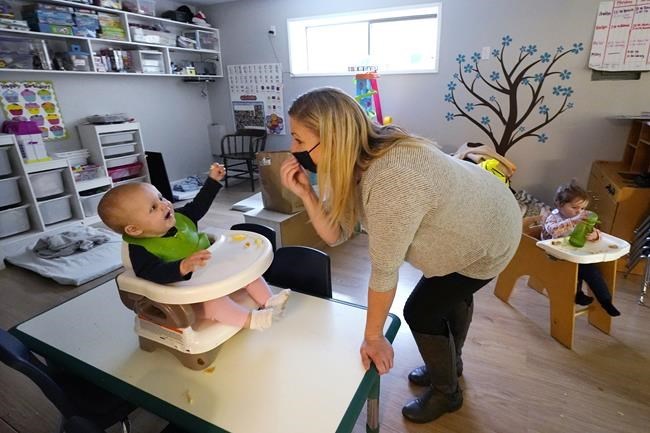
Amy McCoy signs to a baby about food as a toddler finishes lunch behind at her Forever Young Daycare facility, Monday, Oct. 25, 2021, in Mountlake Terrace, Wash. Child care centers once operated under the promise that it would always be there when parents have to work. Now, each teacher resignation, coronavirus exposure, and day care center closure reveals an industry on the brink, with wide-reaching implications for an entire economy's workforce. (AP Photo/Elaine Thompson)

During a COVID-19-related day care closure in August, the single mom could only stitch together help from relatives for some of the time. Russell ultimately had to miss four days of work.

“It’s been a nightmare, and it’s not over,” Russell said.

___

Boak reported from Washington, D.C.

Report Error Submit a Tip

More Stories

Today’s horoscope

Georgia Nicols 4 minute read Preview

Today’s horoscope

Georgia Nicols 4 minute read 2:00 AM CDT

Moon Alert: Until 11 p.m. PDT tonight there are no restrictions to shopping or important decisions today. The Moon is in Capricorn.

Aries (March 21-April 19)

Steer clear of confrontation with authority figures this morning. Instead, get yourself ready for a productive four weeks ahead because you intend to work and get better organized. Oh yeah – you’re going to pull your act together so you can take it on the road.

Taurus (April 20-May 20)

Read
2:00 AM CDT

Provincial teacher watchdog releases names, details in three disciplinary matters

Maggie Macintosh 6 minute read Preview

Provincial teacher watchdog releases names, details in three disciplinary matters

Maggie Macintosh 6 minute read Friday, Aug. 21, 2026

An Interlake teacher with a history of “intimidating” outbursts has been ordered to participate in counselling and study anger-management strategies after he made a child cry.

Read
Friday, Aug. 21, 2026

Residents fear mailbox crime sprees

Morgan Modjeski 4 minute read Preview

Residents fear mailbox crime sprees

Morgan Modjeski 4 minute read Yesterday at 2:01 AM CDT

Some North End residents are concerned new community mailboxes will become a target for vandalism and crime after the base of one was recently lit ablaze — before it was even installed.

The community mailboxes started to show up on Andrews Street within the last two weeks. Some have been installed, while at other locations, only the concrete foundation is in place.

“They just dumped them on the boulevard,” said Stephen Giesbrecht, who lives beside one of the boxes in the St. John’s neighbourhood. “They dumped them on the corner and then they were gone.”

One of the concrete slabs has already played host to a fire and some of the hardware needed to install the mailbox melted.

Read
Yesterday at 2:01 AM CDT

Plenty of alternatives to U.S. wines on the shelves

Ben Sigurdson 5 minute read Preview

Plenty of alternatives to U.S. wines on the shelves

Ben Sigurdson 5 minute read Yesterday at 6:00 AM CDT

In February 2025, Manitoba (and most other provinces) pulled American liquor from store shelves as part of the ongoing trade dispute with the United States.

Then in December, the province followed a similar course to others and put American booze that was already on hand back on shelves, selling off inventory that had been wasting away in warehouses for months, and directing proceeds from those sales to charities.

Lineups sprung up at numerous stores as consumers snapped up bestselling American products — think Maker’s Mark, Jack Daniel’s, Apothic Red and the like. After that initial rush, what was left has been languishing on shelves ever since, with many products eventually being drastically discounted for a quick sale, lest they become too long in the tooth.

I decided early on not to write about/review U.S. products in this space until things were well and truly sorted. But a few months back, I found myself in the mood for a big, oaky red wine and — in a moment of weakness, or nostalgia, or maybe just curiosity — I picked up a $30-ish California Cabernet Sauvignon.

Read
Yesterday at 6:00 AM CDT

ER wait times have hit all-time highs in Winnipeg and are impacting nearly all aspects of hospital operations

Tom Brodbeck 17 minute read Preview

ER wait times have hit all-time highs in Winnipeg and are impacting nearly all aspects of hospital operations

Tom Brodbeck 17 minute read Friday, Aug. 21, 2026

On most days at Health Sciences Centre’s adult emergency department, all 58 treatment beds are filled with sick patients. Another dozen or so brought in by ambulance line the hallways on stretchers, with only one nurse to look after them.

Out in the waiting room, about 30 or 40 people — sometimes more — are slouched in chairs in pain or discomfort, waiting hours to see a doctor. Most have been assessed by a triage nurse, but many will have to wait 10 to 20 hours to be examined by a physician because there’s no room for them in the treatment area.

Some patients leave because they can no longer tolerate the excruciating wait, only to return days later, sicker than they were before.

Welcome to the emergency department at Manitoba’s largest hospital, where some of the highest-acuity patients seek medical care but now face delays that were unimaginable a few years ago.

Read
Friday, Aug. 21, 2026

BigXThaPlug misses Country Rising appearance after arrest

1 minute read Yesterday at 12:05 PM CDT

Country-rap headliner BigXThaPlug, scheduled to appear at the third annual Country Rising festival at Blue Cross Park on Friday, missed performing at the festival after being arrested on drug charges in Texas earlier in the day.

According to Dallas’s KDFW, the performer, born Xavier Landum, was arrested by the Allen Police Department and booked into the Collin County Jail on Friday.

The jail’s website states Landum was charged with driving while intoxicated, marijuana possession of less than two ounces, and unlawful possession of a firearm.