

In really bad company
Blue Bombers' 45-0 beatdown of Lions last weekend sends longtime B.C. fan down sports rabbit hole in search of comfort from other legendary losers
Advertisement
Read this article for free:
or
Already have an account? Log in here »
To continue reading, please subscribe:
Monthly Digital Subscription
$1 per week for 24 weeks*
- Enjoy unlimited reading on winnipegfreepress.com
- Read the E-Edition, our digital replica newspaper
- Access News Break, our award-winning app
- Play interactive puzzles
*Billed as $4.00 plus GST every four weeks. After 24 weeks, price increases to the regular rate of $19.95 plus GST every four weeks. Offer available to new and qualified returning subscribers only. Cancel any time.
Monthly Digital Subscription
$4.99/week*
- Enjoy unlimited reading on winnipegfreepress.com
- Read the E-Edition, our digital replica newspaper
- Access News Break, our award-winning app
- Play interactive puzzles
*Billed as $19.95 plus GST every four weeks. Cancel any time.
To continue reading, please subscribe:
Add Free Press access to your Brandon Sun subscription for only an additional
$1 for the first 4 weeks*
*Your next subscription payment will increase by $1.00 and you will be charged $16.99 plus GST for four weeks. After four weeks, your payment will increase to $23.99 plus GST every four weeks.
Read unlimited articles for free today:
or
Already have an account? Log in here »
Hey there, time traveller!
This article was published 30/10/2021 (1618 days ago), so information in it may no longer be current.
Demolished. Dismantled. Destroyed. Humbled. Crushed. Trounced. Humiliated. Pulverized. Annihilated. Flattened. Obliterated. Clobbered. Walloped. Mangled. Massacred.
There are a lot of words that describe what happened to the B.C. Lions last Saturday night when they tangled with the Blue Bombers at IG Field, but the most telling would be the final score: Bombers 45, Lions 0.
The defending Grey Cup-champion Bombers played as close to a perfect game as you’ll ever see, scoring touchdowns on offence, defence and special teams, whereas the Lions… well, not so much.
The Bombers’ performance was so impressive it was almost an afterthought that the victory means they will host a division final for the first time since 2011 when they won the East. It’s the first time Winnipeg will be the site of a West Division final since 1972.
For the Lions, it was the first time the team had been shut out in 51 years — a 29-0 loss at Calgary on Oct. 25, 1970 — and the 12th time overall in franchise history the team has been blanked in a CFL contest.
B.C. QB Michael Reilly agreed with the suggestion that the Lions have hit rock-bottom, adding that only “time will tell” whether things can get even worse.
Technically, it wasn’t the biggest blowout in CFL history; on Oct. 20, 1956, the Hamilton Tiger-Cats were drubbed 82-14 by the Montreal Alouettes.
The lacklustre Lions can take cold comfort in the fact they are in good company, as we see from today’s high-scoring list of Five of the Biggest Blowouts in Sports History:
5) The matchup: Chicago Bears vs. Washington Redskins, NFL Championship, Dec. 8, 1940
The margin of victory: Chicago 73, Washington 0
The blowout: What we are talking about here is the largest margin of defeat in the history of the National Football League.
Three weeks before the championship, Washington had defeated Chicago 7-3 in a regular-season squeaker. After the game, Washington owner George Preston Marshall famously told reporters that Bears coach George Halas and his team were “quitters” and “crybabies” when the going got tough.
A furious Halas used Marshall’s words to galvanize his players, and the Bears scored 78 points in their next two games to set up a showdown with Washington in the league’s championship game on Dec. 8. Going into the final in front of 36,034 fans, Washington had the better record (9-2) compared to the Bears (8-3).
Just to set the scene, the game marked the last time that an NFL player (Bears end Dick Plasman) played without a helmet. Less than a minute into the game, Bears’ running back Bill Osmanski ran 68 yards for the first touchdown. On the next series, Washington quarterback Sammy Baugh appeared to connect with Charlie Malone for a 35-yard touchdown pass, but Malone dropped the ball, and Washington missed a subsequent field-goal attempt.
Asked after the game if the outcome would’ve been different had Malone not dropped that first-quarter pass, Baugh is said to have quipped, “Sure, it would’ve been 73-7.” Chicago racked up 45 of its points in the second half in the most lopsided game in NFL history.
Here is arguably the most telling statistic of how dominant the Bears were — the game had to be completed using practice balls after the Bears kicked all the game balls into the grandstands on extra points.

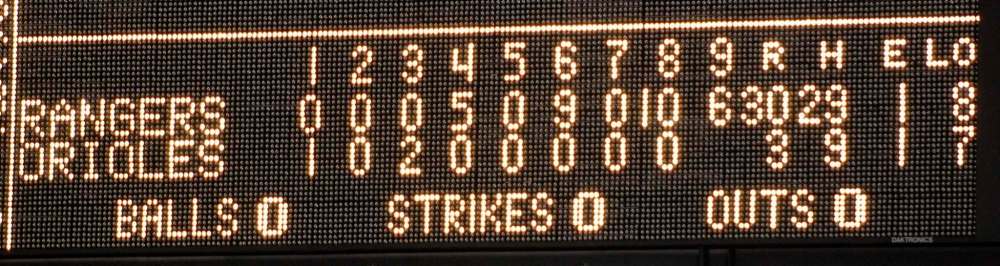
4) The matchup: Texas Rangers vs. Baltimore Orioles, Oriole Park, Aug. 22, 2007
The margin of victory: Texas 30, Baltimore 3
The blowout: Fourteen years later, it’s considered one of the most incredible — and unlikely — games in Major League Baseball history.
The one-sided final score was wild, but even stranger was the unlikely cast of characters that made it happen. On a humid August evening in Baltimore on Aug. 22, 2007, the visiting Rangers crushed the Orioles, 30–3, setting a modern-era record for most runs in a single game and biggest blowout. For those of you who don’t do math, that’s a 27-run differential.
It was only the ninth time in history a team had reached 30 runs, and it hadn’t happened since the Chicago Colts beat the Louisville Colonels, 36–7, in 1897. The Rangers became the first team in 110 years to score 30 runs in a game, setting an American League record. “All 30 of Texas’ runs were scored in the fourth inning or later as the Rangers trailed 3-0 after three innings.
Even more remarkable was the fact that the Orioles never had a position player pitch in the later stages of the game after going down by double-digit runs,” according to MLB.com. The Rangers weren’t powered to 30 runs by all-stars, but because their eighth and ninth hitters — Jarrod Saltalamacchia and Ramon Vazquez — each knocked two homers and drove in seven runs.
A few years ago, Vazquez’s then-11-year-old son, Nomar, came across a video of that game. “He was like, ‘I found a video of you hitting two home runs, and one of them made the score 30–3,’” Vazquez told Sports Illustrated. “Then he says, ‘I showed my buddies at school, and they don’t believe it’s you.’”
Or as Freddie Bynum, who played shortstop and left field for the Orioles that day, said: “You’re asking like, man, do they have a mercy rule? You know there ain’t, but you’re hoping for one.”
3) The matchup: Tiger Woods vs. Everyone Else, 2000 U.S. Open, June 15-18, Pebble Beach (Calif.) Golf Links
The margin of victory: Tiger won by 15 strokes
The blowout: In 2000, in the 100th edition of the U.S. Open, in his 100th tournament as a professional, Tiger Woods powered a 7-iron from 205 yards out of thick rough — over a tree and Stillwater Cove, no less — onto the par-5 sixth green for a two-putt birdie in the second round.
The miraculous shot prompted broadcaster Roger Maltbie to proclaim: “It’s just not a fair fight!”
Maltbie could not have been more right. It was the least fair fight in the history of golf. Woods, all of 24, left onlookers and his competitors in awe at Pebble Beach.
“Woods won his first U.S. Open by decimating the rest of the field by 15 strokes. Woods finished at 12-under and his closest competitors were three-over, causing many to wonder if they were playing in two different tournaments,” noted stacker.com. “The margin of victory is a record that holds to this day and is considered the most dominant performance in major championship history.”
While Tiger was 12 under — with rounds of 65-69-71-67 — the rest of the field was a combined 1,917 strokes over par. Tiger’s historic margin of victory — Miguel Angel Jimenez and Ernie Els tied for second at three-over — broke the record for a major that was set during the Civil War, when Old Tom Morris beat just seven players by 13 shots in the 1862 British Open.
“What he did at Pebble Beach is still the greatest performance in golf of all time,” five-time major champion Phil Mickelson, who tied for 16th that year, told Golfweek magazine.
“That’s a once-in-a-lifetime sort of performance,” four-time major champion Rory McIlroy, who was playing a junior golf tournament in the States at the time and watched as much of the U.S. Open as he could, told Golfweek. “I don’t think something like that’s going to happen again.”
In the year 2000, Woods also won the Masters and The Open Championship, along with six additional PGA events. “If you want to watch a guy win the U.S. Open playing perfectly, you’ve just seen it this week,” Els, Woods’ final-round partner, said of Tiger’s blowout win in 2000.
2) The matchup: Detroit Red Wings vs. New York Rangers, Jan 23, 1944, Olympia Stadium
The margin of victory: Red Wings 15, Rangers 0
The blowout: Winnipeg hockey fans have seen their Jets take a few beatings over the years, but they’ve never seen anything like what happened on Jan. 23, 1944, in Detroit’s Olympia Stadium.
That was the night the Rangers made hockey history in the worst way, losing 15-0 to the hometown Red Wings in the most one-sided game in NHL history. The Red Wings also broke another record by becoming the first team in history to score 15 consecutive goals in a game.
“The biggest blowout in NHL history could have been worse — a shot went into the Rangers’ net just after the horn sounded… the Red Wings’ eight third-period goals were one shy of the Rangers’ shot total for the entire game,” gushes ESPN.com.
The game took place during the Second World War, a time when NHL rosters were weakened because so many players were serving in the military, but the blowout still is hard for hockey fans to wrap their heads around. The Rangers arrived in Detroit that night with one of the most wretched records in hockey history. By the end of that season, they would win only six games, tie another five and lose 39, whereas the Wings had a decent team by wartime standards.
While Rangers goalie Ken McAuley, a former truant officer from Saskatchewan, missed 15 shots, he made 43 saves. Detroit’s rookie goalie, Connie Dion, had an easier time, making only nine saves for his first NHL shutout.
In a 1972 interview with Sports Illustrated, McAuley took a philosophic view of taking the worst shellacking of any NHL goalie. “I ask people when they remind me of that night, ‘Where would the Detroit Red Wings have been without me? I gave them the confidence to become big stars.’” At the end of the game, someone took out the scoring light and gave it to McAuley. It was his best stop of the night.
1) The matchup: Secretariat vs. The Rest of the Field, June 9, 1973, Belmont Park, Elmont, N.Y.
The margin of victory: “Big Red” won by 31 lengths
The blowout: Yes, we are talking about a horse, but WHAT a horse! Nicknamed “Big Red,” Secretariat was arguably the greatest — and certainly most famous — thoroughbred racehorse of all time.
In 2010, his legendary career was chronicled in the Hollywood film Secretariat, wherein Diane Lane portrayed plucky owner Penny Chenery. In a career that spanned only 16 months, Secretariat started 21 times, won 16 and finished in the money in all but his first race. By the time he went to stud, he had won back-to-back Horse of the Year awards.
But the true measure of this horse’s greatness is what he did on June 9, 1973. It was a warm sunny day and Secretariat was facing off against four other horses, including his arch-rival Sham, in the Belmont Stakes, the third leg of the famed Triple Crown, which includes the Kentucky Derby and the Preakness. Secretariat was a 1-10 favourite to win the race and become the first Triple Crown champion in 25 years.
In the big race, Secretariat and Sham broke together, but in the backstretch, Secretariat made the biggest move in Triple Crown history.
“Secretariat is alone. He is moving like a tremendous machine!” track announcer Chic Anderson famously yelled. “He’s going to be the Triple Crown winner. Unbelievable! An amazing performance. He’s 25 lengths in front!”
In what is arguably one of the greatest displays of dominance in the history of sports — in other words, a blowout — three-year-old Secretariat didn’t just beat the competition — he demolished them. Secretariat won by an astounding 31 lengths, almost an entire football field, breaking Count Fleet’s 1943 mark of 25 lengths. His time of 2:24 remains a world record for 1.5 miles on a dirt track.
“But most impressive was the 31-length gap. It was so big, even the widest angle of the CBS camera covering the stretch run could barely show Secretariat in the same shot as the next-nearest horse, Twice A Prince,” ESPN.com notes. Secretariat still holds the speed records for all the Triple Crown races.
Declares BleacherReport.com: “Secretariat’s record margin of victory in the Belmont Stakes has never been approached, nor will it ever. Big Red remains one of the greatest racehorses of all time.”
doug.speirs@freepress.mb.ca
