Out of time: Climate talks go past deadline over coal, cash

Advertisement

Advertise with us

GLASGOW, Scotland (AP) — Going into overtime Friday night, negotiators at U.N. climate talks in Glasgow were still trying to find common ground on phasing out coal, when nations need to update their emission-cutting pledges and, especially, on money.

Read this article for free:


or

Already have an account? Log in here »

To continue reading, please subscribe:

Subscribe and receive a limited-edition Free Press branded hat or tote.

Digital Subscription

One year of digital access for only $205*

  • Enjoy unlimited reading on winnipegfreepress.com
  • Read the E-Edition, our digital replica newspaper
  • Access News Break, our award-winning app
  • Play interactive puzzles

*First annual payment billed as $205.00 + GST for one year. This annual subscription will automatically renew at $233.00 + GST every 52 weeks (10% off the regular annual price of $259.35). Offer available to new and qualified returning subscribers only. Cancel any time.

To continue reading, please subscribe:

Add Free Press access to your Brandon Sun subscription for only an additional

$1 for the first 4 weeks*

  • Enjoy unlimited reading on winnipegfreepress.com
  • Read the E-Edition, our digital replica newspaper
  • Access News Break, our award-winning app
  • Play interactive puzzles
Start now

*Your next Brandon Sun subscription payment will increase by $1.00 and you will be charged $17.95 plus GST for four weeks. After four weeks, your payment will increase to $24.95 plus GST every four weeks.

Hey there, time traveller!
This article was published 12/11/2021 (1746 days ago), so information in it may no longer be current.

GLASGOW, Scotland (AP) — Going into overtime Friday night, negotiators at U.N. climate talks in Glasgow were still trying to find common ground on phasing out coal, when nations need to update their emission-cutting pledges and, especially, on money.

Talks are at a “bit of a stalemate,” and the United States, with support from the European Union, is holding back talks, said Lee White, the Gabonese minister for forests and climate change.

Mohamed Adow of Power Shift Africa, a long-time talks observer, said poorer nations are beyond disappointed with the way the United Kingdom presidency has come up with drafts and that this has become “a rich world” negotiation. He said poorer nations cannot accept what has been proposed.
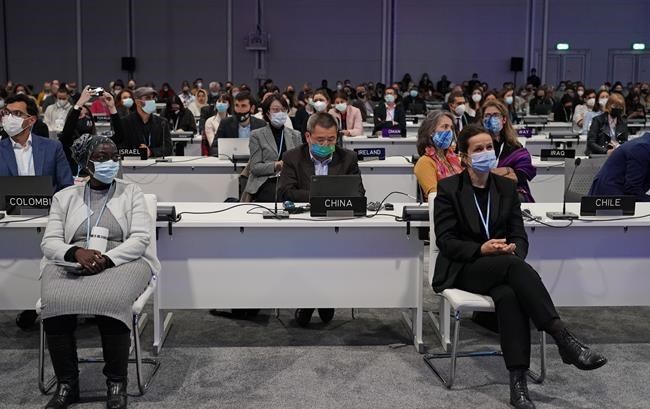
Delegates pack the hall at the COP26 U.N. Climate Summit in Glasgow, Scotland, Thursday, Nov. 11, 2021. (AP Photo/Alberto Pezzali)

As the talks approached midnight, rich nations had a much more optimistic view, showing the split that might occur after new drafts appear Saturday.

United Kingdom Prime Minister Boris Johnson, host of the meeting, said through a spokesperson that he believes “an ambitious outcome is in sight.”

U.S. Climate Envoy John Kerry told The Associated Press on Friday night that climate talks were “working away,” commenting after a late night meeting with his Chinese counterpart and before a hallway chat with India’s minister.

Chinese Climate Envoy Xie Zhenhua told Kerry in the hallway: “I think the current draft is more close” in a conversation that AP witnessed. When Kerry asked him if he felt better about it, Xie answered: “Yes, I feel better about it because Alok Sharma is a smart guy.”

No agreement was ready by the 6 p.m. local time scheduled end of the conference. And sometimes that helps diplomats get in a more deal-making mood.
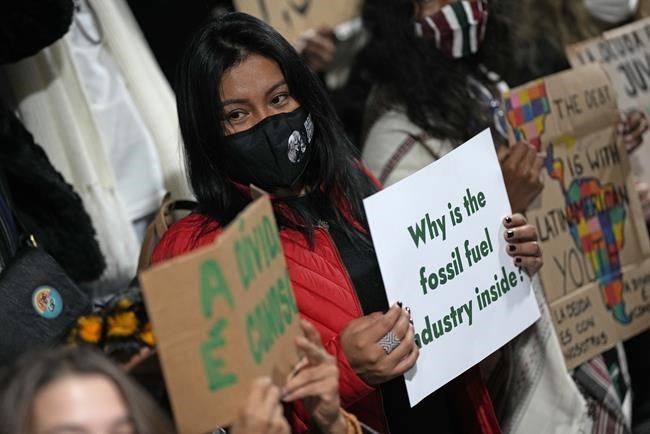
Youth climate activists protest that representatives of the fossil fuel industry have been allowed inside the venue during the COP26 U.N. Climate Summit in Glasgow, Scotland, Thursday, Nov. 11, 2021. (AP Photo/Alastair Grant)

“The negotiating culture is not to make the hard compromises until the meeting goes into extra innings, as we now have done,” said long-time climate talks observer Alden Meyer of the European think tank E3G. “But the U.K. presidency is still going to have to make a lot of people somewhat unhappy to get the comprehensive agreement we need out of Glasgow.”

Three sticking points were making people unhappy on Friday: cash, coal and timing.

A crunch issue is the question of financial aid for poor countries to cope with climate change. Rich nations failed to provide them with $100 billion annually by 2020, as agreed, causing considerable anger among developing countries going into the talks.

A Friday morning draft reflects those concerns, expressing “deep regret” that the $100 billion goal hasn’t been met and urging rich countries to scale up their funding for poor nations to reduce emissions and adapt to climate change — an issue with which developed countries are also grappling.

Poorer nations say regret isn’t enough.
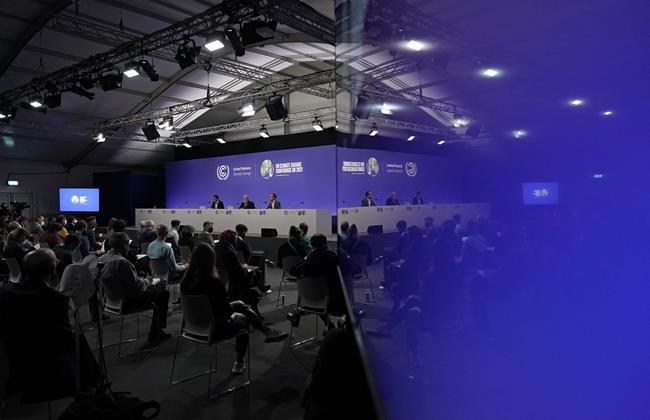
European Commissioner for European Green Deal Frans Timmermans, center, speaks during a press conference by the EU at the COP26 U.N. Climate Summit in Glasgow, Scotland, Thursday, Nov. 11, 2021. (AP Photo/Alberto Pezzali)

“Don’t call them donor countries. They’re polluters. They owe this money,” said Saleemul Huq, a climate science and policy expert who is director of the International Centre for Climate Change and Development in Bangladesh.

The draft also proposes creating a loss-and-damage fund to help poor countries tap existing sources of aid when they face the devastating impacts of climate change. But rich nations such as the United States, which have historically been the biggest source of human-caused greenhouse gas emissions, are opposed to any legal obligation to compensate poor countries.

But Gabon’s White said rich countries, particularly the United States and the European Union, had said they weren’t ready. “They said we never agreed to that. It won’t work. It’s too complicated.”

The proposal for creating this mechanism is like creating a bank account, said Adow of Power Shift Africa. “We don’t need to push cash into the account now. It is just the opening of the account.”

This was the “elephant in the room,” said Lia Nicholson, lead negotiator for the alliance of small islands at the summit. She said that developing nations and China had a “united position” on this but the proposal hadn’t met with “significant pushback” from rich countries.
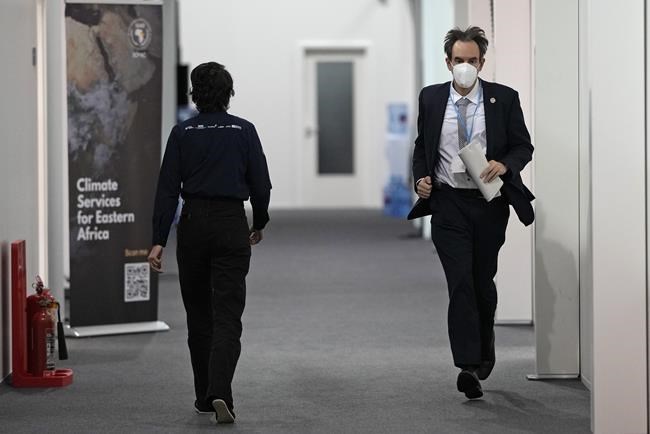
Luxembourg negotiator Andrew Ferrone runs inside the venue of the COP26 U.N. Climate Summit in Glasgow, Scotland, Friday, Nov. 12, 2021. Negotiators from almost 200 nations were making a fresh push Friday to reach agreements on a series of key issues that would allow them to call this year's U.N. climate talks a success. (AP Photo/Alastair Grant)

“Small islands can’t always be the ones who are asked to compromise our interest with the objectives of reaching consensus,” she said.

That Friday draft also called on countries to accelerate “the phaseout of unabated coal power and of inefficient subsidies for fossil fuels.”

A previous draft Wednesday had been stronger, calling on countries to “accelerate the phasing out of coal and subsidies for fossil fuel.”

Kerry said Washington backed the current wording. “We’re not talking about eliminating” coal, he told fellow climate diplomats. But, he said: “Those subsidies have to go.”

Kerry said it was “a definition of insanity” that trillions were being spent to subsidize fossil fuels worldwide. “We’re allowing to feed the very problem we’re here to try to cure. It doesn’t make sense.”
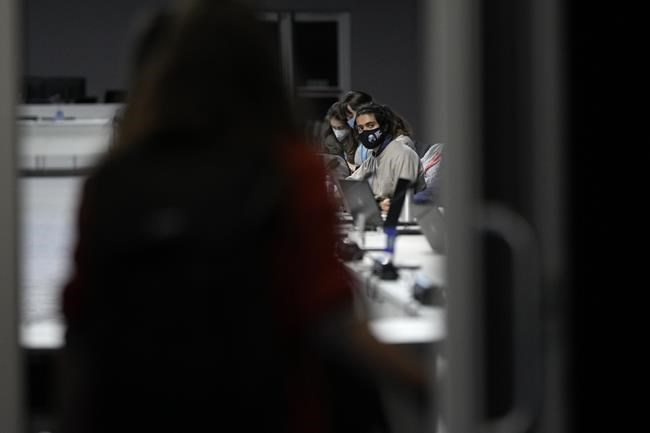
Delegates gather inside the venue of the COP26 U.N. Climate Summit in Glasgow, Scotland, Friday, Nov. 12, 2021. Negotiators from almost 200 nations were making a fresh push Friday to reach agreements on a series of key issues that would allow them to call this year's U.N. climate talks a success. (AP Photo/Alastair Grant)

But there was a mixed response from activists and observers on how significant the addition of the words “unabated” and “inefficient” was.

Richie Merzian, a former Australian climate negotiator who directs the climate and energy program at the Australia Institute think tank, said the additional caveats were “enough that you can run a coal train through it.”

Countries like Australia and India, the world’s third-biggest emitter, have resisted calls to phase out coal any time soon.

Scientists agree it is necessary to end the use of fossil fuels as soon as possible to meet the 2015 Paris accord’s ambitious goal of capping global warming at 1.5 degrees Celsius (2.7 Fahrenheit). But explicitly including such a call in the overarching declaration is politically sensitive, including for countries, such as Saudi Arabia, that fear oil and gas may be targeted next.

Another issue from Friday morning’s draft concerns when nations have to come back with new emission-cutting targets which they were supposed to submit before the Glasgow talks. Because the pledges weren’t enough, the draft calls on the nations to submit another tougher target by the end of 2022, but some nations, such as Saudi Arabia, are balking about this said World Resources Institute’s David Waskow.
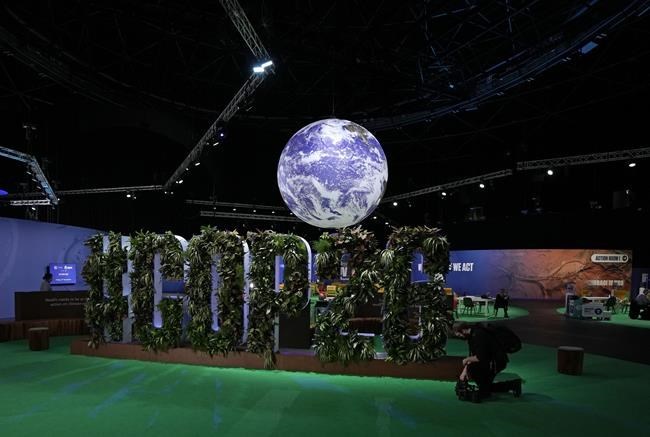
People start to gather near the Action Zone inside the venue of the COP26 U.N. Climate Summit in Glasgow, Scotland, Friday, Nov. 12, 2021. Negotiators from almost 200 nations were making a fresh push Friday to reach agreements on a series of key issues that would allow them to call this year's U.N. climate talks a success. (AP Photo/Alastair Grant)

In 2015 in Paris, there was a debate about whether targets should be updated every five or 10 years so going to one year after Glasgow is a big deal, said Environmental Defense Fund Vice President Kelley Kizzier, a former EU negotiator.

Negotiators from almost 200 nations gathered in Glasgow on Oct. 31 amid dire warnings from leaders, activists and scientists that not enough is being done to curb global warming.

According to the proposed decision, countries plan to express “alarm and utmost concern” that human activities have already caused around 1.1C (2F) of global warming “and that impacts are already being felt in every region.”

While the Paris accord calls for limiting temperature to “well below” 2C (3.6F), ideally no more than 1.5C, by the end of the century compared to pre-industrial times, the draft agreement notes that the lower threshold “would significantly reduce the risks and impacts of climate change” and resolves to aim for that target.

In doing so, it calls for the world to cut carbon dioxide emission by 45% in 2030 compared with 2010 levels, and to add no additional CO2 to the atmosphere by mid-century. So far the world is not on track for that.
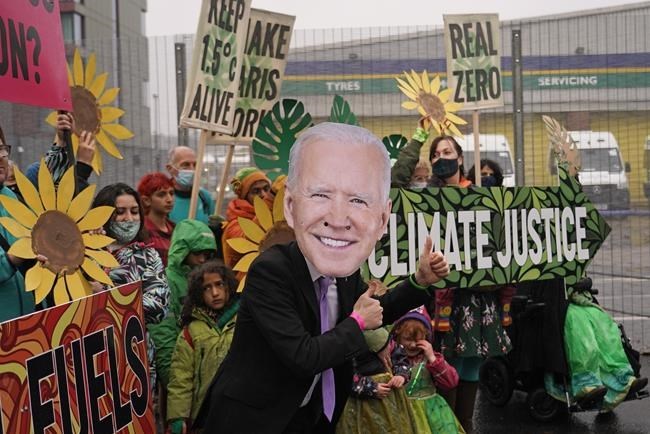
A climate activist wearing a mask of US President Joe Biden takes part in a demonstration against the use of fossil fuels outside the venue for the COP26 U.N. Climate Summit in Glasgow, Scotland, Friday, Nov. 12, 2021. Negotiators from almost 200 nations were making a fresh push Friday to reach agreements on a series of key issues that would allow them to call this year's U.N. climate talks a success. (AP Photo/Alberto Pezzali)

U.N. Secretary-General Antonio Guterres told The Associated Press this week that the 1.5C-goal “is still in reach but on life support.”

The annual meetings, first held in 1995 and only skipped once last year due to the pandemic, are designed to get all countries to gradually ratchet up their efforts to curb global warming.

But for many vulnerable nations the process has been far too slow.

“We need to deliver and take action now,” said Seve Paeniu, the finance minister of the Pacific island nation of Tuvalu. “It’s a matter of life and survival for many of us.”

___
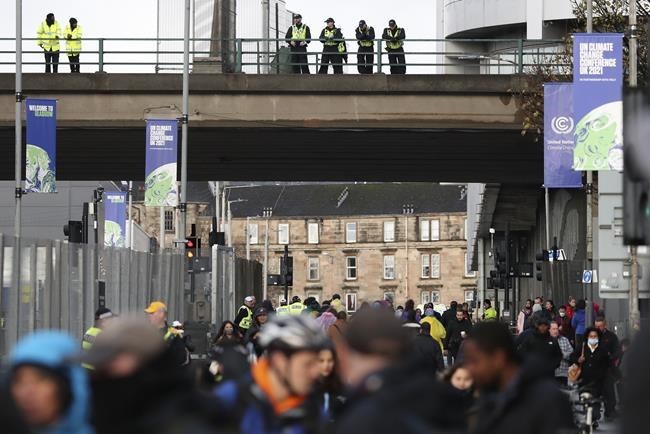
Police officers keep watch from a walkway over looking the outside of the venue of the COP26 U.N. Climate Summit in Glasgow, Scotland, Friday, Nov. 12, 2021. Negotiators from almost 200 nations were making a fresh push Friday to reach agreements on a series of key issues that would allow them to call this year's U.N. climate talks a success. (AP Photo/Scott Heppell)

Ellen Knickmeyer, Philipp Jenne and Karl Ritter contributed to this report.

___

Follow AP’s coverage of the talks at http://apnews.com/hub/climate
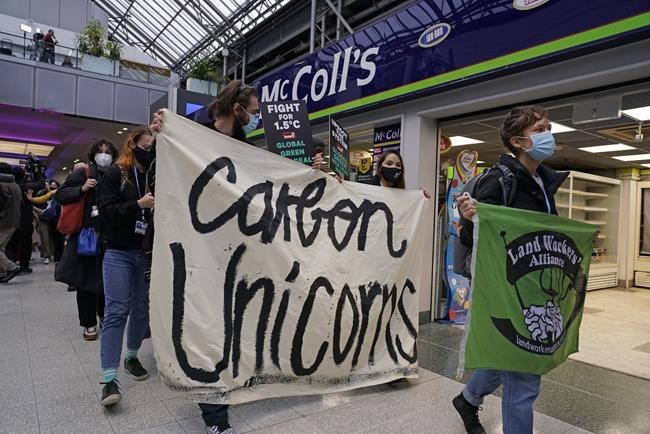
Climate activists hold a demonstration through the venue of the COP26 U.N. Climate Summit in Glasgow, Scotland, Friday, Nov. 12, 2021. Negotiators from almost 200 nations were making a fresh push Friday to reach agreements on a series of key issues that would allow them to call this year's U.N. climate talks a success. (AP Photo/Alberto Pezzali)
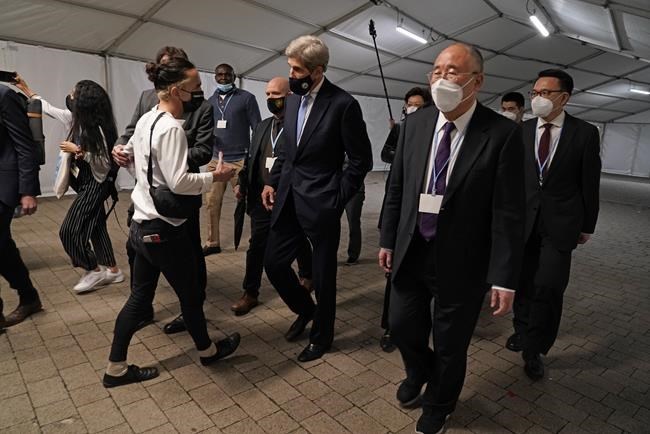
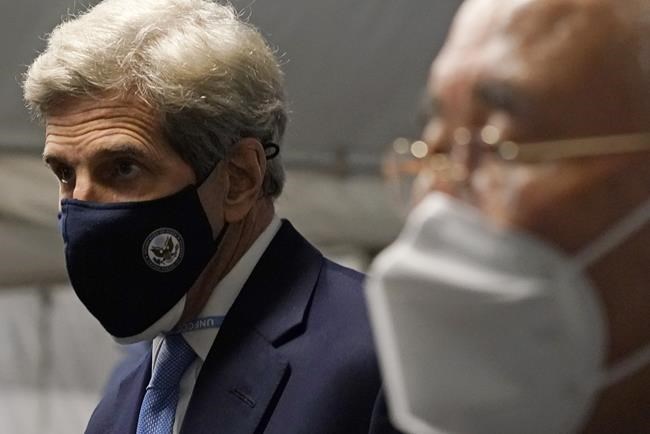
China's chief negotiator Xie Zhenhua, right, walks with John Kerry, United States Special Presidential Envoy for Climate at the COP26 U.N. Climate Summit in Glasgow, Scotland, Friday, Nov. 12, 2021. Going into overtime, negotiators at U.N. climate talks in Glasgow are still trying to find common ground on phasing out coal, when nations need to update their emission-cutting pledges and, especially, on money. (AP Photo/Alberto Pezzali)
Report Error Submit a Tip

More Stories

Options for selling U.S. alcohol in Canada

Charles S. Shaver 5 minute read Preview

Options for selling U.S. alcohol in Canada

Charles S. Shaver 5 minute read 2:00 AM CDT

U.S. President Donald Trump had threatened to impose tariffs of 50 per cent by Aug. 19 on over 500 Canadian items worth $28 billion. This would threaten 56,000 Canadian jobs and five per cent of our exports.

Read
2:00 AM CDT

The trolls inside the Conservative tent

David McLaughlin 5 minute read Preview

The trolls inside the Conservative tent

David McLaughlin 5 minute read Saturday, Aug. 22, 2026

The Conservative Party of Canada has a troll problem. And it’s coming from inside the tent.

Once, trolls existed only in imagination. They were figures of mythical proportion, big and small. They lived solitary lives under bridges, in caves, or forests. They were considered dim-witted and mean. Best avoided.

Today, they are real, unavoidable, and ubiquitous on social media. They are anything but solitary. There are tribes of them out there and tribal is how they think and post. As for dim-witted and mean, others can opine but they are uniformly mean and dismissive.

Mean to anyone who disagrees with their views. Dismissive of any view but their own. They distribute questionable, at best, facts and opinions grounded in hostility towards anything or anyone deemed disagreeable or heretical to their world view.

Read
Saturday, Aug. 22, 2026

Executive exodus continues at Shared Health with three recent departures

Chris Kitching 5 minute read Preview

Executive exodus continues at Shared Health with three recent departures

Chris Kitching 5 minute read Updated: Yesterday at 10:15 AM CDT

Manitoba’s provincial health authority is looking for its fourth chief financial officer since 2023 and additional replacements after the recent departures of three executives.

Read
Updated: Yesterday at 10:15 AM CDT

Five Things: PM Carney explains why Canada left the U.S. negotiating table

David Baxter, The Canadian Press 5 minute read Preview

Five Things: PM Carney explains why Canada left the U.S. negotiating table

David Baxter, The Canadian Press 5 minute read Saturday, Aug. 22, 2026

OTTAWA - Canada is preparing to hit the U.S. with dollar-for-dollar tariffs in response to new 50 per cent duties on $28 billion worth of Canadian products that took effect when talks between the two nations collapsed as negotiations neared the finish line. 

Prime Minister Mark Carney was quiet publicly during the final days of negotiations, but now has now explained his rationale for telling the Canadian negotiating team, led by Canada-U.S. Trade Minister Dominic LeBlanc and chief negotiator Janice Charette, to leave the table.

Restrictions on further trade deals

"The U.S. Introduced at the last hours, in the last hours, efforts to restrict our ability to have other trade deals. You heard me say a moment ago, what we've accomplished in the past year, 20 new deals, economic and security partnerships, the prospect of doubling our market access because we believe in free trade. We're the partner of choice in many respects for countries around the world and the Americans wanted to restrict that. They had language that what they wanted to restrict that, unacceptable," Carney said during a press conference on Parliament Hill.

Read
Saturday, Aug. 22, 2026

Residents fear mailbox crime sprees

Morgan Modjeski 4 minute read Preview

Residents fear mailbox crime sprees

Morgan Modjeski 4 minute read Saturday, Aug. 22, 2026

Some North End residents are concerned new community mailboxes will become a target for vandalism and crime after the base of one was recently lit ablaze — before it was even installed.

The community mailboxes started to show up on Andrews Street within the last two weeks. Some have been installed, while at other locations, only the concrete foundation is in place.

“They just dumped them on the boulevard,” said Stephen Giesbrecht, who lives beside one of the boxes in the St. John’s neighbourhood. “They dumped them on the corner and then they were gone.”

One of the concrete slabs has already played host to a fire and some of the hardware needed to install the mailbox melted.

Read
Saturday, Aug. 22, 2026

Trump threatens to hike tariffs on Canadian autos, steel to 50% in January

Nick Murray, The Canadian Press 4 minute read Preview

Trump threatens to hike tariffs on Canadian autos, steel to 50% in January

Nick Murray, The Canadian Press 4 minute read Updated: 12:35 PM CDT

OTTAWA - President Donald Trump escalated his trade war with Canada again Monday, this time threatening to hike tariffs on all vehicles, auto parts and steel from Canada to 50 per cent on Jan. 1.

Trump took to Truth Social to lash out at Canada three days after trade talks broke down in Washington and Canada accused the U.S. of negotiating in bad faith. As a result, new 50 per cent tariffs took effect Saturday on a range of Canadian goods, including honey, hockey sticks, flower bulbs and a long list of alcoholic beverages.

The new threat of tariffs for Jan. 1 would build on existing tariffs on the auto and steel sector, and are separate from the tariffs applied on Saturday.

In his post Monday, Trump accused Canada — without presenting evidence — as being "among the worst nations in the world to deal with."

Read
Updated: 12:35 PM CDT