

German government hints at smaller crowds or empty stadiums
Advertisement
Read this article for free:
or
Already have an account? Log in here »
To continue reading, please subscribe:

Digital Subscription
One year of digital access for only $205*
- Enjoy unlimited reading on winnipegfreepress.com
- Read the E-Edition, our digital replica newspaper
- Access News Break, our award-winning app
- Play interactive puzzles
*First annual payment billed as $205.00 + GST for one year. This annual subscription will automatically renew at $233.00 + GST every 52 weeks (10% off the regular annual price of $259.35). Offer available to new and qualified returning subscribers only. Cancel any time.
To continue reading, please subscribe:
Add Free Press access to your Brandon Sun subscription for only an additional
$1 for the first 4 weeks*
- Enjoy unlimited reading on winnipegfreepress.com
- Read the E-Edition, our digital replica newspaper
- Access News Break, our award-winning app
- Play interactive puzzles
*Your next Brandon Sun subscription payment will increase by $1.00 and you will be charged $17.95 plus GST for four weeks. After four weeks, your payment will increase to $24.95 plus GST every four weeks.
Read unlimited articles for free today:
or
Already have an account? Log in here »
Hey there, time traveller!
This article was published 29/11/2021 (1764 days ago), so information in it may no longer be current.
The German government suggested big crowds at sports events should be reduced Monday after a weekend which featured one empty-stadium Bundesliga game and another with a crowd of 50,000.
Germany leaves policy on sports events during the coronavirus pandemic to the state governments, but there are calls for a more unified approach.
Leipzig had the first top-division game of the season in an empty stadium Sunday, losing 3-1 to Bayer Leverkusen, because its home eastern state of Saxony has Germany’s highest infection rates. The day before, Cologne was allowed 50,000 in attendance for its 4-1 win over local rival Borussia Mönchengladbach.
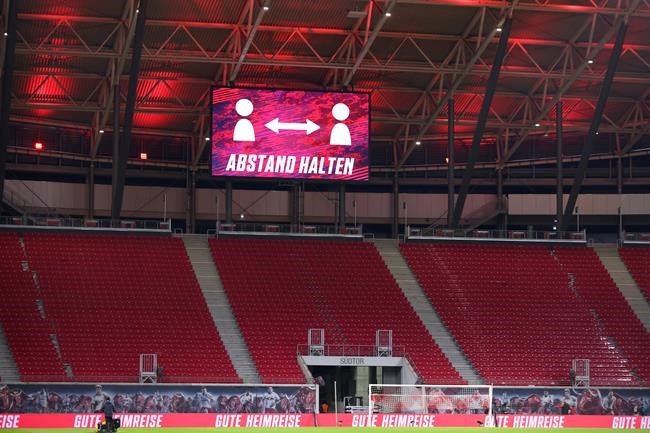
Some other states have allowed crowds, but at sharply reduced capacity. Around the country, entry is typically restricted to people with proof of vaccination or proof they recently recovered from a coronavirus infection.
Outgoing Chancellor Angela Merkel’s spokesman, Steffen Seibert, said it is “really hard to understand why 50,000 people are coming together in a football stadium, even if it was approved,” at a time when experts are saying that contacts need to be reduced.
“This inequality among the German states in the pandemic as far as large events are concerned — which doesn’t just affect sports, but other big events — is really unsatisfactory,” Interior Ministry spokesman Steve Alter said. Outgoing Interior Minister Horst Seehofer has been saying for weeks that it should be reduced, Alter added.
The varying approaches are “a sign for (Seehofer) that it would perhaps make sense to react to this at the federal level,” Alter said.

The outgoing government is likely to leave office next week, and Seehofer’s party will be going into opposition. The incoming coalition hasn’t yet named a successor.
Some regional politicians go even further. Baden-Württemberg governor Winfried Kretschmann indicated plans Monday to “massively restrict or prohibit” large-scale sports events, in comments reported by the dpa agency. Bremen’s interior minister Ulrich Mäurer last week suggested suspending the soccer season completely.
European countries have taken starkly different approaches to allowing crowds at sports events as winter begins and coronavirus cases rise. The English Premier League has played in front of full houses all season so far with no vaccination or testing requirements for fans. The Netherlands moved to empty stadiums for sports events this month.
___
More AP soccer: https://apnews.com/hub/soccer and https://twitter.com/AP_Sports
Related Articles
Czech-Belarus Women's WCup qualifier postponed until 2022 NYC reaches Eastern Conference final after penalty shootout




Advertisement Advertise With Us
Advertisement Advertise With Us