U.S. to require all inbound foreign air passengers to get COVID test the day before
Advertisement
Read this article for free:
or
Already have an account? Log in here »
To continue reading, please subscribe:

Digital Subscription
One year of digital access for only $205*
- Enjoy unlimited reading on winnipegfreepress.com
- Read the E-Edition, our digital replica newspaper
- Access News Break, our award-winning app
- Play interactive puzzles
*First annual payment billed as $205.00 + GST for one year. This annual subscription will automatically renew at $233.00 + GST every 52 weeks (10% off the regular annual price of $259.35). Offer available to new and qualified returning subscribers only. Cancel any time.
To continue reading, please subscribe:
Add Free Press access to your Brandon Sun subscription for only an additional
$1 for the first 4 weeks*
- Enjoy unlimited reading on winnipegfreepress.com
- Read the E-Edition, our digital replica newspaper
- Access News Break, our award-winning app
- Play interactive puzzles
*Your next Brandon Sun subscription payment will increase by $1.00 and you will be charged $17.95 plus GST for four weeks. After four weeks, your payment will increase to $24.95 plus GST every four weeks.
Read unlimited articles for free today:
or
Already have an account? Log in here »
Hey there, time traveller!
This article was published 02/12/2021 (1741 days ago), so information in it may no longer be current.
WASHINGTON – President Joe Biden set out to turn the tables on the COVID-19 pandemic Thursday with a 10-point winter offensive against the Omicron variant that further complicates flying from Canada to the United States on the eve of the holiday travel season.
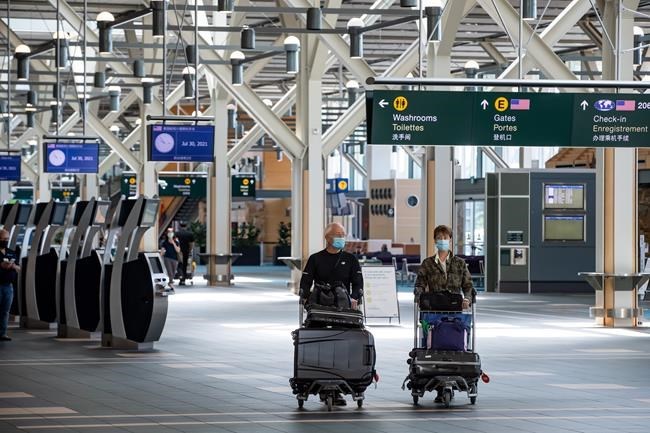
As early as Monday, Canadians and all other foreign visitors who travel to the U.S. by air will need to get a COVID-19 test no later than one day before their departure.
Biden is slashing the testing window — currently three days for fully vaccinated travellers — as part of a suite of public health measures aimed at slowing and limiting the spread of a highly mutated variant about which there are more questions than answers.
“All inbound international travellers must test within one day of departure, regardless of their vaccination status or nationality,” Biden said as he outlined the plan at the National Institutes of Health headquarters in Bethesda, just north of D.C.
“This tighter testing timeline provides an added degree of protection and scientists continue to study the Omicron variant.”
The plan also extends into March a rule requiring domestic and international passengers by air, rail and public transportation to wear a face mask, including inside airports, train stations and bus terminals.
The White House is also ramping up access and outreach to encourage eligible U.S. residents to get a COVID-19 vaccine or booster shot, accelerating research into vaccinating kids under the age of five, expanding access to at-home tests and donating 200 million more vaccine doses around the world within the next 100 days.
It’s a plan that “pulls no punches,” and is as much about bringing a fractured country back together as it is about staving off yet another deadly wave of infection, Biden said.
“I know COVID-19 has been very divisive in this country; it’s become a political issue, which is a sad, sad commentary,” he said.
“This is a moment we can put the divisiveness behind us, I hope. This is a moment when we can do what we haven’t been able to do enough of throughout this whole pandemic: get the nation to come together, unite the nation in a common purpose.”
Currently, fully vaccinated travellers do not need to show a test result to drive into the U.S. Neither Biden, White House press secretary Jen Psaki nor a background briefing the day before made any mention of whether that could change in the coming days or weeks.
Martin Firestone, a travel insurance broker in Toronto, said he’s been run off his feet in recent weeks as clients seek clarity on the ever-changing constellation of travel rules — and he expects that to continue given the latest pivots.
Firestone said he’s already heard from clients who say they’re having trouble finding an affordable antigen test that has a turnaround time of less than 24 hours, forcing them to pay a premium for quicker testing options.
“They called Shoppers (Drug Mart) … and they say they can’t get it back to you quick enough that you’ll have it guaranteed for sure before you hop on an 8 a.m. flight,” Firestone said.
“So they’re being forced to go to private health clinics where the cost of a rapid test, to get it back in 15 minutes, is $350, if you can believe it.”
Psaki was asked Thursday about the potential challenges of getting tested within a 24-hour window and said the White House is taking the issue under consideration, but couldn’t say immediately whether there would be any exceptions.
She also pointed out that there are still too many unknowns surrounding Omicron to predict any future changes to international travel restrictions.
“I wouldn’t expect the lifting of restrictions before we know more about the variant,” Psaki said.
“We will continue to evaluate if additional restrictions need to be put in place. None of these are meant to be permanent. None of them are meant to be a punishment. They’re all put in place to protect the American people, to hopefully save more lives.”
The rise of Omicron marks only the latest twist in the long road back to some semblance of normality for people who routinely travel back and forth between the two countries.
Prior to the advent of the latest variant, there was a growing din of dissent around U.S. restrictions at the Canada-U.S. land border, which lasted nearly 20 months until they were eased in early November.
This time, however, the reaction has been decidedly more muted.
“It has long been known that measures to combat the virus and its variants would evolve and require us to be nimble and adapt,” said Tori Emerson Barnes, the U.S. Travel Association’s vice-president of public affairs and policy.
“It is critically important that we communicate these policy changes clearly to global travellers and continue to welcome all qualified visitors to the United States.”
Canada, meanwhile, has for now exempted U.S. visitors from its own stringent new rules, which require all other foreign air travellers to get tested upon arrival and self-isolate while awaiting the results.
Fully vaccinated U.S. and Canadian citizens and permanent residents are still required to provide proof of a recent negative COVID test along with proof of vaccination in order to enter Canada.
Travellers are developing a severe case of travel-rule whiplash, Firestone said.
“They are mentally fatigued. It plays mind games with you,” he said.

“The bottom line is we’ve taken two steps back in the last little while. We were really on a nice trajectory, and I think the combination of the variant, along with new rules being put in place, has really put us behind the 8-ball.”
The Canadian government has so far remained mum on whether it expects the exemption for air passengers from the U.S. to change before Monday.
Health Minister Jean-Yves Duclos had said the government would consult with provinces and territories on whether to impose similar measures on visitors from the U.S., but it remained unclear Thursday if such changes were imminent.
This report by The Canadian Press was first published Dec. 2, 2021.
Note to readers: This is a corrected story. Previous version used 24 hours, 72 hours.
Related Articles
Omicron and delta spell return of unpopular restrictions
Advertisement Advertise With Us
Advertisement Advertise With Us