Awash in illegal pot farms, Oregon plans millions for relief

Advertisement

Advertise with us

SALEM, Ore. (AP) — Theft of water during a drought. Exploitation of immigrant laborers. Intimidation of residents by armed criminals.

Read this article for free:


or

Already have an account? Log in here »

To continue reading, please subscribe:

Subscribe and receive a limited-edition Free Press branded hat or tote.

Digital Subscription

One year of digital access for only $205*

  • Enjoy unlimited reading on winnipegfreepress.com
  • Read the E-Edition, our digital replica newspaper
  • Access News Break, our award-winning app
  • Play interactive puzzles

*First annual payment billed as $205.00 + GST for one year. This annual subscription will automatically renew at $233.00 + GST every 52 weeks (10% off the regular annual price of $259.35). Offer available to new and qualified returning subscribers only. Cancel any time.

To continue reading, please subscribe:

Add Free Press access to your Brandon Sun subscription for only an additional

$1 for the first 4 weeks*

  • Enjoy unlimited reading on winnipegfreepress.com
  • Read the E-Edition, our digital replica newspaper
  • Access News Break, our award-winning app
  • Play interactive puzzles
Start now

*Your next Brandon Sun subscription payment will increase by $1.00 and you will be charged $17.95 plus GST for four weeks. After four weeks, your payment will increase to $24.95 plus GST every four weeks.

Hey there, time traveller!
This article was published 16/12/2021 (1745 days ago), so information in it may no longer be current.

SALEM, Ore. (AP) — Theft of water during a drought. Exploitation of immigrant laborers. Intimidation of residents by armed criminals.

A Democratic state senator from southern Oregon said his region, awash in illegal marijuana farms that are protected by gunmen, is starting to look more like a failed state.

After hearing him and others testify this week, the Oregon Legislature dedicated $25 million to help police, sheriff’s offices and community organizations pay for the ballooning costs of cracking down on the thousands of industrial-scale, illegal pot farms. Residents said the assistance is welcome but not enough.
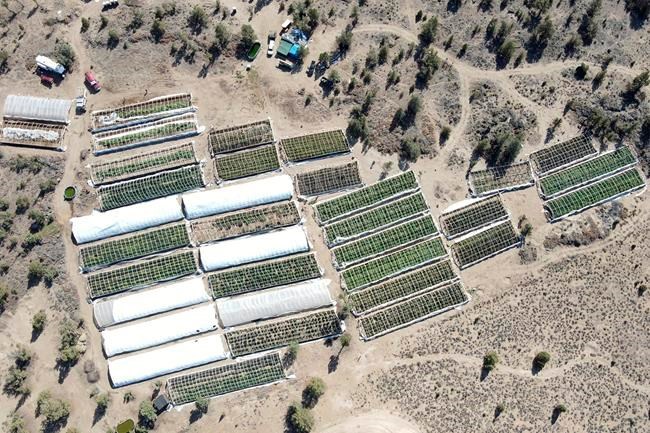
A marijuana grow is seen on Sept. 2, 2021, in an aerial photo taken by the Deschutes County Sheriff's Office in the community of Alfalfa, Ore. After hearing testimony this week about the proliferation of illegal marijuana farms in Oregon and their negative impacts, the Oregon Legislature dedicated $25 million to combatting them. (Deschutes County Sheriff via AP)

Seven years after Oregon voters passed a ballot measure legalizing the recreational use of marijuana and its regulated cultivation and sale, the state is grappling with an explosion of illegal marijuana farms that have brazenly cropped up, primarily in Josephine and Jackson counties in the south.

Hoop houses — cheaply built greenhouses — have been erected along highways and within city limits, with many growers claiming to be legal hemp farmers but cultivating plants with illegal amounts of THC, the component that creates the “high.”

The illicit industry is generating billions of dollars in profits and is financed by well-heeled foreign criminal gangs and drug cartels, law enforcement officials said.

Jackson County Sheriff Nathan Sickler told lawmakers the cartels “have a business model: Put up more cannabis illegal grows than law enforcement can ever get. They know we’re going to get some, but they know we can’t get it all.”

A farmer in southern Oregon — who used a creek for irrigating his crops before it ran dry because an illegal pot farm siphoned off the water, all while the West deals with a climate-change-fueled drought — blames the state for not having enough inspectors to determine which cannabis farms claiming to be hemp really are growing hemp. He spoke on condition he not be identified because he worries the cartels could retaliate against him.

The farmer also blames landowners for selling or leasing property to bad actors.

“If somebody walks onto your property with a suitcase with $100,000 in $20 bills, you kind of know they’re not on the up and up. And if you take that money and allow them to do something on your land, you should probably anticipate that they’re there to break the law,” he said.

Sen. Jeff Golden, a Democrat from the southern town of Ashland, said some rural areas are “military-weapons zones, like the ones we usually associate with failed states.”

“Illegal cannabis operations in southern Oregon have been using our limited water supply, abusing local workers, threatening neighbors and negatively impacting businesses run by legal marijuana growers,” said Golden, who pushed to get the measure and related funding on the agenda for the one-day special session.

Golden and two other lawmakers from southern Oregon, Rep. Pam Marsh, D-Ashland, and Rep. Lily Morgan, R-Grants Pass, previously said i n a letter to Gov. Kate Brown that workers on the illegal farms are subjected to “conditions approaching slavery.”

Some are also being deprived of their promised wages.

A 27-year-old Argentinian man said in an interview Wednesday that he learned last August through a WhatsApp message group that workers were needed on a pot farm in southern Oregon. At the time, he was working on a pot farm in Humboldt County, California. He then went to the location near Cave Junction, Oregon, expecting to be paid $2,500 for three weeks of work.

He did 12-hour shifts under the hot sun tending the plants and slept in a tent. When three weeks were up, he and other workers went to the farm manager to get paid.

FILE - A marijuana bud is seen before harvest near Corvallis, Ore. on Sept. 30, 2016. Seven years after Oregon voters passed a ballot measure legalizing the recreational use of marijuana and its regulated cultivation and sale, the state is grappling with an explosion of illegal marijuana farms, and after hearing testimony during the week of Dec. 13, 2021, the Oregon Legislature dedicated $25 million to combatting them. (AP Photo/Andrew Selsky, File)

“He didn’t even look at us. He got in his pickup truck and left,” the worker, who is in the U.S. on a tourist visa, said. He spoke on condition he not be named because of federal immigration laws.

When he called the manager, there was no answer. Another worker went to the farm for the wages but had a gun aimed at him.

“The truth is, I’m very disappointed and I don’t understand why they were that way with me when I was respectful and I worked all the hours they asked of me,” the man said over the phone from Florida, where he was trying to find temporary work before flying home for Christmas.

T he bill passed by the Legislature Monday and signed by the governor on Tuesday establishes the “Illegal Marijuana Market Enforcement Grant Program” to assist cities and counties with costs incurred by local law enforcement in addressing illegal pot farms. It will be administered by the Oregon Criminal Justice Commission.

“It will help,” said Josephine County Sheriff Dave Daniel. “But the issue is metastasizing statewide.”

Sheriff’s offices and other law enforcement that apply for the grants will have to work with community-based organizations to deal with the labor trafficking, said Morgan, the lawmaker. Of the $25 million, $5 million is dedicated to enforcing water rights.

Several bills coming in the 2022 legislative session will address further needs, she said.

___

Follow Andrew Selsky on Twitter at https://twitter.com/andrewselsky
Report Error Submit a Tip

More Stories

Several mayors bow out of fall’s municipal elections

Connor McDowell 3 minute read Yesterday at 2:01 AM CDT

BRANDON — A number of mayors have decided not to run for re-election in western Manitoba municipalities.

U of W marks 10 years of Indigenous education requirement

Maggie Macintosh 5 minute read Preview

U of W marks 10 years of Indigenous education requirement

Maggie Macintosh 5 minute read Yesterday at 2:00 AM CDT

The University of Winnipeg is collecting course outlines, historic concerns about systemic racism on campus and related records to mark the 10-year anniversary of mandating Indigenous studies.

The unveiling of a new archive drew nearly 200 people to Centennial Hall on Thursday afternoon to reflect on how the Indigenous course requirement, also known as “the ICR,” came to be.

University archivist Brett Lougheed told the crowd its inception is “an amazing story” of student activism that, until now, wasn’t accurately reflected in U of W records.

“What little material we had told the story of administration’s role in developing the ICR as though it was the ultimate driver… and not a student-led response to racism,” Lougheed said.

Read
Yesterday at 2:00 AM CDT

Man stabbed downtown Wednesday

1 minute read Updated: Yesterday at 12:28 PM CDT

Police are looking for suspects after a 46-year-old man was stabbed on Portage Avenue Wednesday.

Officers were called at about 5:45 p.m., and found the victim with serious upper-body injuries in the 200 block of Portage Avenue. He was sent to hospital in unstable condition but has been upgraded to stable condition.

The suspects fled before police arrived. Investigators say the victim was confronted by several people in the 300 block of Portage Avenue and was stabbed with an unknown weapon. He went to a nearby business, where police were called.

Anyone with information should contact police at 204-986-6219, or leave a tip anonymously at Crime Stoppers at 204-786-TIPS or winnipegcrimestoppers.org.

Sequestered skivvies seem like last straw

Maureen Scurfield 5 minute read Yesterday at 2:00 AM CDT

DEAR MISS LONELYHEARTS: My husband, who earns a hefty income, stayed in the city most of the summer working, except for a few long weekends with the kids and me at the cottage. He has giant work projects that need daily tending.

I work hard, too, with our four kids, two dogs and a cat. But I have to tell you I got a shock last week after coming home to organize my family team for a thorough cleaning of our three-storey home.

You’ll never guess what they found up in the attic — hidden boxes of sexy women’s lingerie that all looks brand-new.

I’ve kept my mouth shut so far, but my mind is spinning.

Winnipeg a character all its own onscreen

Jen Zoratti 4 minute read Preview

Winnipeg a character all its own onscreen

Jen Zoratti 4 minute read 2:01 AM CDT

Watch something shot in Winnipeg with a Winnipegger, and you will be treated to a live running commentary. We can’t help playing “spot the location.”

When we recognize that field/statue/mall/intersection/theatre, we have to say it. It’s practically civically mandated.

A friend told me she was at a film screening at which people literally applauded footage of the Mint. (That likely would have been 2005’s The Constant Gardener.)

Being excited about seeing Portage Place Mall at Christmastime in the trailer for Violent Night 2 — and then exclaiming, to your husband, “Oh, look, it’s Portage Place Mall at Christmastime!” — is not, I will admit, particularly cosmopolitan behaviour. In fact, I could be accused of suffering from a mild case of Podunkitis.

Read
2:01 AM CDT

Public versus private schooling

John R. Wiens 5 minute read 2:01 AM CDT

A Recent Maggie Macintosh piece (Enrolment up at alternative schools, Sept. 7) and several letters to the editor touted the benefits and values of private schooling. The executive director of the Manitoba Federation of Independent Schools, Andrew Micklefield, emphasized schools of choice and governmental cost-saving. A private, formerly public, schoolteacher emphasized finances, academics and parental support.

None are wrong in their arguments, but they are missing the main reasons for the existence of public schools, which has less to do with money and academics than with inclusion and equality. Nor do they adequately acknowledge the downsides of exclusion and elitism fostered by some aspects of choice and inequality. The increase in numbers of private schools and their attendees is a cause for some public concern.

Micklefield’s assertion is that private schools save the government money. Letter-writer Paulo Borges intimates he saves the province $52,500 ($15,000 each for three home-schooled children and $7500 for one private-school tuition), further suggesting that the savings are not used wisely by governments in supporting public schools.

In the front-page article, Micklefield and others go further to suggest that the main reason parents choose private schools is to receive an education in a Christian setting. That is a very limited rationale and certainly does not include the much larger variety of reasons why people choose private schooling or an even more restricted version of schools of choice, home schooling.