Omicron wave may be peaking, but modelling shows COVID-19 hospitalizations to surge

Advertisement

Advertise with us

OTTAWA - Canada could be nearing the peak of the Omicron wave of COVID-19, but public health experts still expect the high number of cases to drive a surge in daily hospitalizations in coming weeks.

Read this article for free:


or

Already have an account? Log in here »

To continue reading, please subscribe:

Subscribe and receive a limited-edition Free Press branded hat or tote.

Digital Subscription

One year of digital access for only $205*

  • Enjoy unlimited reading on winnipegfreepress.com
  • Read the E-Edition, our digital replica newspaper
  • Access News Break, our award-winning app
  • Play interactive puzzles

*First annual payment billed as $205.00 + GST for one year. This annual subscription will automatically renew at $233.00 + GST every 52 weeks (10% off the regular annual price of $259.35). Offer available to new and qualified returning subscribers only. Cancel any time.

To continue reading, please subscribe:

Add Free Press access to your Brandon Sun subscription for only an additional

$1 for the first 4 weeks*

  • Enjoy unlimited reading on winnipegfreepress.com
  • Read the E-Edition, our digital replica newspaper
  • Access News Break, our award-winning app
  • Play interactive puzzles
Start now

*Your next Brandon Sun subscription payment will increase by $1.00 and you will be charged $17.95 plus GST for four weeks. After four weeks, your payment will increase to $24.95 plus GST every four weeks.

Hey there, time traveller!
This article was published 14/01/2022 (1732 days ago), so information in it may no longer be current.

OTTAWA – Canada could be nearing the peak of the Omicron wave of COVID-19, but public health experts still expect the high number of cases to drive a surge in daily hospitalizations in coming weeks.

New federal modelling released Friday shows the wave might be cresting — or just about to do so — but health experts won’t know for sure for another week or so.

“It’s quite possible that in the next few days we will see that peak, at least in the number of cases,” chief public health officer Dr. Theresa Tam said at a news conference.
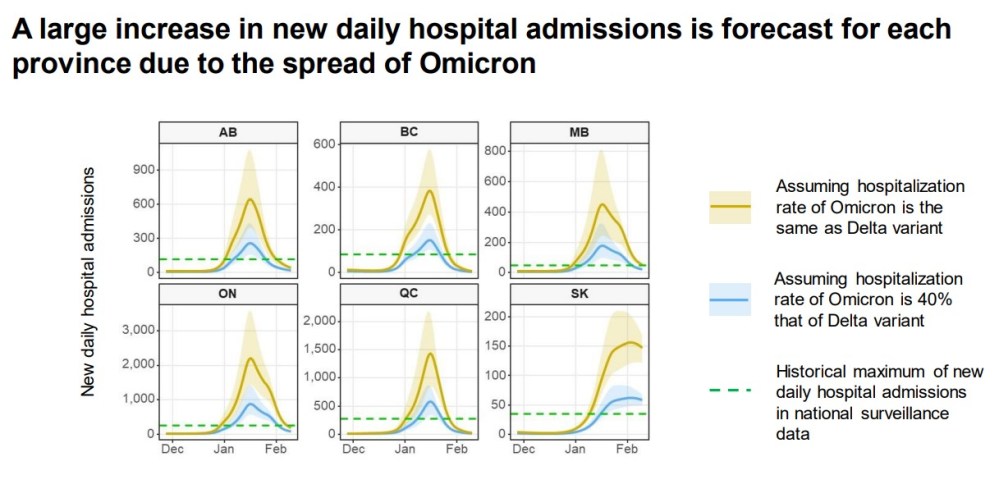
Under federal modelling, Manitoba would see nearly more than 100 new hospital admissions per day by mid-January even in the best-case scenario. (Public Health Agency of Canada modelling)

Quebec had already pronounced the latest wave is cresting, and on Friday British Columbia’s modelling suggested the province likely hit its peak this past weekend.

In Ontario, the expert pandemic advisory group said the latest indications suggest COVID-19 hospitalizations could peak in the next few weeks, as test positivity has started to decline in the province.

Nationally, this wave is expected to top out at between 170,000 and 300,000 actual daily cases and recede into February, based on available data.

“The true number of daily cases, driven by extremely high transmissibility of the Omicron variant, could still vastly exceed anything we have experienced to date during this pandemic,” Tam said.

Current national case counts show about 37,500 new cases are reported daily, but those far underestimate the reality. Many parts of the country no longer provide laboratory tests for most people.

About 28 per cent of lab tests that are performed are coming back positive.

“The current very high positivity rate shows that COVID-19 is widespread and that case counts underestimate the true burden of infection in the broader population,” Tam said.

The number of hospitalizations also helps to give a clearer picture of how the virus is sweeping through the population, she said.

Though the rate of people who are hospitalized with Omicron is lower compared to the Delta variant, the forecast shows new daily hospital admissions will far exceed previous peaks due to the number of cases.

Severe outcomes are also possible. Prince Edward Island reported the first two deaths in the province related to COVID-19 since the pandemic began.

Since the federal government’s previous update before the holidays, the number of people with COVID-19 treated in hospitals has more than quadrupled. The average is now over 6,779 daily, the national numbers show.

The Public Health Agency of Canada expects the high number of people seeking hospital treatment for COVID-19 will put a significant strain on health-care systems over the next several weeks.

B.C.’s provincial health officer, Dr. Bonnie Henry, said these next few weeks will be the most challenging that hospitals have seen yet.

“We know that the peak is coming at the same time that we’re still seeing health care workers off ill and not being able to go into work,” Henry said at a briefing Friday.

Some parts of the United States and United Kingdom have already reported their COVID-19 cases have begun to stabilize, and Tam hopes Canada is following the same trajectory.

Quebec, following its declaration the wave had peaked in the province, announced it will lift its controversial 10 p.m. to 5 a.m. curfew on Monday.
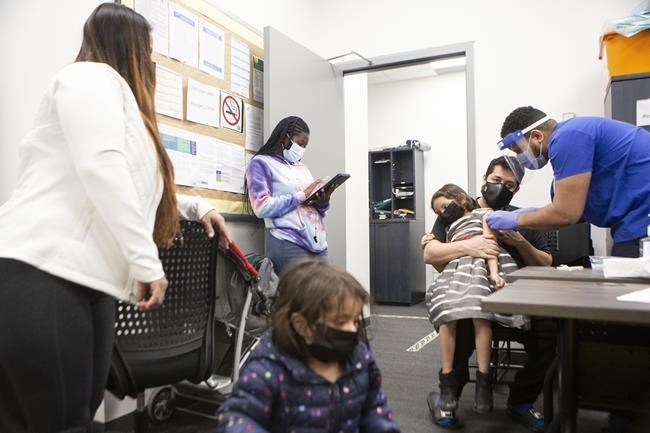
Seven-year-old Lorena Limdao is held by her father William as Dr. Kevin Evelyn of UHN gives her a COVID-19 vaccine needle while mother Gisella (left) looks on. They were at a
Seven-year-old Lorena Limdao is held by her father William as Dr. Kevin Evelyn of UHN gives her a COVID-19 vaccine needle while mother Gisella (left) looks on. They were at a "Kids and Families Vaccine Clinic" operated by Black Creek Community Health Centre in the Jane and Finch Mall in Toronto on Thursday, January 13, 2022. THE CANADIAN PRESS/Chris Young

And Nunavut officials said the tough measures it implemented just before Christmas have been so effective that it’s cancelling travel restrictions on Monday and allowing businesses to reopen. Schools will resume in-person learning on Jan. 24.

Provinces that were hit by the Omicron wave first will also likely be among the first to see signs of stabilization, Tam said, but she warned that changes to public health restrictions could change the trajectory of the virus.

“For example, as people go back to school and work those cases could come back so it won’t be necessarily a smooth curve downwards,” she said.

It’s a different story in New Brunswick, where new restrictions came into effect Friday limiting residents to a single-household bubble while also closing gyms, entertainment venues and indoor dining at restaurants.

In neighbouring Prince Edward Island, where chief medical health officer Dr. Heather Morrison says the “worst of this wave” is yet to come, current restrictions that include business capacity limits and remote learning for school students will be extended.

Tam said the surest way out of this wave remains vaccination.

The trends show unvaccinated people are 19 times more likely to be hospitalized with COVID-19 compared to fully vaccinated people.

“We need to continue efforts to increase vaccine coverage to enhance protection for everyone we can,” Tam said.

Even the downside of the curve will have considerable health system impacts, she warned.

She urged Canadians to get up to date on their vaccines and continue to follow public health measures and limit contacts outside their households.

The House of Commons standing committee on health voted Friday to summon Tam, the federal health minister and several other health officials to answer questions about the federal response to the Omicron wave.

Some of the key concerns are how the government plans to respond to the flagging surge capacity of Canada’s health systems as the number of hospitalizations climb and health workers fall ill.

This report by The Canadian Press was first published Jan. 14, 2022.

Federal COVID-19 modelling

Report Error Submit a Tip

More Stories

Late philanthropist, family fill Harvest’s Empty Bowls with record-setting $5-M donation

Morgan Modjeski 3 minute read Preview

Late philanthropist, family fill Harvest’s Empty Bowls with record-setting $5-M donation

Morgan Modjeski 3 minute read Friday, Oct. 9, 2026

It was a record-breaking night for Harvest Manitoba made possible by a genuine Winnipeg hero and his family.

The organization’s annual Empty Bowls Celebrity Auction Dinner on Thursday raised $6.5 million to support Manitobans facing hunger and food insecurity.

And it was a $5-million legacy donation from late city philanthropist Doug Harvey and his family that will see the event go down in the history books as the largest gala fundraising total ever recorded in Manitoba.

“There was literally nothing that lit my dad up more than contributing himself, but even more so, inspiring others to give,” his daughter Lauren Harvey said Friday.

Read
Friday, Oct. 9, 2026

Hurricane Simon pounds resorts and vulnerable towns along Mexico’s Pacific coast

Fernando Llano And Martin Silva, The Associated Press 5 minute read Preview

Hurricane Simon pounds resorts and vulnerable towns along Mexico’s Pacific coast

Fernando Llano And Martin Silva, The Associated Press 5 minute read Updated: 2:38 AM CDT

PUERTO VALLARTA, Mexico (AP) — Hurricane Simon pounded Mexico’s Pacific coast as a Category 3 storm on Sunday, its eye remaining just offshore as its most powerful winds and rain slammed people living between the Sierra Madre and the ocean.

The hurricane's center swirled parallel to the coast, closing in on the Puerto Vallarta area, where its most damaging winds and rain were expected to hit around midnight and continue through Monday morning. Its maximum sustained winds weakened late Sunday to 115 mph (185 kph), according to the U.S. National Hurricane Center in Miami, but it was still expected to remain a dangerous hurricane.

That’s not good news for people in and around Puerto Vallarta, a popular tourist destination in the state of Jalisco. Just inland and uphill from the resort areas, many Mexicans live in communities where housing might not stand up to the storm.

By late Sunday, Simon's eye was moving northwest about 45 miles (75 kilometers) south of Cabo Corrientes at about 5 mph (7 kph). A senior hurricane center specialist, Philippe Papin, said this westernmost tip of mainland Mexico is the area most likely to get a direct hit from the system. Cabo Corrientes is at the southern tip of Bahia de Banderas, the wide bay where Puerto Vallarta looks out to the Pacific.

Read
Updated: 2:38 AM CDT

France’s envoy says Carney admired for response to ‘extremely radical’ U.S.

Dylan Robertson, The Canadian Press 4 minute read Preview

France’s envoy says Carney admired for response to ‘extremely radical’ U.S.

Dylan Robertson, The Canadian Press 4 minute read Updated: Yesterday at 9:16 AM CDT

OTTAWA - France's new ambassador to Canada says her country admires the Carney government's response to "extremely radical" American demands and is calling for swift action to boost Canada's strategic ties with Europe.

"My mission is very clear. It's to work toward making France one of Canada’s closest allies in Europe, in each field, in every sector," French Ambassador Hélène Farnaud-Defromont told The Canadian Press on Friday.

In her first interview since her posting started last month, Farnaud-Defromont said in French her country sees Prime Minister Mark Carney's approach to managing trade negotiations with U.S. President Donald Trump's administration as "exemplary."

The prime minister called a halt to trade talks with Washington in August and accused the Trump administration of bringing fresh demands to the table at the last minute. Carney also has vowed to protect Canada's language sovereignty and ability to regulate big tech firms.

Read
Updated: Yesterday at 9:16 AM CDT

A Life's Story: Writer built bridges with genuine curiosity, compassion for diversity of religious practices

Janine LeGal 6 minute read Preview

A Life's Story: Writer built bridges with genuine curiosity, compassion for diversity of religious practices

Janine LeGal 6 minute read Saturday, Oct. 10, 2026

Brenda Suderman knew how to make people feel comfortable. For a journalist, that character trait is a real strength, and it made people trust and appreciate her.

Whether covering musicals, worship spaces, the effects of pandemic shutdowns, death rituals and practices of different traditions, the discovery of the burial of 2,284 infants in unmarked graves, or any other of the countless topics she wrote about in her four- decade career, Suderman did it with genuine interest and care.

Born and raised in Winkler, Suderman grew up on a farm. Much of her childhood was spent in gardens and sugar beet fields.

Baptized at 16, she became a member of the Winkler Bergthaler Mennonite Church. The restrictions against women at the time contributed to planting the seeds of Suderman’s feminist perspective.

Read
Saturday, Oct. 10, 2026

Today’s horoscope

Georgia Nicols 4 minute read Preview

Today’s horoscope

Georgia Nicols 4 minute read 2:00 AM CDT

MOON ALERT: There are no restrictions to shopping or important decisions. The moon is in Scorpio.

ARIES (March 21-April 19)

Tread carefully as it’s easy to get into an argument, especially with your kids or even a romantic partner. Very likely the dispute will be about mutual expenses, shared property or perhaps differing values. Do what you can to keep the peace.

TAURUS (April 20-May 20)

Read
2:00 AM CDT

Manitoba e-scooter legislation changes set to impose speed limit, age restrictions, sidewalk ban

Matthew Frank 5 minute read Preview

Manitoba e-scooter legislation changes set to impose speed limit, age restrictions, sidewalk ban

Matthew Frank 5 minute read Updated: Yesterday at 5:14 PM CDT

People riding e-scooters and other personal electric vehicles in Manitoba will have to strap on a helmet, stay off sidewalks and follow new age limits once new provincial rules for the devices take effect next year.

The vehicles, which also include electric skateboards, hoverboards and unicycles, will fall under The Highway Traffic Act starting in 2027, according to the province’s website. E-bikes are excluded from the new rules, according to the province’s frequently-asked-questions page.

All riders must be at least 16 years old and wear properly fitting helmets — that goes for passengers, too, the province said.

The proposed new legislation sets a speed limit of 25 km/h and would prohibit personal electric vehicles from sidewalks unless signs specifically allow sidewalk use. Riders would be using shared paths or roads with speed limits of 50 km/hr or less. They won’t be allowed to operate the vehicles under the influence of alcohol or drugs and they must use hand signals and obey traffic signs.

Read
Updated: Yesterday at 5:14 PM CDT