WEATHER ALERT

EXPLAINER: How COVID tests, isolation will work at Olympics

Advertisement

Advertise with us

NEW YORK (AP) — Athletes and others headed to the Olympics face a multitude of COVID-19 testing hurdles as organizers seek to catch any infections early and keep the virus at bay.

Read this article for free:

or

Already have an account? Log in here »

To continue reading, please subscribe:

Subscribe and receive a limited-edition Free Press branded hat or tote.

Digital Subscription

One year of digital access for only $205*

  • Enjoy unlimited reading on winnipegfreepress.com
  • Read the E-Edition, our digital replica newspaper
  • Access News Break, our award-winning app
  • Play interactive puzzles

*First annual payment billed as $205.00 + GST for one year. This annual subscription will automatically renew at $233.00 + GST every 52 weeks (10% off the regular annual price of $259.35). Offer available to new and qualified returning subscribers only. Cancel any time.

To continue reading, please subscribe:

Add Free Press access to your Brandon Sun subscription for only an additional

$1 for the first 4 weeks*

  • Enjoy unlimited reading on winnipegfreepress.com
  • Read the E-Edition, our digital replica newspaper
  • Access News Break, our award-winning app
  • Play interactive puzzles
Start now

*Your next Brandon Sun subscription payment will increase by $1.00 and you will be charged $17.95 plus GST for four weeks. After four weeks, your payment will increase to $24.95 plus GST every four weeks.

Hey there, time traveller!
This article was published 26/01/2022 (1641 days ago), so information in it may no longer be current.

NEW YORK (AP) — Athletes and others headed to the Olympics face a multitude of COVID-19 testing hurdles as organizers seek to catch any infections early and keep the virus at bay.

A positive test could mean athletes sitting out the Beijing Games — perhaps even if they’re no longer contagious. Olympic officials say they’ll be flexible and review the need for isolation on a case-by-case basis.

It’s part of the complexities of staging a big event in the pandemic, because organizers want to ensure they don’t fuel outbreaks among participants or the local population. Since early in the pandemic, China has taken a “zero tolerance” approach to the virus.
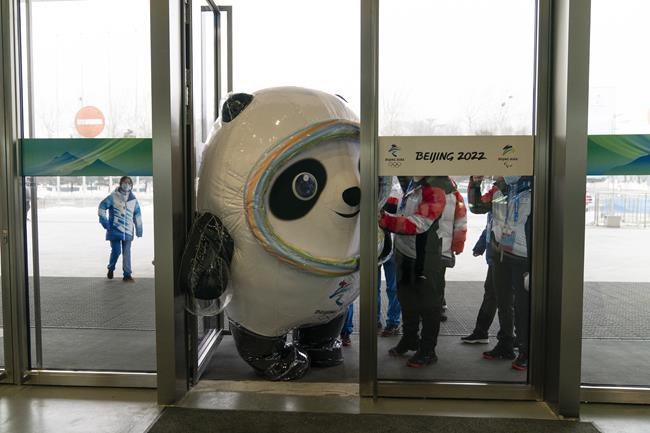
FILE - Inflated Beijing Games mascot, Bing Dwen Dwen, tries to squeeze through the door to enter the main media center at the 2022 Winter Olympics, Monday, Jan. 24, 2022, in Beijing. Athletes and others headed to the Olympics face a multitude of COVID-19 testing hurdles as organizers seek to catch any infections early and keep the virus at bay. (AP Photo/Jae C. Hong, File)

Similar protocols to create virus-free “bubbles” were part of the Tokyo Games last summer and the end of the 2020 NBA season.

Here’s how testing will work at the Winter Olympics:

WHAT WILL TESTING BE LIKE?

All athletes, team officials, staff and journalists need to provide two recent negative tests before heading to China. They will be tested again at the airport before heading to their Olympic sites. During the Games, everyone will get daily throat swabs for PCR lab tests, with results coming back within a day.

And most everyone will already be vaccinated, because those who aren’t have to quarantine for three weeks.

WHAT IF SOMEONE TESTS POSITIVE?

First, there will be a confirmatory test. Anyone who has COVID-19 with symptoms will go to a hospital. Those without symptoms go to a dedicated hotel for isolation. In both cases, they’ll be unable to compete until cleared for discharge.

HOW LONG WILL ISOLATION LAST?

It depends. To get out of isolation, people generally need consecutive days of negative tests and no symptoms. They will be tested with PCR lab tests that can detect tiny amounts of virus. That means a test can come back positive long after a person is likely to spread the virus. The uncertainty over how long isolation might last is fueling worries. Last week, NBC said its announcers and many hosts would cover the Games from the U.S.

ARE TESTS THE ONLY FACTOR?

Organizers in Beijing say they’ll look at other factors in addition to testing when evaluating whether someone can leave isolation.

“What’s the person’s past history? Have they had confirmed COVID in the past? Have they been vaccinated fully?” said Dr. Brian McCloskey, chair of the medical expert panel for the Beijing Olympics.

PCR tests work by copying the genetic material in a specimen to detect a virus. If a lab needs to run a lot of amplification cycles to pick up the virus, it could mean a person has low levels and isn’t likely to spread it.

This week, organizers said they would take a less stringent approach on isolation for those with low levels of the virus. They eased the testing threshold that requires isolation but said people with detectable levels of the virus still need to take extra precautions, such as limiting contact with others and taking two tests a day, instead of one.

As scientists have learned more about COVID-19 and how it spreads, health officials in a number of countries have revised isolation requirements. In the U.S., for example, people can end isolation after five days if they don’t have any symptoms — without testing to see if they’re negative. But they’re advised to avoid travel and others at high risk.

ARE MANY INFECTIONS EXPECTED?

Positive cases are expected to pop up, with the highly contagious omicron variant fueling infections in many parts of the world.

So far, organizers say there have been 39 positive results out of the more than 2,500 tests at the airport among those who arrived since early January. Within the bubble, there have been 33 positives out of 336,400 tests. None of the positives involved athletes. The average time spent in isolation for most has been around six days.

___

The Associated Press Health and Science Department receives support from the Howard Hughes Medical Institute’s Department of Science Education. The AP is solely responsible for all content.

Report Error Submit a Tip

More Stories

Longtime Assiniboine Park Zoo resident Blizzard the bison dies

Zoe Pierce 2 minute read Preview

Longtime Assiniboine Park Zoo resident Blizzard the bison dies

Zoe Pierce 2 minute read Yesterday at 3:03 PM CDT

Blizzard, the white bison that became one of Assiniboine Park Zoo’s most recognizable residents during nearly 20 years at the facility, has died, the zoo announced Friday.

The zoo said Blizzard’s health declined in recent weeks, so a diagnostic exam was recommended to better understand his condition. He died during the procedure.

Blizzard arrived at Assiniboine Park Zoo in 2006 and went on to become a favourite among visitors, inspiring “millions of visitors with his remarkable presence,” the zoo said in a social media post.

“While all animals in our care are deeply valued, Blizzard held a special place in the hearts of many people and carried profound cultural and spiritual significance for many Indigenous peoples,” the post reads.

Read
Yesterday at 3:03 PM CDT

Men cycling across Canada for charity have bikes stolen in Winnipeg

Chris Kitching 5 minute read Preview

Men cycling across Canada for charity have bikes stolen in Winnipeg

Chris Kitching 5 minute read Updated: Yesterday at 5:27 PM CDT

Thomas Clark and Valentin Duquenne were devastated after their bikes went missing outside CBC Manitoba’s headquarters, but uplifted by the outpouring of support from Manitobans afterward.

Read
Updated: Yesterday at 5:27 PM CDT

Bridgwater residents fed up with Manitoba Housing eyesore

Malak Abas 4 minute read Preview

Bridgwater residents fed up with Manitoba Housing eyesore

Malak Abas 4 minute read Wednesday, Jul. 22, 2026

A weed-covered plot of land in Bridgwater has been left to grow wild all summer, raising the ire of neighbours who say they were told the property is owned by Manitoba Housing and bylaw officers cannot intervene.

Read
Wednesday, Jul. 22, 2026

Vacant Bay store on road to redevelopment, St. Vital Centre owner says

Gabrielle Piche 6 minute read Preview

Vacant Bay store on road to redevelopment, St. Vital Centre owner says

Gabrielle Piche 6 minute read Yesterday at 5:29 PM CDT

Entertainment attractions are coming to fill the former Hudson’s Bay space in St. Vital Centre.

Montreal-based real estate firm Leyad, the south Winnipeg mall’s owner, says it is finalizing an agreement for the vacant property. Further details should appear in the next couple months, said president Henry Zavriyev.

“We’re looking at what other types of experiences we can bring to the mall that aren’t just typical retail,” he said during a visit to Winnipeg this week.

“We want to create an experience where you can just come to the mall, hang out here for hours, no matter if you’re a kid, an adult, a retiree.”

Read
Yesterday at 5:29 PM CDT

Dropping the gloves to make the point

Editorial 4 minute read Preview

Dropping the gloves to make the point

Editorial 4 minute read 2:01 AM CDT

In hockey parlance, it’s called “shedding,” the moment in a game when you are forced to deal with an instigator by dropping (shedding) your gloves for an all-out brawl.

That term is a deep cut from hockey culture that Prime Minister Mark Carney — he of the “elbows up” phenomenon — may need to not only embrace but practise more often in the face of yet another round of overly punitive tariffs imposed by United States President Donald Trump.

To be fair, under Carney’s leadership, Canada has not exactly rolled over in the face of Trump’s bully-boy tactics.

Yes, Canada has made concessions to placate Trump to further a new continental trade agreement: investing more money to combat the cross-border flow of fentanyl that isn’t actually happening, stalling efforts to tax streaming companies as most European countries already do, and — most recently — giving Trump a cut of profits from the Canadian-made, Canadian-paid Gordie Howe bridge between Windsor and Detroit.

Read
2:01 AM CDT

A distraction for the war-weary

Gwynne Dyer 5 minute read 2:01 AM CDT

I have been writing this column twice a week for a long time, so I have a finely developed sense for when the audience is sick of a subject. We have definitely crossed that boundary with regard to the wars currently being fought up and down the strip of land between the longitudes of 40°E and 50°E (Eastern Ukraine/Persian Gulf/Israel, Gaza and Lebanon).

It’s not just that they are stupid wars, launched by men who were too ignorant or too arrogant to realize that they could not win them (Vladimir Putin, Donald Trump, Benjamin Netanyahu), and it’s certainly not because they are harmless wars.

Not only are they killing thousands of people every week, but in every case the country that started the war also has nuclear weapons. In each case there is a small but real possibility that the leader in question might resort to using at least one “tactical” nuclear weapon as a final warning rather than accept the blame for a humiliating failure to achieve his aims.

Yet nothing much new and interesting is happening from one day to the next in any of these wars, and the audience would really like to move on. I have been trying to write about something else at least once a week, so I thought: maybe I could do a piece about Kim Jong Un’s teenage daughter’s chance of being North Korea’s next dictator.