Study: Gas stoves worse for climate than previously thought

Advertisement

Advertise with us

Gas stoves are contributing more to global warming than previously thought because of constant tiny methane leaks while they’re off, a new study found.

Read this article for free:


or

Already have an account? Log in here »

To continue reading, please subscribe:

Subscribe and receive a limited-edition Free Press branded hat or tote.

Digital Subscription

One year of digital access for only $205*

  • Enjoy unlimited reading on winnipegfreepress.com
  • Read the E-Edition, our digital replica newspaper
  • Access News Break, our award-winning app
  • Play interactive puzzles

*First annual payment billed as $205.00 + GST for one year. This annual subscription will automatically renew at $233.00 + GST every 52 weeks (10% off the regular annual price of $259.35). Offer available to new and qualified returning subscribers only. Cancel any time.

To continue reading, please subscribe:

Add Free Press access to your Brandon Sun subscription for only an additional

$1 for the first 4 weeks*

  • Enjoy unlimited reading on winnipegfreepress.com
  • Read the E-Edition, our digital replica newspaper
  • Access News Break, our award-winning app
  • Play interactive puzzles
Start now

*Your next Brandon Sun subscription payment will increase by $1.00 and you will be charged $17.95 plus GST for four weeks. After four weeks, your payment will increase to $24.95 plus GST every four weeks.

Hey there, time traveller!
This article was published 27/01/2022 (1720 days ago), so information in it may no longer be current.

Gas stoves are contributing more to global warming than previously thought because of constant tiny methane leaks while they’re off, a new study found.

The same study that tested emissions around stoves in homes raised new concerns about indoor air quality and health because of levels of nitrogen oxides measured.

Even when they are not running, U.S. gas stoves are putting 2.6 million tons (2.4 million metric tons) of methane — in carbon dioxide equivalent units — into the air each year, a team of California researchers found in a study published in Thursday’s journal Environmental Science & Technology. That’s equivalent to the annual amount of greenhouse gases from 500,000 cars or what the United States puts into the air every three-and-a-half hours.
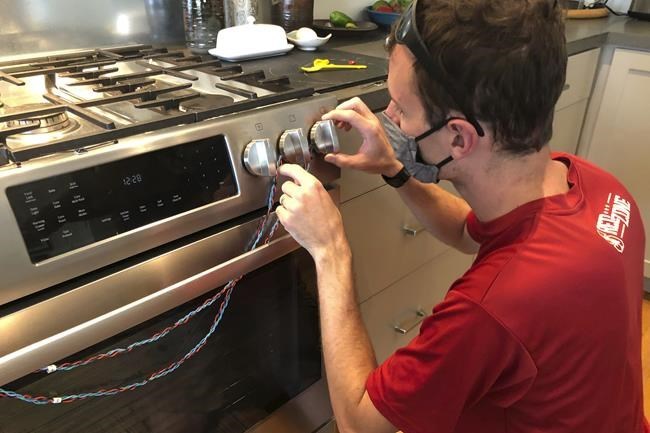
In this photo provided by climate scientist Rob Jackson, researcher Eric Lebel attaches sensors to a stove to measure how often it is used in Stanford, Calif., in 2020. According to a study published Thursday, Jan. 27, 2022, in the journal Environmental Science & Technology, gas stoves are worse for the climate than previously thought because of constant tiny methane leaks even while they’re off. (Rob Jackson via AP)

“They’re constantly bleeding a little bit of methane into the atmosphere all the time,” said the study’s co-author Rob Jackson, a Stanford University climate scientist.

That methane is on top of the 6.8 million tons (6.2 million metric tons) of carbon dioxide that gas stoves emit into the air when they are in use and the gas is burned, the study said. Methane is a greenhouse gas that is dozens of times more potent than carbon dioxide but doesn’t stay in the atmosphere nearly as long and isn’t as plentiful in the air.

The researchers examined 53 home kitchens in California — many in bed and breakfasts they rented. They sealed most of the rooms in plastic tarps and then measured emissions when the stoves were working and when they were not. And what was surprising was that three-quarters of the methane released happened while the stoves were off, Jackson said. Those are emissions releases that the government doesn’t account for, he said.

“That’s a big deal because we’re trying to really reduce our carbon footprint and we claim that gas is cleaner than coal, which it is,” said study lead author Eric Lebel, a scientist at PSE Healthy Energy, an Oakland nonprofit. But he said much of the benefit disappears when leaks are taken into account.

Many communities have bans on gas stove use in future new construction that will take effect in future years, including New York City and the Bay Area cities of San Francisco, Oakland, San Jose, and Berkeley, Jackson said.

“People can already choose electric appliances if they want,” said Frank Maisano, a Washington policy and public relations expert who represents gas and appliance interests. “People just like gas appliances because they perform better, especially in colder climates.”

“Natural gas appliances are generally more energy- and cost-effective than their electric counterparts,” Maisano said.

Jackson estimated that when all natural gas use and extraction is taken into account, about 100 million tons (91 million metric tons) of gas leaks into the atmosphere. And the couple million tons from gas stoves “is meaningful. That’s a substantial part and it’s a part that we haven’t included accurately in the past.”

The leakage finding is “a very important takeaway” and fits with other work that found there are often big leaks that account for much of the emissions, said Zachary Merrin, a research engineer with the Illinois Applied Research Institute’s Indoor Climate Research & Training group.

Merrin, who wasn’t part of the study, said the emission of un-combusted methane is “clearly bad. From an emissions standpoint, cooking directly with gas is better than using a fossil fuel powered electric stove but worse than using a solar powered electric stove.”

The methane leak isn’t dangerous to human health or as a possible explosive, Jackson said. But when conducting the tests, researchers found high levels of nitrogen oxides, greater than 100 parts per billion. Jackson said the U.S. Environmental Protection Agency doesn’t have indoor air quality standards for that gas, but the measurements they took exceed its outdoor air quality standards. While methane doesn’t include nitrogen, the nitrogen oxides are byproducts of the combustion in natural gas ovens, he said.

Maisano said people should always use hood ranges and make sure they have proper ventilation. Jackson, who has a gas stove that he plans to replace, said he never used ventilation before this study, but that he now does so every time.

___

Follow AP’s climate coverage at https://apnews.com/hub/climate and follow Seth Borenstein on Twitter at https://twitter.com/borenbears.

___

The Associated Press Health and Science Department receives support from the Howard Hughes Medical Institute’s Department of Science Education. The AP is solely responsible for all content.


Report Error Submit a Tip

More Stories

Piece of magic history disappears

Kelly-Anne Riess 5 minute read Preview

Piece of magic history disappears

Kelly-Anne Riess 5 minute read Updated: Yesterday at 4:15 PM CDT

A piece of Winnipeg’s magic history has vanished, and internationally renowned escape artist Dean Gunnarson is offering a $500 reward to anyone who can make it reappear.

The plaque marked the birthplace of what has become the world’s largest organization of professional and amateur magicians, the International Brotherhood of Magicians, which was founded in Winnipeg more than a century ago.

Gunnarson said fellow magician and local magic historian Bruce Thompson discovered the disappearance Tuesday while on his way to work.

Thompson returned to inspect the site and found what appeared to be evidence it had been forcibly removed.

Read
Updated: Yesterday at 4:15 PM CDT

Riding the Unity Bus to rally support for Canada in Alberta

Melissa Martin 8 minute read Preview

Riding the Unity Bus to rally support for Canada in Alberta

Melissa Martin 8 minute read Updated: Yesterday at 9:57 PM CDT

WAINWRIGHT, Alta. — The Unity Bus arrives right on time, pulling into a parking lot on the edge of this town of about 6,600 people close to the Alberta-Saskatchewan border. As the vehicle slows to a halt, resplendent in its patriotic red-and-white paint, a small group of supporters stand waiting, decked in their own maple leaf garb.

The Unity Bus’s doors open and former Alberta deputy premier Thomas Lukaszuk bounds to the ground. The supporters, volunteers with Lukaszuk’s Forever Canadian campaign, welcome him with applause; he greets them with open arms. He knows many by name, having been to Wainwright four times; some of them fondly call him “the boss.”

“Do you need some stickers?” he asks. “Do you need some swag to give away?”

It’s a chilly Thanksgiving Monday morning on the eastern edge of Alberta. A sharp wind nips at exposed skin and drab grey clouds hang low in the sky. Such weather does not encourage high spirits, but Lukaszuk and these volunteers can’t afford to let theirs falter: in just one week, on Oct. 19, Albertans will vote on a historic question on whether to remain in Canada.

Read
Updated: Yesterday at 9:57 PM CDT

Israel and Palestine: 30 wasted years

Gwynne Dyer 5 minute read 2:00 AM CDT

Here is how the high command of the Israel Defence Forces (IDF) laid down the rules for “remotely” killing suspected Palestinian activists in the densely populated Gaza Strip after the surprise Hamas attack on Israel on Oct. 7, 2023.

Letters, Oct. 13

7 minute read Preview

Letters, Oct. 13

7 minute read Updated: 8:14 AM CDT

The major assumption Manitoba Hydro undertakes is the weather. Hydro projected a $214 million profit for the 2025-26 fiscal year. On Sept. 29, it reported a $446 million loss. It took on additional debt due to $751 million in operating losses. In addition, Hydro stated the fiscal results for 2025-26 were “significantly influenced by circumstances largely beyond Hydro’s control.”

Read
Updated: 8:14 AM CDT

Puzzles Palace

1 minute read Monday, Jul. 27, 2026

To solve our puzzles, please subscribe with this special offer: |

A question of public utility

Tom Pearson 5 minute read 2:00 AM CDT

The editorial page of the Free Press often provides perspectives that are thought-provoking and sometimes contradictory. Keeping the lights on, (Oct. 5) by Hal Turner and Wasteful operations should be held accountable, (Oct. 6) by Barry Prentice are both thought-provoking. They are not contradictory because they cover two quite different topics. Where they differ is in their delivery and the quality of the underlying facts.

Mr. Turner provides what is, in my view, the most cogent rationale for gas-fuelled generation that I have read. He highlights the essential aspect of power supply to Manitobans. He supports the argument for natural gas generation with succinct, relatable facts and anecdotes relating to what other comparable utilities have done. He states that, “Manitoba Hydro’s experts are neither anti-wind nor pro-fossil fuel.” They are simply seeking the best possible solution for Manitobans — a fact many special-interest groups either ignore or sadly, impugn.

Although some would argue the contrary, I believe that Mr. Turner’s position and longevity in the Manitoba Hydro organization lend gravitas to his column. Mr. Turner understands that “keeping the lights on” is a non-negotiable requirement and a public trust.

Before I turn to Mr. Prentice’s column, I should disclose that before I retired (it’s been a while), I was responsible at different times for Winnipeg’s regional water system and subsequently water supply from source to tap. In that context I was also responsible for the operation of the Greater Winnipeg Water District (GWWD) railway. Like Mr. Turner’s perspective on the supply of electricity to Manitobans, I regard the supply of safe drinking water to Winnipeggers as a public trust.