Pandemic creates openings for would-be entrepreneurs
Advertisement
Read this article for free:
or
Already have an account? Log in here »
To continue reading, please subscribe:

Digital Subscription
One year of digital access for only $205*
- Enjoy unlimited reading on winnipegfreepress.com
- Read the E-Edition, our digital replica newspaper
- Access News Break, our award-winning app
- Play interactive puzzles
*First annual payment billed as $205.00 + GST for one year. This annual subscription will automatically renew at $233.00 + GST every 52 weeks (10% off the regular annual price of $259.35). Offer available to new and qualified returning subscribers only. Cancel any time.
To continue reading, please subscribe:
Add Free Press access to your Brandon Sun subscription for only an additional
$1 for the first 4 weeks*
- Enjoy unlimited reading on winnipegfreepress.com
- Read the E-Edition, our digital replica newspaper
- Access News Break, our award-winning app
- Play interactive puzzles
*Your next Brandon Sun subscription payment will increase by $1.00 and you will be charged $17.95 plus GST for four weeks. After four weeks, your payment will increase to $24.95 plus GST every four weeks.
Read unlimited articles for free today:
or
Already have an account? Log in here »
Hey there, time traveller!
This article was published 02/02/2022 (1686 days ago), so information in it may no longer be current.
NEW YORK (AP) — The number of Americans looking to start their own business is on the rise, as the coronavirus pandemic creates opportunities for some would-be entrepreneurs.
People are starting businesses for a variety of reasons: some lost their job during the pandemic and decided to make their “side hustle” their main occupation. Others reevaluated their priorities and decided to leave the corporate world. Some took advantage of the flexibility of working remotely and lower commercial rents.
There were 5.4 million applications for business tax identification numbers filed in 2021, according to the U.S. Census Bureau, surpassing the previous peak in 2020 of 4.4 million In 2019, pre-pandemic, there were 3.5 million new business applications. The applications don’t necessarily mean businesses were launched, but the numbers do show that people were considering starting companies despite the virus’s impact on the economy. Some economists attribute part of the nation’s labor shortage to an increase in people who have recently gone to work for themselves.
Now, these new owners are also dealing with the problems the pandemic has posed for many established businesses: changing guidance from health officials, difficulty reaching customers, snags in the supply chain and general uncertainty about what’s ahead.
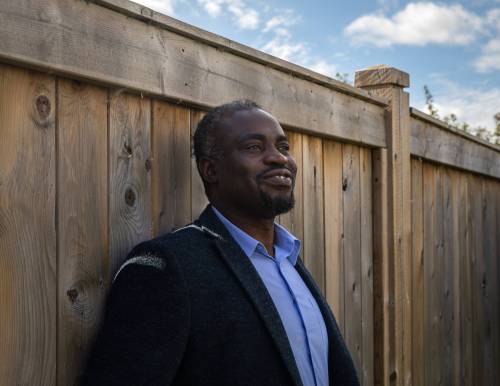
Darin Mays of Minneapolis had been a healthcare software executive for 15 years when the pandemic came and the project he was working on ended. Mays could have accepted a different assignment but decided to leave instead.
While living on his severance package, he made a table that encircles a patio heater for a neighbor, who soon hosted a cookout. “Everyone said this table is great, you should throw it on Etsy.” He did and sold his first one about a week later.
Mays, 38, has a patent pending for his table designs, and he also sells other woodwork at his Etsy store, Urban Wing Co. The shop took in six figures in revenue in 2021, he said, and he’s thinking about expanding.
“The pandemic, as much as it’s been awful, has been an opportunity for innovation,” he said.
The increase in entrepreneurship in the past two years is much different than what happened after the last downturn in 2008-2009, when weak consumer spending and the hangover from the housing bubble dragged on the economy and new business formation fell.
People who start their own companies are counted as employed by the government, lowering the jobless rate. But they aren’t included in the government’s count of total payroll jobs. As a result, the number of new jobs added each month may be understated as more Americans have struck out on their own. The Labor Department issues its latest employment report on Friday.
For Kelly Van Arsdale, 32, a pandemic-related relocation and a fortuitous stroll past a well-located storefront were keys to starting up his own business.
Van Arsdale was a freelance web developer in San Francisco when the pandemic hit. He and his wife decided to move to Seattle in August of 2020, where they could afford more space and be closer to his parents.
During his time in San Francisco, Van Arsdale and his brother had been making chocolate in their garage and giving bars to friends and family. While walking in his North Seattle neighborhood in April of last year, he happened upon an unoccupied storefront that had room for chocolate production. He leased the space, built it out and founded Spinnaker Chocolate in October.
His neighbors were early customers. But reaching a broader clientele online has been harder.
“The pandemic pushed a ton of businesses online and it’s now more expensive than ever to run any amount of advertising,” he said. “Overall, the hardest challenge has been spreading awareness of our brand.”
Freelance designer Emma Gage, 26, was overwhelmed at first when she lost her job right after the coronavirus struck New York. But with pandemic unemployment assistance paired with savings, she soon had the budget to try to start her own fashion label. Her brand, Melke, is gender fluid and uses natural materials.
“I already had a name and logo and I also knew the general ethos of the brand,” she said. “The next steps were to start sourcing and sewing. Since I had the time, I decided why not?”
The label has taken off and she plans a show at New York Fashion week in February. So far, the biggest problems have come from shipping snags.
“Overall, being a new business owner is tough,” Gage said. “I’m learning every day that there are a million things I don’t know.”
In New York City, the pandemic took a heavy toll on the restaurant industry. But it also created new opportunities for some people who had previously toiled on the fringes of the food business.
Elyssa Heller worked in the food and beverage business for 10 years, and was working for a vegan snack company at the start of the pandemic, but wanted to try out her own concept focused on Jewish comfort food.
Heller, 32, initially had success with a bagel pop-up at the popular pizzeria Paulie Gee’s in Brooklyn in 2020. The pop-up concept blossomed in many states as the pandemic either forced limited seating or closed dining rooms altogether.
She eventually opened a sandwich counter in March 2021, and a full-fledged restaurant, Edith’s Eatery & Grocery, in January.
“The New York dining scene was always very exclusive,” she said. Before the pandemic, “there weren’t vacancies and affordable rent options. Someone like me that didn’t have a name in the restaurant space normally wouldn’t have access to the talent I was able to hire.”
Her biggest challenges now are what any restaurant is facing: keeping diners safe and making them feel comfortable eating out and dealing with ever-changing pandemic rules.
“It’s just a day of problem-solving every single day, it’s just a new reality,” she said.
___
AP Economics Writer Christopher Rugaber in Washington contributed.