Treasury urges closer watch on money laundering in fine art

Advertisement

Advertise with us

WASHINGTON (AP) — Fine art isn’t just nice to look at — it’s also attractive to criminals trying to launder money, finance terrorism and trade illegal drugs and arms. And the Treasury Department wants art dealers and financiers to do something about that.

Read this article for free:


or

Already have an account? Log in here »

To continue reading, please subscribe:

Subscribe and receive a limited-edition Free Press branded hat or tote.

Digital Subscription

One year of digital access for only $205*

  • Enjoy unlimited reading on winnipegfreepress.com
  • Read the E-Edition, our digital replica newspaper
  • Access News Break, our award-winning app
  • Play interactive puzzles

*First annual payment billed as $205.00 + GST for one year. This annual subscription will automatically renew at $233.00 + GST every 52 weeks (10% off the regular annual price of $259.35). Offer available to new and qualified returning subscribers only. Cancel any time.

To continue reading, please subscribe:

Add Free Press access to your Brandon Sun subscription for only an additional

$1 for the first 4 weeks*

  • Enjoy unlimited reading on winnipegfreepress.com
  • Read the E-Edition, our digital replica newspaper
  • Access News Break, our award-winning app
  • Play interactive puzzles
Start now

*Your next Brandon Sun subscription payment will increase by $1.00 and you will be charged $17.95 plus GST for four weeks. After four weeks, your payment will increase to $24.95 plus GST every four weeks.

Hey there, time traveller!
This article was published 04/02/2022 (1686 days ago), so information in it may no longer be current.

WASHINGTON (AP) — Fine art isn’t just nice to look at — it’s also attractive to criminals trying to launder money, finance terrorism and trade illegal drugs and arms. And the Treasury Department wants art dealers and financiers to do something about that.

The agency issued a 40-page report Friday recommending that financial firms and art dealers set up an information-sharing database to track how sales of fine art are linked to bad actors who make anonymous purchases.

The need to monitor art sales has become more complicated and necessary with the recent rise in sales of digital assets known as NFTs, or non-fungible tokens.
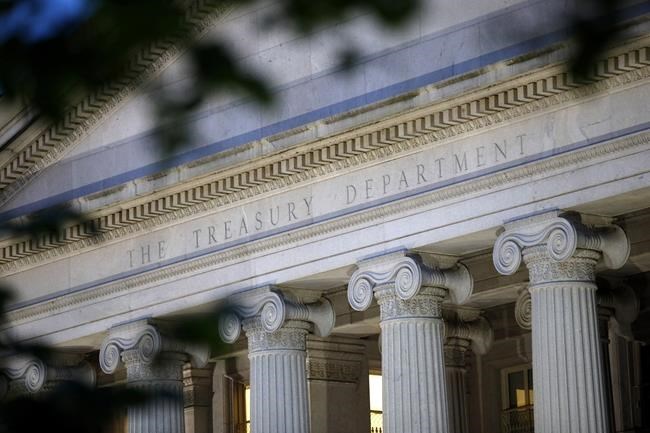
FILIE - This June 6, 2019, photo, shows the U.S. Treasury Department building at dusk in Washington. Fine art isn't just nice to look at. It's also attractive to criminals trying to launder money, finance terrorism and trade illegal drugs and arms. The agency issued a report on Feb. 4, 2022, recommending that financial firms and art dealers set up an information-sharing database to track how sales of fine art are linked to bad actors who make anonymous purchases. (AP Photo/Patrick Semansky, File)

Michael Greenwald, a former Treasury official and adjunct senior fellow at the Center for a New American Security, called the report “a critical first step for there to be a regulatory structure around the broader art market,” which he called one of the last unregulated markets.

“This puts illicit actors and people in the art market on notice that this is a serious issue and will also lead to regulation of the NFT digital art market space,” he said.

In issuing the report, the Treasury Department declined to take more robust steps toward creating new regulations on the art sales, after it found limited evidence of terrorist financing risk.

However, the department did find evidence of money laundering in the high-value art market. A common theme is that criminals use shell companies to buy art and hide behind a corporate veil.

The report cites Brazilian authorities’ seizure of former bank owner Edemar Cid Ferreira’s multimillion dollar art collection, after he was found to have unlawfully taken bank funds to purchase the art. A painting by Jean-Michel Basquiat called “Hannibal,” as well as a Roman Togatus statue had been illegally smuggled into the United States in violation of customs law.

Another example included Mark Bloom, an investment fund manager who pleaded guilty to investment fraud charges after misappropriating least $20 million from a $30 million partnership, which he used for the purchase of high-value art, among other items.

Maureen Bray, executive director of the New York-based Art Dealers Association of America, welcomed a study on the topic rather than immediate regulation, which she said could hurt smaller dealers.

On the recommendation encouraging information-sharing between firms, Bray said, “it’s an interesting idea in principle, but serious thought would be put into how that would work in practice.”

The Treasury study was required by Congress as a part of the Anti-Money Laundering Act of 2020.

It states that financial firms are most vulnerable to money laundering in the art market through art collections used as loan collateral. This sort of lending can be used to disguise the original source of money, the Treasury said.

Scott Rembrandt, who heads strategic policy in the Treasury’s Office of Terrorist Financing and Financial Crimes, said the need to tackle corporate transparency and “loopholes that allow criminals to abuse the financial system” is not just limited to the art world, but also real estate transactions.

In September 2021, Treasury’s financial crimes enforcement arm issued a notice of proposed rulemaking informing financial institutions about the new money-laundering law and reporting requirements related to antiquities, which the agency defines separately from high-value artwork.

“Certain characteristics of the trade in antiquities may be exploited by money launderers and terrorist financiers to evade detection by law enforcement,” the document said.

The issue has become so pervasive that the Group of 20 culture ministers’ meeting last summer included a session on protecting cultural heritage.


Report Error Submit a Tip

More Stories

Winnipeg Jets GM reveals new details of Hellebuyck's trade request, elaborates on suspension

Mike McIntyre 5 minute read Preview

Winnipeg Jets GM reveals new details of Hellebuyck's trade request, elaborates on suspension

Mike McIntyre 5 minute read 12:02 PM CDT

Connor Hellebuyck and his family were subject to so much post-Olympic vitriol that both the Winnipeg Jets security team and even police had to get involved.

General manager Kevin Cheveldayoff revealed new details about the situation when asked about it Thursday by the Free Press, acknowledging it may have played a role in the star goaltender now refusing to report to training camp while he awaits word of a trade he’s demanded.

“That’s the dangers of being on social media today,” said Cheveldayoff, who took aim at the trolls.

“You open yourself up, obviously to the fans and you want to make that connection, but some of the fans aren’t true blue fans. There’s a lot of things that probably get said that have nothing to do with anybody in our market. They might not even be from a Canadian market.”

Read
12:02 PM CDT

Big off-season trade bolsters Pistons

Cassidy Dankochik 7 minute read Preview

Big off-season trade bolsters Pistons

Cassidy Dankochik 7 minute read 1:28 PM CDT

In what’s becoming a regular occurrence, the Steinbach Pistons have nearly a whole new crop of players set to take the ice for them this season.

Just eight players are returning from last year’s squad that finished with the second-highest record in the league.

With such a fresh roster, head coach and general manager Paul Dyck said the Pistons are a “work in progress,” noting this was the first time he’s only had a single-digit number of returnees.

“It takes time,” he said after a team event Sept. 15.

Read
1:28 PM CDT

Winnipeg, police and downtown crime

Editorial 4 minute read Preview

Winnipeg, police and downtown crime

Editorial 4 minute read Yesterday at 2:01 AM CDT

A safer downtown is not much use if people are still afraid to walk there.

That is the uncomfortable message from Winnipeg’s latest police citizen survey, and one city council should take seriously.

Downtown crime has fallen this year, according to the most recent police statistics. Violent crime is down even more. But for most Winnipeggers, the downtown still feels like a place to avoid, particularly after dark.

Only 44 per cent of survey respondents said they feel very or reasonably safe walking alone downtown during the day. At night, that number plunges to just eight per cent. Among women, it is an appalling three per cent, compared with 14 per cent of men.

Read
Yesterday at 2:01 AM CDT

We’re not falling back, springing forward anymore; Manitoba staying on daylight time

Carol Sanders 3 minute read Preview

We’re not falling back, springing forward anymore; Manitoba staying on daylight time

Carol Sanders 3 minute read Updated: 9:55 AM CDT

Time’s up for the time change in Manitoba.

Manitobans won’t be setting their clocks back an hour when daylight time comes to an end elsewhere on Nov. 1.

After surveying residents on the twice annual clock adjustment, the province announced Thursday that it will no longer spring forward and fall back, as has been the case for the majority of the past 110 or so years.

“We heard from Manitobans loud and clear — no more changing the clocks in Manitoba,” Premier Wab Kinew said in a news release Thursday. “Permanent daylight saving time is good for our health, good for business and good for parents… This change means one less adjustment families have to deal with each spring and fall. That’s why this November, your clocks won’t be changing.”

Read
Updated: 9:55 AM CDT

Canada-U.S. trade relationship is broken, but the damage can — and will — be repaired

Tom Brodbeck 5 minute read Preview

Canada-U.S. trade relationship is broken, but the damage can — and will — be repaired

Tom Brodbeck 5 minute read 1:35 PM CDT

Canada needs to get serious about diversifying its trade beyond the United States. But at the same time, Canadians should expect relations with the U.S. to normalize after Donald Trump is no longer in the White House.

For generations, Canada-U.S. trade was considered almost a fact of geography. The two countries share the world’s longest undefended border, deeply integrated supply chains and a century of commercial relationships.

Canadian manufacturers depend on American customers. American manufacturers depend on Canadian suppliers. Energy, agriculture, automotive production and countless other industries operate across the border as though it barely exists.

That isn’t going to change dramatically, even in the midst of a bitter trade war unleashed by the U.S. president.

Read
1:35 PM CDT

Wind and batteries the best bet

James Wilt 5 minute read Preview

Wind and batteries the best bet

James Wilt 5 minute read Yesterday at 2:01 AM CDT

For years, Manitoba Hydro has claimed that we can’t rely on wind turbines during multi-day or even multi-week cold snaps.

Read
Yesterday at 2:01 AM CDT