Scale up B.C. drug-checking programs to save lives: centre on substance use

Advertisement

Advertise with us

VANCOUVER - Checking illicit drugs for deadly toxins is the best option to prevent fatal overdoses without a safer supply, but that service should be expanded to rural and remote communities in British Columbia, says the manager of a drug-checking program being evaluated by the BC Centre for Substance Use.

Read this article for free:


or

Already have an account? Log in here »

To continue reading, please subscribe:

Subscribe and receive a limited-edition Free Press branded hat or tote.

Digital Subscription

One year of digital access for only $205*

  • Enjoy unlimited reading on winnipegfreepress.com
  • Read the E-Edition, our digital replica newspaper
  • Access News Break, our award-winning app
  • Play interactive puzzles

*First annual payment billed as $205.00 + GST for one year. This annual subscription will automatically renew at $233.00 + GST every 52 weeks (10% off the regular annual price of $259.35). Offer available to new and qualified returning subscribers only. Cancel any time.

To continue reading, please subscribe:

Add Free Press access to your Brandon Sun subscription for only an additional

$1 for the first 4 weeks*

  • Enjoy unlimited reading on winnipegfreepress.com
  • Read the E-Edition, our digital replica newspaper
  • Access News Break, our award-winning app
  • Play interactive puzzles
Start now

*Your next Brandon Sun subscription payment will increase by $1.00 and you will be charged $17.95 plus GST for four weeks. After four weeks, your payment will increase to $24.95 plus GST every four weeks.

Hey there, time traveller!
This article was published 19/02/2022 (1677 days ago), so information in it may no longer be current.

VANCOUVER – Checking illicit drugs for deadly toxins is the best option to prevent fatal overdoses without a safer supply, but that service should be expanded to rural and remote communities in British Columbia, says the manager of a drug-checking program being evaluated by the BC Centre for Substance Use.

Jenny Matthews said drug users who live in non-urban areas often can’t get their drugs tested for contaminants, including high concentrations of fentanyl and, increasingly, benzodiazepines, for which the overdose-reversing medication naloxone is not as effective.

“Ideally, we want there to be a safer supply so that people don’t have to fight for access to drug checking, but in the short term we want to try and increase access to testing,” Matthews said.
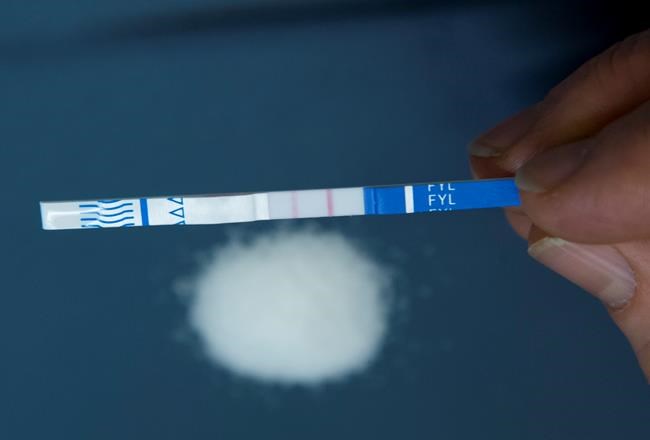
A fentanyl test strip is used at Vancouver Coastal Health in Vancouver, Tuesday, January, 21, 2020. Checking illicit drugs for potentially deadly toxins is the best option to prevent fatal overdose in the absence of a safer supply, but that service should be expanded to rural and remote communities in British Columbia, says the manager of a drug-checking program being evaluated by the BC Centre for Substance Use. THE CANADIAN PRESS/Jonathan Hayward

Health authorities and non-profit groups run drug-checking programs in B.C. using two technologies: take-home test strips that detect the presence of fentanyl or benzodiazepines; and a device called a spectrometer, which is operated by a technician at overdose prevention sites to look for a variety of substances. Results are available in five to 10 minutes.

Matthews said there are 12 spectrometers in the province — five each in the Vancouver Coastal and Interior Health regions, one each in the Fraser and Vancouver Island regions and none in Northern Health.

Data from tiny samples of checked drugs is entered into a provincial database, which is used by the BC Centre on Substance Use to report trends on what’s found in contaminated drugs as a part of a research project funded by Health Canada.

The centre’s latest report, published last month, says 1,180 samples were tested from communities participating in the project, and 88 per cent were from the Vancouver Coastal region. Nine per cent were from Interior Health, two per cent from Vancouver Island and one per cent came from Fraser Health, the largest in the province.

As fentanyl became a dominant drug in B.C., health authorities were issuing alerts about the presence of the opioid in street drugs that were killing so-called opioid naive people with little to no tolerance to it.

Those who developed an addiction to fentanyl, which is 100 times more potent compared with heroin or morphine, needed more of it to stave off withdrawal symptoms like vomiting, nausea and sweating, leading to greater amounts of it being sold in other drugs.

This week, Interior Health issued an urgent drug alert about a high risk of fatal overdose from tested drugs that contain up to 55 per cent fentanyl, up from 10 per cent, and 25 per cent benzodiazepine, often prescribed to treat conditions like anxiety.

Dr. Carol Fenton, a medical health officer with Interior Health, said there are limitations to checking samples to protect those who are at risk of overdose.

“The problem is we don’t have a really good sample of what’s going on the streets because our drug-checking data is only those people who are interested in and willing to bring in their drugs and get them checked. So, I would imagine that’s a relatively small proportion of people using the street supply,” she said.

For Matthews, raising awareness about getting drugs tested is crucial for users smoking, snorting and injecting them.

“What’s really important is that when people are getting their drugs tested, they are having conversations with a technician,” she said, adding the current pilot programs need core funding so more technicians are trained, which would allow the service to be scaled up.

“We’re all hoping that we would never need drug checking and that people could rely on a good supply that was safe to use.”

The coroners’ service says there were a record 2,224 suspected overdose deaths in the province last year, a 26 per cent jump over the previous year.

This report by The Canadian Press was first published Feb. 19, 2022.
Report Error Submit a Tip

More Stories

Labour leaders, councillors urge Wyatt to reconsider re-election bid

Malak Abas 5 minute read Preview

Labour leaders, councillors urge Wyatt to reconsider re-election bid

Malak Abas 5 minute read Updated: Yesterday at 7:29 PM CDT

City councillors and labour leaders called on incumbent Transcona councillor Russ Wyatt to reconsider his decision to seek re-election while facing sexual assault charges.

A day after the longtime councillor announced he would be running again, the Canadian Union of Public Employees Local 500 and the Winnipeg Labour Council, joined by Couns. Cindy Gilroy and Evan Duncan, told reporters Wyatt would not be able to serve Transcona while fighting multiple sexual assault charges in court and should step aside.

The community of Transcona, traditionally known for its working-class roots, has “been through enough drama,” the president of the city’s largest union said.

“I am not declaring him guilty of anything, the courts will decide that, and his lawyer says that he is innocent. I’m stating a plain fact about capacity. Every hour spent on legal defence is an hour not spent on Transcona,” CUPE 500 president Patrick Troughton said at city hall Tuesday afternoon.

Read
Updated: Yesterday at 7:29 PM CDT

Letters, Sept. 23

7 minute read 2:00 AM CDT

Banning gambling ads

Re: Sweeney’s sexist U.S. gambling-site ad isn’t the real problem, Sept. 16

I applaud Dan Lett’s opinion piece regarding online gambling.

Reporting of increasing social issues due to the proliferation of gambling addictions has been thin. Online gambling (not just sports gambling) is super-charging this serious and growing problem.

Decorated business vet Spiring announced as NSL Winnipeg president

Grace Anne Paizen 5 minute read Preview

Decorated business vet Spiring announced as NSL Winnipeg president

Grace Anne Paizen 5 minute read Updated: Yesterday at 12:30 PM CDT

Manitoba’s own Dayna Spiring is no stranger to the sports world, but her latest venture into the world of football — this time of the kick-about variety — is a whole new ball game.

“I’m getting up to speed on that as quickly as I can,” Spiring told the Free Press Tuesday, shortly after the accomplished business leader was announced as Northern Super League Winnipeg’s president.

Spiring joins an already stacked roster on the first women’s professional sports team in the Keystone province alongside the likes of NSL Winnipeg’s decorated co-founders Desiree Scott and Rob Gale.

And her own stats sheet is just as historic. Spiring was one of the first women to serve on the CFL’s Board of Governors and was the first woman to serve as chair of the Winnipeg Football Club’s board of directors. She is also the first woman to have her name engraved on the Grey Cup when the Winnipeg Blue Bombers captured back-to-back titles in 2019 and 2021.

Read
Updated: Yesterday at 12:30 PM CDT

Jets land state-of-the-art dressing room after off-season of renovations

Mike McIntyre 7 minute read Preview

Jets land state-of-the-art dressing room after off-season of renovations

Mike McIntyre 7 minute read 1:46 PM CDT

It’s not just the on-ice product that’s getting an overhaul this season for the Winnipeg Jets.

The hockey club has also undergone an extreme makeover when it comes to player facilities, including a new state-of-the-art dressing room that now rivals any around the league.

And if you don’t think that matters, you haven’t been paying attention.

“We’ve talked about doing everything first class,” head coach Scott Arniel told the Free Press on Tuesday. “We can’t do anything about the weather, but when people come here, we want them to know we look after them and we look after their families.”

Read
1:46 PM CDT

Ignoring AI warning could be the death of us all

Pam Frampton 5 minute read Preview

Ignoring AI warning could be the death of us all

Pam Frampton 5 minute read 2:00 AM CDT

In the 7th century BC, the formative years of Greek literature, the poet Hesiod told the story of Pandora’s Box.

Read
2:00 AM CDT

Manitoba students able to opt out of classes with sensitive lessons on sex, drug use

Maggie Macintosh 6 minute read Preview

Manitoba students able to opt out of classes with sensitive lessons on sex, drug use

Maggie Macintosh 6 minute read Yesterday at 7:08 PM CDT

Manitoba’s premier pledges to continue allowing parents to pull their kids from health class if content — be it related to human sexuality, substance use or otherwise — clashes with personal beliefs.

Wab Kinew said Tuesday the government’s overhaul of phys-ed and health curriculum in Manitoba schools won’t impact the ability for parents to opt-out of a lesson and deliver material as they see fit.

“As a parent, you are your child’s first and most important teacher and that will always be the case,” Kinew said, surrounded by hundreds of teenagers on the football field outside Kelvin High School during an announcement Tuesday.

More than 100 schools are taking part in a voluntary pilot project this fall. It’s the first systematic review of this curriculum in decades. The changes to kindergarten-to-Grade 12 courses will be mandated to all schools in September 2028.

Read
Yesterday at 7:08 PM CDT