Ottawa police push ahead to end protest as bail hearings for organizers move forward
Advertisement
Read this article for free:
or
Already have an account? Log in here »
To continue reading, please subscribe:
Digital Subscription
One year of digital access for only $1.44 a week*
- Enjoy unlimited reading on winnipegfreepress.com
- Read the E-Edition, our digital replica newspaper
- Access News Break, our award-winning app
- Play interactive puzzles
*Billed as $5.77 plus GST every four weeks. After 52 weeks, price increases to the regular rate of $19.95 plus GST every four weeks. Offer available to new and qualified returning subscribers only. Cancel any time.
To continue reading, please subscribe:
Add Free Press access to your Brandon Sun subscription for only an additional
$1 for the first 4 weeks*
- Enjoy unlimited reading on winnipegfreepress.com
- Read the E-Edition, our digital replica newspaper
- Access News Break, our award-winning app
- Play interactive puzzles
*Your next Brandon Sun subscription payment will increase by $1.00 and you will be charged $17.95 plus GST for four weeks. After four weeks, your payment will increase to $24.95 plus GST every four weeks.
Read unlimited articles for free today:
or
Already have an account? Log in here »
Hey there, time traveller!
This article was published 19/02/2022 (1706 days ago), so information in it may no longer be current.
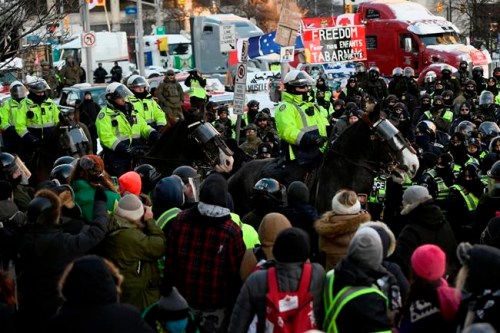
OTTAWA – Police officers donned helmets, wielded batons and deployed pepper spray in downtown Ottawa on Saturday as they tried to clear out protesters putting up what the city’s interim police chief described as a “barrage of resistance” to ending their illegal occupation of the national capital.
Steve Bell said officers had little choice but to use greater force in the face of demonstrators who refused to heed repeated requests to clear the area they’ve occupied for four weeks, adding protest participants have been aggressive toward police and assaulted them on multiple occasions.
“I have been at this podium for the last five days, imploring people to leave, asking them to get out of our streets,” Bell said at an afternoon news conference. “This occupation is over.”
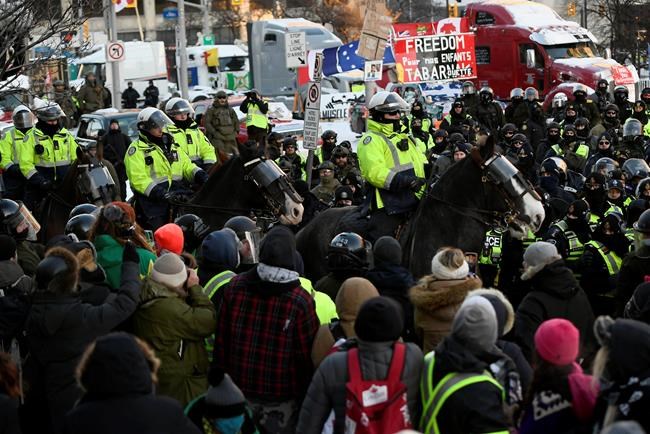
Police later said they deployed mid-range impact weapons on Saturday evening after protesters allegedly assaulted officers with weapons. They said in a tweet that they deployed these weapons to “stop the violent actions of the protesters.”
The second, more acrimonious day of police enforcement operations came as members of parliament resumed debating the government’s decision to invoke the Emergencies Act in an effort to quell the demonstrations, which persisted in cities beyond Ottawa’s borders. At the same time, an Ontario judge reserved a bail decision for one of the protest movement’s key organizers, while another saw his case postponed to early next week.
Earlier in the day, lines of officers clad in riot gear massed along Wellington Street near the Prime Minister’s Office. Officers advanced toward the protesters swinging batons at them, while the crowd pushed back amid shouts of “shame” and “freedom” mixed in with other taunts.
As police forced some in the crowd around a street corner, one man retreated and began washing an eye out with milk, saying he got a face full of pepper spray.
Despite their multiple warnings to leave, the heavy police response appeared to catch some protesters off-guard.
“It has been three weeks of peace and then the cops come in and do this,” said a woman named Valerie, who was in tears and declined to give her last name.
Tom Marazzo, a self-declared spokesperson for protesters, told a news conference that truckers were prepared to leave if police would remove barriers that would allow them to refuel their rigs. He said police hadn’t responded to the request.
That withdrawal did not appear to have taken effect by late afternoon when hundreds of protesters faced off against rows of armed officers south of Wellington Street. The crowd of drum-beating, flag-waving demonstrators, which included at least half a dozen elementary school-aged children, were packed tightly against the police line.
The Children’s Aid Society of Ottawa urged parents to remove their kids from the protest site immediately.
As nightfall came, the street in front of the parliamentary buildings was clear of protesters as snow swirled in the unplowed streets, where some cars and big rigs still remained. Fencing had also been installed to block further access.
Bell said 47 more people had been arrested, bringing the total to 170 since police moved in on Thursday. Police also said 46 vehicles were removed from the downtown core since Friday, while 53 others were towed.
Bell warned police would be working for months to come to identify other protesters and bring criminal charges or financial sanctions against them.
The ongoing police operation prompted Parliamentary Protective Services to place the precinct under a hold and secure order on Saturday, limiting movement between buildings. The service noted the area was not under lockdown and staff were on hand to manage the situation.
In the West Block, MPs in the House of Commons resumed their debate on the government’s historic invocation of the Emergencies Act that had to be paused Friday because of security concerns.
“I talked earlier about my frustration with the failure of Ottawa police, but what we saw yesterday was policing at its best in this country,” NDP MP Charlie Angus said to a light smattering of applause.
Angus called for a public inquiry, saying it was needed to determine why Ottawa police let large trucks enter the national capital and set up a blockade that included bouncy castles while members of the freedom convoy harassed local residents and forced businesses to close.
“We cannot be made to look like a failed state to the world,” he added.
Government House Leader Mark Holland has said MPs will vote early next week on the Emergencies Act motion.
Public Safety Minister Marco Mendicino, meanwhile, said the government’s decision to invoke the Emergencies Act is giving police additional tools to restore order in downtown Ottawa.
“We will only use the Emergencies Act as long as it is necessary,” he told a virtual news conference.
Mendicino noted that authorities used the measure to freeze 76 bank accounts with $3.2 million earmarked for the illegal blockades.
The federal government announced Saturday that $20 million will be made available to downtown Ottawa businesses to help recover from the occupation, with individual eligible businesses able to get a maximum of $10,000.
Elsewhere Tamara Lich, one of the convoy organizers, appeared for a bail hearing in an Ottawa courtroom before Ontario Court Justice Julie Bourgeois. No publication ban was requested in the proceeding.
Lich faces a charge of counselling to commit mischief.
She promised to give up her advocacy of the protest and return to Alberta, leaving Ottawa by vehicle. She told the judge she doesn’t have the required vaccine passport to travel by commercial air and her bank accounts are now frozen.
She pledged a $5,000 bond, saying that was all she could afford, while her husband, Wayne, promised the same amount.
Under cross examination, Wayne Lich told the court that he flew to Ottawa on a private jet to meet his wife in early February. The $5,000 bill was paid for by a man he hardly knew.
He also questioned whether the Emergencies Act was invoked unlawfully by the current Liberal government, saying that people’s right to protest in Canada “was part of our first amendments.”
Bourgeois interjected: “First amendment? What’s that?”
Lich said he didn’t follow politics, and just wanted to make sure his wife was safe.
The judge reserved her bail decision on Lich. She will return to jail until a court appearance on Tuesday morning.
Another prominent protest organizer, Patrick King of Alberta, is expected to appear at a bail hearing early next week after he was arrested by police on Friday.
As in previous weeks, some protests in solidarity with the Ottawa demonstrators unfolded in other parts of the country.
In British Columbia, the Canada Border Services Agency announced the busiest Canada-U.S. border crossing used by the province’s truckers was experiencing a service disruption due to protest activity in the area.
It said the Pacific Highway port of entry remains open, but advised travelers to use an alternative route. RCMP said an arterial road near the border crossing had been closed and access to the border was blocked as a preventative measure to help ensure public safety.
In Quebec, thousands of protesters converged on the provincial legislature to take part in a rally inspired by the Freedom Convoy protest. Horns could be heard as a convoy of vans and cars circled near the legislature. Quebec’s government has already announced its phasing out use of its vaccine passport and intends to withdraw most COVID-19 health measures by March 14.

Protestors in Fredericton, N.B. also staged another anti-mandate rally, with police saying the crowd reached about 100 people at the peak of the protest.
Organizer Adie Pearson of Hampton, N.B., said the demonstration was an effort to maintain momentum.
“We had a rally here last weekend and it was supposed to go non-stop but it petered-off through the week, so we decided to rally some more people up here today,” she said. “We are all here with the common goal of standing up for our human rights.”
This report by The Canadian Press was first published Feb. 19, 2022.
— With files from Sidhartha Banerjee in Montreal, Kevin Bissett in Fredericton and Amy Smart in Vancouver