
Beekeepers using tracking devices to protect precious hives

Advertisement

Advertise with us

WOODLAND, Calif. (AP) — For a few frenzied weeks, beekeepers from around the United States truck billions of honeybees to California to rent them to almond growers who need the insects to pollinate the state's most valuable crop.

Read this article for free:


or

Already have an account? Log in here »

To continue reading, please subscribe:

Subscribe and receive a limited-edition Free Press branded hat or tote.

Digital Subscription

One year of digital access for only $205*

  • Enjoy unlimited reading on winnipegfreepress.com
  • Read the E-Edition, our digital replica newspaper
  • Access News Break, our award-winning app
  • Play interactive puzzles

*First annual payment billed as $205.00 + GST for one year. This annual subscription will automatically renew at $233.00 + GST every 52 weeks (10% off the regular annual price of $259.35). Offer available to new and qualified returning subscribers only. Cancel any time.

To continue reading, please subscribe:

Add Free Press access to your Brandon Sun subscription for only an additional

$1 for the first 4 weeks*

  • Enjoy unlimited reading on winnipegfreepress.com
  • Read the E-Edition, our digital replica newspaper
  • Access News Break, our award-winning app
  • Play interactive puzzles
Start now

*Your next Brandon Sun subscription payment will increase by $1.00 and you will be charged $17.95 plus GST for four weeks. After four weeks, your payment will increase to $24.95 plus GST every four weeks.

Hey there, time traveller!
This article was published 21/02/2022 (1665 days ago), so information in it may no longer be current.

WOODLAND, Calif. (AP) — For a few frenzied weeks, beekeepers from around the United States truck billions of honeybees to California to rent them to almond growers who need the insects to pollinate the state’s most valuable crop.

But as almond trees start to bloom, blanketing entire valleys in white and pink flowers, so begin beehive thefts that have become so prevalent that beekeepers are now turning to GPS tracking devices, surveillance cameras and other anti-theft technology to protect their precious colonies.

Hive thefts have been reported elsewhere in the country, most recently three hives containing about 60,000 bees taken from a grocery chain’s garden in central Pennsylvania. They happen at a larger scale and uniquely in California this time of year because bees are most in demand during the largest pollination event in the world.

Beekeeper Hello Medina displays a beehive frame outfitted with a GPS locater that will be installed in one of the beehives he rents out, in Woodland, Calif., Thursday, Feb. 17, 2022. As almond flowers start to bloom, beekeepers rent their hives out to farmers to pollinate California's most valuable crop, but with the blossoms come beehive thefts. Medina says last year he lost 282 hives estimated to be worth $100,000, and is now installing GPS-enabled sensors to help find the stolen hives. (AP Photo/Rich Pedroncelli)

In the past few weeks, 1,036 beehives worth hundreds of thousands of dollars were reported stolen from orchards statewide, authorities said. The largest heist involved 384 beehives that were taken from a field in Mendocino County, prompting the state beekeepers association to offer a $10,000 reward for information leading to their recovery.

“It’s hard to articulate how it feels to care for your hives all year only to have them stolen from you,” Claire Tauzer wrote on Facebook to spread the word about the reward. A day later, an anonymous tipster led authorities to recover most of the boxes and a forklift stolen from Tauzer’s family business some 55 miles (88 kilometers) away, at a rural property in Yolo County. One suspect was arrested.

Investigators also found frames, the kinds used to hold the honeycomb, belonging to Helio Medina, another beekeeper who lost 282 hives a year ago.

Medina said the theft devastated his apiary, so this year he placed GPS trackers inside the boxes. He also strapped cable locks around them and installed cameras nearby. As the almond bloom approached and the hives became most valuable, he drove around patrolling the orchards in the dark.

“We have to do what we can to protect ourselves. Nobody can help us,” Medina said.

Thefts usually happen at night, when no one is in the orchard and the bees are back in their hives. The rustler is usually a beekeeper or someone familiar with the transportation of bees.

“More often than not, they steal to make money and leave the bees to die,” said Rowdy Jay Freeman, a Butte County sheriff’s detective who has been keeping track of hive thefts since 2013.

Trevor Tauzer, whose family-owned business, Tauzer Apiaries, rents beehives for crop pollination, inspects a beehive rented to an almond grower in Woodland, Calif., Tuesday, Feb. 15, 2022. About a thousand beehive boxes worth hundreds of thousands of dollars have been reported stolen across California the past few weeks. The thefts have become so frequent that beekeepers are putting tracking devices, surveillance cameras and other anti-theft technology to protect their hives. (AP Photo/Rich Pedroncelli)

A tightening supply of bees and soaring pollination fees — jumping from less than $50 to rent a hive two decades ago to as much as $230 per hive this year — are likely motivating beekeepers to go rogue.

The demand for bees has steadily risen over the last 20 years as popularity of the healthy, crunchy nut turned California into the world’s biggest almond producer. Accordingly, the amount of land used to grow almonds has more than doubled to an estimated 1.3 million acres (526,000 hectares).

Beekeepers have been keeping up with that growth by providing an ever-increasing proportion of the nation’s available stock of hives. This year, a survey of commercial beekeepers estimated it will take 90% of honeybee colonies in the U.S. to pollinate all the almond orchards.

“What that means is that beekeepers are coming from as far as New York and Florida, and to get them to come all that way, pollinator fees have to rise,” said Brittney Goodrich, an agriculture economist at the University of California at Davis.

But bee populations are notoriously unstable due to a host of problems, including disease, loss of habitat and insecticides.

The drought that gripped Western states last summer also weakened colonies. The lack of rain ravaged wildflowers that provide the nectar that bees turn into honey. Beekeepers had to artificially supplement their diet with sugar solutions and pollen substitutes — and incur more costs.

For beekeepers, the loss of a hive means the loss of income from honey production and future pollination, not to mention the expense of managing the hive throughout the year. They say they hardly break even.

Jesus Llamas, field operations manager for beehive supplier Tauzer Apiaries, uses smoke to calm the bees before inspecting one of the companies hives in an almond orchard in Woodland, Calif., Tuesday, Feb. 15, 2022. About a thousand beehive boxes worth hundreds of thousands of dollars have been reported stolen across California the past few weeks. The thefts have become so frequent that beekeepers are putting tracking devices, surveillance cameras and other anti-theft technology to protect their hives. (AP Photo/Rich Pedroncelli)

“For every $210 paid to rent a beehive, we put close to that much into it the whole year feeding the bees because of drought. We do all the health checks, which is labor intensive, and we pay our workers full benefits,” Tauzer said.

Denise Qualls, a pollination broker who connects beekeepers with growers, suspects the thefts are happening because beekeepers can’t provide the strong colonies they promised, “so they can get the money from the grower and then they leave the hives.”

“The grower is just as responsible when they accept them,” she said.

To help her clients track their investments, Qualls merged her business with tech startup Bee Hero to equip hive boxes with a GPS-enabled sensor.

Freeman, who got into beekeeping after investigating his first hive theft, said he advises beekeepers to use security cameras and put their names and phone numbers on the boxes.

He said some beekeepers have tried tagging their boxes with SmartWater CSI, a forensic tool used to help police trace recovered stolen property. The clear liquid is visible only under UV light, even through layers of paint, so police can ascertain the rightful owner even when thieves try to disguise boxes.

To raise the crime’s severity, Freeman worked with prosecutors in 2016 to charge a man accused of stealing 64 beehives with theft of livestock. Under California law, theft of property worth $950 or less is classified as a misdemeanor. But the theft of any agricultural product worth at least $250 is considered a felony.
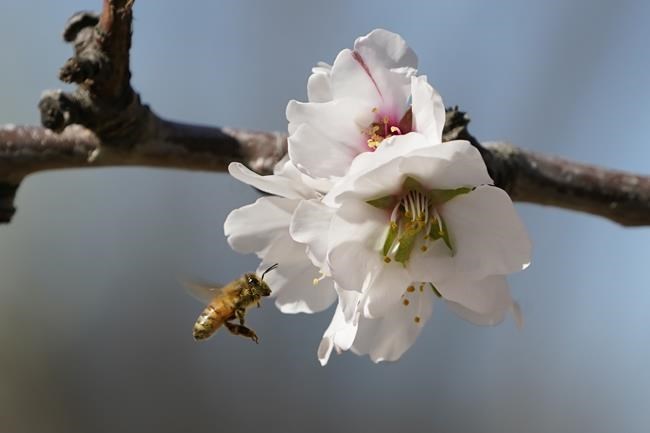
A bee approaches an almond blossom in an orchard near Woodland, Calif., Thursday, Feb. 17, 2022. About a thousand beehive boxes worth hundreds of thousands of dollars have been reported stolen across California the past few weeks. The thefts have become so frequent that beekeepers are putting tracking devices, surveillance cameras and other anti-theft technology to protect their hives. (AP Photo/Rich Pedroncelli)

“Stealing one or 10 or 100 hives would result in the same charge,” he said.

The man pleaded guilty and was sentenced to 90 days in jail and three years probation.

The California State Beekeepers’ Association urges beekeepers to communicate regularly with growers about where their hives are placed, and encourages growers to hire reputable beekeepers who can show proof of ownership of their hives. The almond industry, meanwhile, is trying to reduce its dependence on bees by growing “self fertile” almond varieties that require fewer bees for pollination and by investing in research and other initiatives aimed at improving their health.

The Almond Board of California also joined a coalition of agricultural, environmental and government groups to create habitat for wild bees, butterflies and other pollinators on privately owned working lands such as cattle ranches and orchards. The state government is funding $15 million toward the effort, calling it an investment in “climate smart agriculture.”

Report Error Submit a Tip

More Stories

Canadians loving Carney’s decision to stand tall against floundering U.S. bully

Tom Brodbeck 5 minute read Preview

Canadians loving Carney’s decision to stand tall against floundering U.S. bully

Tom Brodbeck 5 minute read Yesterday at 12:11 PM CDT

It’s hard to imagine a more dramatic political contrast than the one unfolding on opposite sides of the Canada-U.S. border.

Mark Carney is fighting a trade war with Donald Trump, taking the occasional verbal punch from the American president and imposing retaliatory tariffs on U.S. products.

And the prime minister is being rewarded for it politically.

Trump, meanwhile, is fighting pretty much everyone he can find — including some of America’s closest allies — and his own voters are increasingly giving him the political equivalent of a raised middle finger. That’s quite a tale of two leaders.

Read
Yesterday at 12:11 PM CDT

Artist’s inspired work brings Red River Métis story back to Portage and Main

Conrad Sweatman 8 minute read Preview

Artist’s inspired work brings Red River Métis story back to Portage and Main

Conrad Sweatman 8 minute read Updated: Yesterday at 2:47 PM CDT

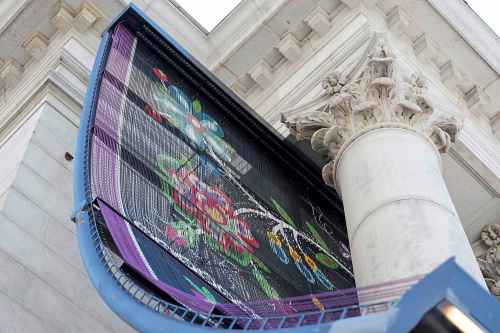
Jennine Krauchi calls them the “grandmothers.” “They speak to you very silently. You never hear a word, but they speak,” Krauchi says, referring to the antique pieces of Métis needlework she’s carefully studied for years. But there are few precedents for her latest art project: a 85-foot-wide by 32-foot-high chain curtain of Métis needlework that drapes over the historic Bank of Montreal’s neoclassical facade.

Read
Updated: Yesterday at 2:47 PM CDT

Is Trump about to poke Quebec’s political beehive?

Peter McKenna 6 minute read Preview

Is Trump about to poke Quebec’s political beehive?

Peter McKenna 6 minute read 2:00 AM CDT

When was the last time that a U.S. president seriously stirred the hornet’s nest of Quebec politics?

My best recollection is former U.S. president Bill Clinton. During the 1994 Quebec referendum campaign, Clinton made clear that the U.S. wholly endorsed a united and strong federal Canada — as opposed to a dismembered one. He went on to add that an independent Quebec would have no guarantee of joining the North American Free Trade Agreement as a full-fledged member.

Today, we see U.S. President Donald Trump inserting himself — unwittingly or wittingly — into the electoral and sovereignty politics of Quebec. It’s pretty clear that the resurgent Coalition Avenir Québec government is trying to make the Oct. 5 provincial election about anything other than its own governmental record and more about Trump’s economic coercion against Canada. Of course, the Parti Québécois, the odds-on-favourite, wants to make the electoral contest a referendum on the CAQ and its party leader, Christine Fréchette.

But what if Trump really wanted to make his presence felt in Quebec’s political life? How much influence could he have on shaping political outcomes in Quebec? How much of an “X factor” could he be?

Read
2:00 AM CDT

Nifty neighbours also jonesing for geniality

Maureen Scurfield 4 minute read 2:01 AM CDT

DEAR MISS LONELYHEARTS: Recently, a new couple with no children moved onto our cul de sac, and everybody is taking notice! This attractive pair with no kids both drive amazing cars, work from home and leave their garage doors up a lot. Everybody on the street walks by to sneak a peek into the big garage at just about any time of day.

Lately, the man’s been out on his front lawn in a muscle shirt in the late afternoon, planting shrubs and putting up stylish fall-themed ornaments. At night they often leave the living-room curtains open. That makes for convenient viewing for curious neighbours like us!

A few days ago, my wife invited the new couple over for a barbecue and swim in our pool. They are really nice people, but mentioned that other people nearby have been pretty stand-offish. They wonder why. Should I tell them it’s probably just jealousy over their beautiful vehicles and enviable lifestyle, or should I just shut up?

—Wanting to Help, Sage Creek

Chrétien says Canada bows to no one in fiery address at 9/11 commemoration

Sarah Smellie, The Canadian Press 7 minute read Preview

Chrétien says Canada bows to no one in fiery address at 9/11 commemoration

Sarah Smellie, The Canadian Press 7 minute read Updated: Yesterday at 8:15 PM CDT

GANDER - Former prime minister Jean Chrétien drew a standing ovation inside a Gander, N.L., hockey arena on Friday as he delivered a pointed message to American leaders during a ceremony marking the 9/11 terrorist attacks in the United States, 25 years ago.

The 92-year-old warned Americans never to mistake Canadian generosity for weakness, nor its kindness for softness.

U.S. Ambassador Pete Hoekstra looked on as Chrétien insisted his pointed words were a sign of friendship. Friends tell each other the truth, he said.

“We embraced our friends and we helped them in their moment of need, but we bow to no one,” Chretien said, as the crowd erupted again.

Read
Updated: Yesterday at 8:15 PM CDT

Closure of Nomads field massive upset for North End

Joshua Frey-Sam 5 minute read Preview

Closure of Nomads field massive upset for North End

Joshua Frey-Sam 5 minute read Updated: Yesterday at 8:49 AM CDT

The North Winnipeg Nomads have a flag on the field.

The long-standing minor football club was recently informed that its field is unfit to host games and that it would need to find a new home for its five youth and adult teams until repairs are made to the playing surface.

“Our board has made every effort to address the condition of our home field,” the club wrote in a statement. “Unfortunately, following a professional assessment, the field has been determined to be unsafe and unstable for our athletes.”

All five of the club’s teams will play their 2026 season at Frank Whyte Field, part of the Northwood Community Centre, with no confirmed date for when they can play on their home field again.

Read
Updated: Yesterday at 8:49 AM CDT