

She left her teaching job to become a ‘Wren coder’ for the navy in 1943
Advertisement
Read this article for free:
or
Already have an account? Log in here »
To continue reading, please subscribe:

Digital Subscription
One year of digital access for only $205*
- Enjoy unlimited reading on winnipegfreepress.com
- Read the E-Edition, our digital replica newspaper
- Access News Break, our award-winning app
- Play interactive puzzles
*First annual payment billed as $205.00 + GST for one year. This annual subscription will automatically renew at $233.00 + GST every 52 weeks (10% off the regular annual price of $259.35). Offer available to new and qualified returning subscribers only. Cancel any time.
To continue reading, please subscribe:
Add Free Press access to your Brandon Sun subscription for only an additional
$1 for the first 4 weeks*
- Enjoy unlimited reading on winnipegfreepress.com
- Read the E-Edition, our digital replica newspaper
- Access News Break, our award-winning app
- Play interactive puzzles
*Your next Brandon Sun subscription payment will increase by $1.00 and you will be charged $17.95 plus GST for four weeks. After four weeks, your payment will increase to $24.95 plus GST every four weeks.
Read unlimited articles for free today:
or
Already have an account? Log in here »
Hey there, time traveller!
This article was published 08/03/2022 (1678 days ago), so information in it may no longer be current.
In 1943, 21-year-old Lucille Brough left her job as a first-grade teacher in Shawville, Que., to enlist in the Women’s Royal Canadian Naval Service (WRCNS) to serve her country and help fight fascism in the Second World War.
“I never got to be an officer,” recalled Lucille, who is now Lucille Lane, speaking from the Amica Westboro Park retirement home in Ottawa. “None of our class did, because it was late in the war; we were all late joining the Wrens.’”
Although Lane considers herself late signing up to work with the Wrens (the colloquial name for the WRCNS), most people would call her ahead of her time. Especially when you consider that a women’s auxiliary unit of the Canadian naval forces had only even been in existence for a year before she joined. Before the Second World War, women were barred from any form of military service, except in nursing roles.
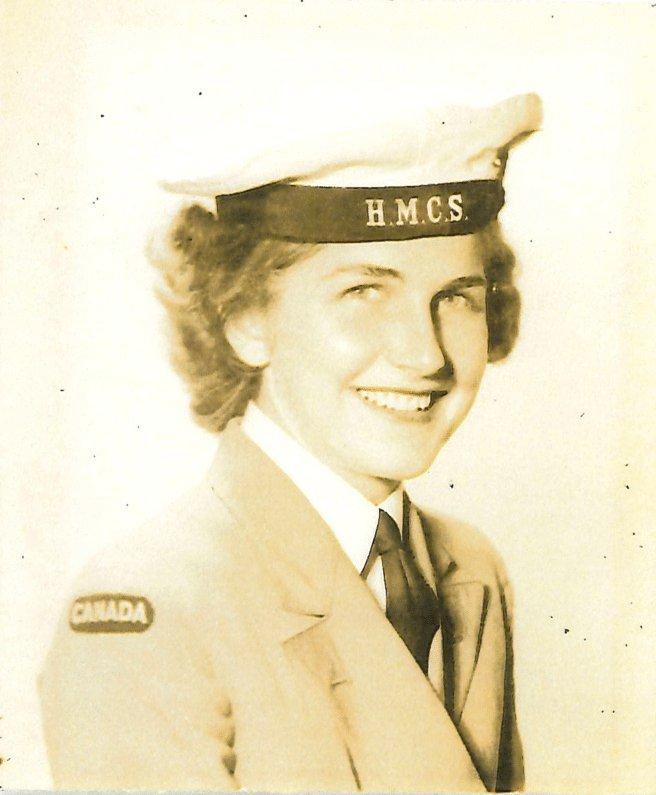
Led by figures like Joan Kennedy (who would go on to become Lt. Col. Kennedy, Canada’s first female soldier) women who wanted to serve their country formed groups and lobbied the federal government to create women’s divisions of the military. The Canadian Women’s Army Corps and the Canadian Women’s Auxiliary Air Force were both established in 1941; the Wrens came the following year.
Of the nearly 50,000 Canadian women who served in the armed forces in the Second World War, the vast majority were initially trained to assume supportive roles: clerks, drivers and telephone operators. Their roles expanded as the war went on, though, and many wound up working as “listeners,” particularly in the navy, which attracted nearly 7,000 recruits during the war.
“I was a ‘Wren coder,’ so we coded and decoded naval messages and other messages, too,” said Lane, who just celebrated her 100th birthday on Valentine’s Day. “First we had to learn to march and then it took some time to learn Morse and other codes. It was really fascinating work.”
Although stories about the Wren coders, along with the First Nations coders who used codes that the Germans couldn’t crack, are starting to become better known, the important role both groups of coders played is still relatively obscure compared to other military operations. Part of the reason for this may be the fact that coders were sworn to secrecy.
“Loose lips sink ships,” said Lane, who notes that it wasn’t simply a saying then but the literal truth about her job. She recalls that her bosses impressed upon her unit that it was a big responsibility and any small error, even being a few minutes late, could impact an entire ship.
Besides the tens of thousands of women who served in the war, hundreds of thousands of women took up jobs, roughly doubling the size of the women’s workforce. Toronto’s Bren Gun Girls, who manufactured weapons at John Inglis and Company in Toronto, are some of the most well-known, but every one of the women who performed a seemingly unconventional role played a part in advancing gender equality.
And their work has also helped to reduce violence and promote peace, since gender equality is the single biggest predictor of peace in any nation. Gender equality is a bigger factor predicting peace than either a country’s economy or its political system. That’s why 45 years ago, when the United Nations declared March 8, International Women’s Day, an official UN holiday in 1977, it specified that the day was dedicated to women’s rights and world peace. The two go hand in hand.
This year, as we reflect on International Women’s Day and watch the many brave women in Ukraine taking up arms to fight, it’s important to think about the relationship between equality and peace. Whether it’s the former Miss Ukraine, Anastasiia Lenna, dressed in combat gear and holding a rifle, or a woman yelling at Russian soldiers and telling them to put sunflower seeds in their pockets (so they’ll grow when they die on Ukrainian soil), it’s never been more obvious that bravery has no gender.
And never has, as we see with women like Lane and the tens of thousands of other Canadian women who joined the war effort 80 years ago.
Lane doesn’t see her past as particularly out of the ordinary. Her fiancé was also in the navy, stationed in the Pacific, so she had a good understanding of what service was like. And it helped her feel like she was serving alongside him. The two managed to get a brief leave together and Lucille married her childhood sweetheart, Captain Robert L. Lane, before the war ended.
“Thanks to the coding job I had, I could keep track of my husband in the Pacific,” she said.
“I wasn’t doing anything extraordinary or brave, you know. I was just part of a group of women who became part of the new era.”
Christine Sismondo is a Toronto-based writer and contributor to the Star. Follow her on Twitter: @sismondo