WEATHER ALERT

Threading the needle

German-based couple’s integrity, intelligence and innovation led to pioneering COVID-19 vaccine

Advertisement

Advertise with us

It’s difficult to comprehend that COVID-19 has been with us for just over two years. In December 2019 and early January 2020, we began to feel tremors of a new virus that was causing significant concern in a Chinese city of which many had never heard. Most of us went on with our lives, thinking that this virus would behave like the swine flu of 2009 or the 2002-2004 SARS outbreak — minor blips that would fizzle out before a vaccine could ever come close to production.

Read this article for free:

or

Already have an account? Log in here »

To continue reading, please subscribe:

Subscribe and receive a limited-edition Free Press branded hat or tote.

Digital Subscription

One year of digital access for only $205*

  • Enjoy unlimited reading on winnipegfreepress.com
  • Read the E-Edition, our digital replica newspaper
  • Access News Break, our award-winning app
  • Play interactive puzzles

*First annual payment billed as $205.00 + GST for one year. This annual subscription will automatically renew at $233.00 + GST every 52 weeks (10% off the regular annual price of $259.35). Offer available to new and qualified returning subscribers only. Cancel any time.

To continue reading, please subscribe:

Add Free Press access to your Brandon Sun subscription for only an additional

$1 for the first 4 weeks*

  • Enjoy unlimited reading on winnipegfreepress.com
  • Read the E-Edition, our digital replica newspaper
  • Access News Break, our award-winning app
  • Play interactive puzzles
Start now

*Your next Brandon Sun subscription payment will increase by $1.00 and you will be charged $17.95 plus GST for four weeks. After four weeks, your payment will increase to $24.95 plus GST every four weeks.

Hey there, time traveller!
This article was published 12/03/2022 (1600 days ago), so information in it may no longer be current.

It’s difficult to comprehend that COVID-19 has been with us for just over two years. In December 2019 and early January 2020, we began to feel tremors of a new virus that was causing significant concern in a Chinese city of which many had never heard. Most of us went on with our lives, thinking that this virus would behave like the swine flu of 2009 or the 2002-2004 SARS outbreak — minor blips that would fizzle out before a vaccine could ever come close to production.

But due to ingenuity, hyper-intelligence and luck, two German scientists knew that this new virus was different. Doctors Ozlem Tureci and Ugur Sahin, married Turkish immigrants who would develop a leading edge biotech company called BioNTech, were the right people at the right time to ensure that millions of lives would be saved.

In The Vaccine: Inside the Race to Conquer the COVID-19 Pandemic, author Joe Miller, the Financial Times correspondent in Frankfurt, captures the unfathomable miracle in real time that would eventually create the BioNTech-Pfizer vaccine in less than a year. Tracing the scientists’ roots back to childhood and then to a courtship on a cancer ward in Germany, Miller creates a timeline of why and how BioNTech, and Tureci and Sahin, were the “secret sauce” for the development of a vaccine that has protected billions of people.
Boris Roessler / The Associated Press files
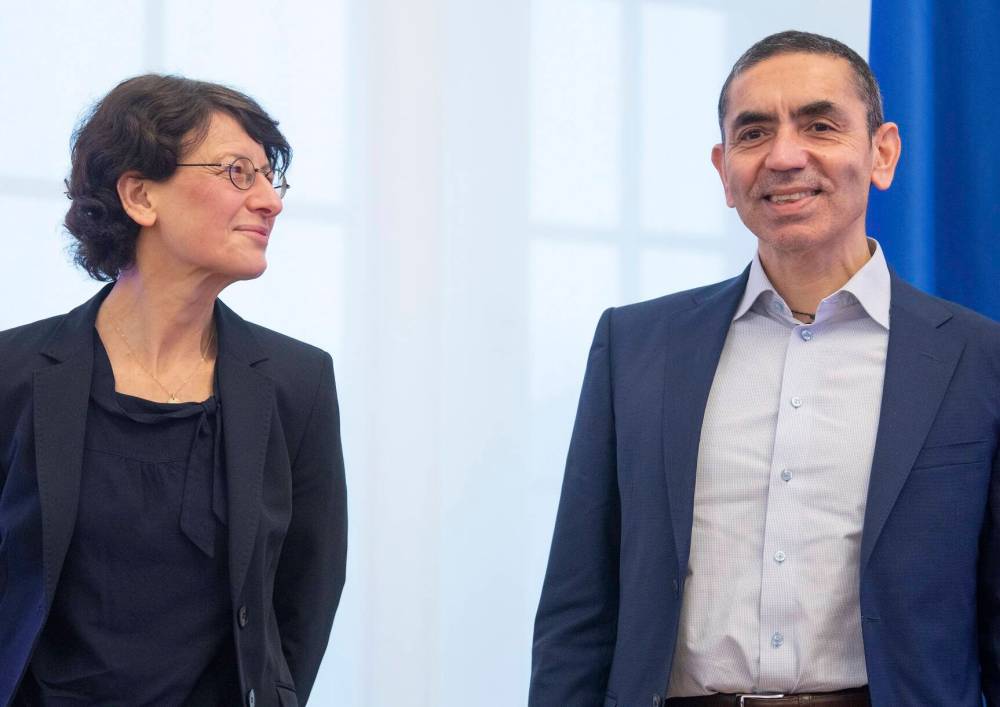
BioNTech co-founders Ozlem Tureci (left) and Ugur Sahin.
Boris Roessler / The Associated Press files BioNTech co-founders Ozlem Tureci (left) and Ugur Sahin.

Originally a small pharmaceutical company devoted to finding cancer treatments based on mRNA technology, Tureci and Sahin were highly confident BioNTech’s genetic toolbox could be used to help create a desperately needed vaccine. In January 2020, Sahin did the math from their small apartment as he began to see reports out of Wuhan.

To his dismay, he knew we were in trouble. “I understood instantly that we were going to face two potential scenarios: either a very fast pandemic which kills millions within a couple of months, or a prolonged epidemic situation which will last for the next sixteen to eighteen months,” he says. As it has turned out, it was the latter; worse so, the virus was being transmitted by people who showed no symptoms. A perfect storm.

BioNTech set out immediately in January 2020 to begin to create a series of vaccines that might latch on to the now-famous crown-like protein of the coronavirus. Through existing but unproven mRNA technology and the backing of the billionaire oligarchy — a theme not critically analyzed by Miller to much extent — Tureci and Sahin assembled teams that worked around the clock to develop a lipid wrapper that would prevent the disintegration of the vaccine as it is exposed to the atmosphere. “For mRNA drugs to be viable, they needed to be shielded as they traveled through the body to find a cell,” they write.

Project Lightspeed, which was the name for the quest to find a vaccine, simultaneously had to ensure that it had the funding to keep the relatively small pharma afloat. Through last-minute deals with backers who scour medical journals for the next big thing — and an eventual deal with pharma giant Pfizer — BioNTech was able to create a viable product by March 27, 2020.

The problem, however, was that it needed to be tested. Due to the advanced technology that mRNA presented, Phase 1 and toxicology tests could be shortened. Furthermore, the BioNTech team was able to convince regulators in both Europe and the U.S. to speed up the process given the evidence produced through testing on rodents. By April 23, the first human volunteer received a jab from a BioNTech-Pfizer vaccine, and by the end of May 2020 the vaccine was ready — a seemingly inconceivable task and one of the most significant scientific feats in human history.

The Vaccine
The Vaccine

And, famously, on December 8, 91-year-old Maggie Keenan of Great Britain was the first person to receive the vaccination. “Less than ten months after he and Ozlem discussed the possibility of developing an mRNA vaccine against an unnamed pathogen in China, their lead candidate had been found to be more than 90 percent effective at preventing disease,” Miller writes.

Since then, most Canadians who seek an end to the pandemic have had their jabs, have anxiously anticipated getting their kids to supersites and have encouraged their reluctant neighbours to get theirs. Vaccines are our way out of this pandemic, there is no doubt.

For Miller, whether overtly or not, the underlying story to the development of species-saving vaccines and cancer treatments is dependent on a billionaire class whose focus is to expand its fortunes. This tension is evident at every corner, as Tureci and Sahin, now billionaires themselves, had to navigate bloodthirsty capital at every step to avoid compromising the goal of Project Lightspeed — to save lives.

In the end, however, it was their relationship, integrity, intellect and unwavering dedication to humanity that propelled Project Lightspeed to success. According to Miller, and much like many of history’s turning points, it was “the character of Ugur and Ozlem” that changed the course of time. As he writes, “It is people, not papers, that really make the difference.”

Matt Henderson is assistant superintendent of Seven Oaks School Division.
Frederic Sierakowski / The Associated Press files
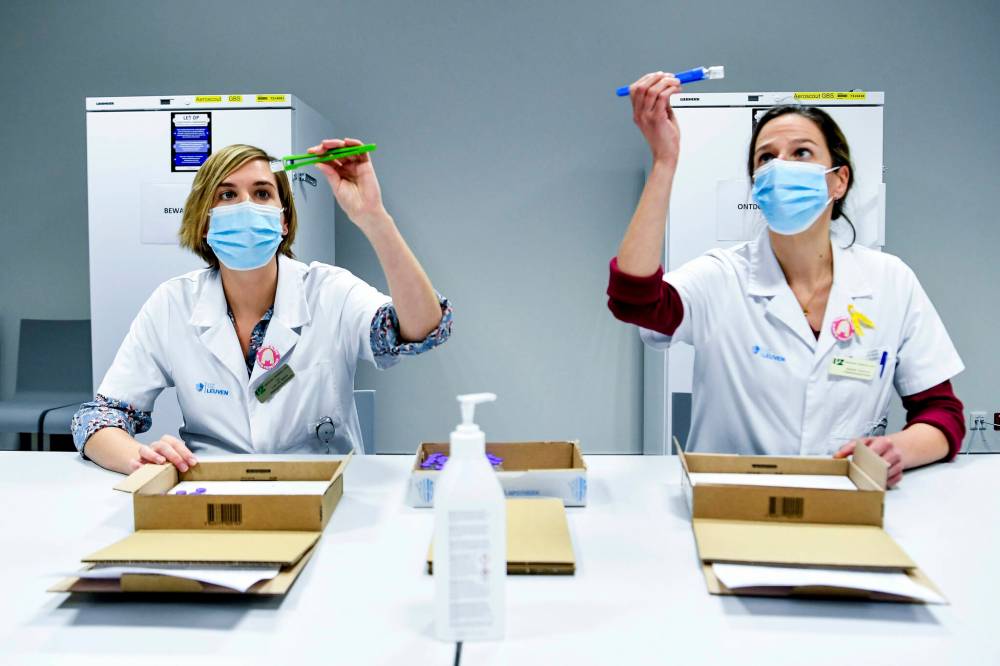
In this 2020 photo, health workers inspect vials of the Pfizer-BioNTech COVID-19 vaccine as they are thawed in a lab at the UZ Leuven hospital in Leuven, Belgium. The first human recipient of the mRNA vaccine got their jab on April 23, 2020.
Frederic Sierakowski / The Associated Press files In this 2020 photo, health workers inspect vials of the Pfizer-BioNTech COVID-19 vaccine as they are thawed in a lab at the UZ Leuven hospital in Leuven, Belgium. The first human recipient of the mRNA vaccine got their jab on April 23, 2020.
History

Updated on Saturday, March 12, 2022 9:34 AM CST: Corrects typo.

Report Error Submit a Tip

More Stories

Province, MPI want court to toss Tesla bid for review of exclusion from EV rebate program

Erik Pindera 3 minute read Preview

Province, MPI want court to toss Tesla bid for review of exclusion from EV rebate program

Erik Pindera 3 minute read 3:47 PM CDT

The provincial government and Manitoba Public Insurance have filed court papers asking a judge to throw out the Canadian subsidiary of Tesla’s application for a judge to review the province’s exclusion of the automaker from a taxpayer-funded rebate program.

The company filed its application for judicial review in the Court of King’s Bench in late April, seeking to have a judge review and overturn the Manitoba government’s decision to exclude Tesla vehicles from its rebate for electric vehicle purchases and leases.

The company argues the decision was unreasonable and procedurally unfair.

The government announced Tesla’s exclusion from the program, which MPI administers, in March 2025 under the province’s “commitment to be elbows up” in retaliation for tariffs imposed by United States President Donald Trump who, at the time, had given Elon Musk, the CEO of Texas-based Tesla Inc., a job in his administration.

Read
3:47 PM CDT

Former teacher would suit up with Bombers in just ninth game of three-down loop career

Taylor Allen 6 minute read Preview

Former teacher would suit up with Bombers in just ninth game of three-down loop career

Taylor Allen 6 minute read Yesterday at 6:02 PM CDT

In a way, Micah Vanterpool’s brief stint as a Grade 3 teacher in his hometown of Tulsa, Okla., prepared him for life in the CFL.

The third-year offensive lineman for the Winnipeg Blue Bombers only has eight career games on his resumé as he has bounced around between the practice roster, starting lineup and injury report.

But thanks to his time in the classroom, he’s developed the patience that’s required by a young American trying to make a name for oneself in the three-down loop.

Vanterpool got into teaching after failing to make the New England Patriots in 2023. He said goodbye to the education profession the following year and took his talents up north to Winnipeg.

Read
Yesterday at 6:02 PM CDT

German-based couple’s quick work led to pioneering COVID-19 vaccine

Reviewed by Matt Henderson 5 minute read Preview

German-based couple’s quick work led to pioneering COVID-19 vaccine

Reviewed by Matt Henderson 5 minute read Saturday, Mar. 12, 2022

It’s difficult to comprehend that COVID-19 has been with us for just over two years. In December 2019 and early January 2020, we began to feel tremors of a new virus that was causing significant concern in a Chinese city of which many had never heard. Most of us went on with our lives, thinking that this virus would behave like the swine flu of 2009 or the 2002-2004 SARS outbreak — minor blips that would fizzle out before a vaccine could ever come close to production.

But due to ingenuity, hyper-intelligence and luck, two German scientists knew that this new virus was different. Doctors Ozlem Tureci and Ugur Sahin, married Turkish immigrants who would develop a leading edge biotech company called BioNTech, were the right people at the right time to ensure that millions of lives would be saved.

In The Vaccine: Inside the Race to Conquer the COVID-19 Pandemic, author Joe Miller, the Financial Times correspondent in Frankfurt, captures the unfathomable miracle in real time that would eventually create the BioNTech-Pfizer vaccine in less than a year. Tracing the scientists’ roots back to childhood and then to a courtship on a cancer ward in Germany, Miller creates a timeline of why and how BioNTech, and Tureci and Sahin, were the “secret sauce” for the development of a vaccine that has protected billions of people.

Originally a small pharmaceutical company devoted to finding cancer treatments based on mRNA technology, Tureci and Sahin were highly confident BioNTech’s genetic toolbox could be used to help create a desperately needed vaccine. In January 2020, Sahin did the math from their small apartment as he began to see reports out of Wuhan.

Read
Saturday, Mar. 12, 2022

South Osborne residents fail in bid to prevent construction of 131-unit apartment tower

Malak Abas 4 minute read Preview

South Osborne residents fail in bid to prevent construction of 131-unit apartment tower

Malak Abas 4 minute read 3:01 PM CDT

A proposed 10-storey highrise on an empty south Osborne lot will move forward despite concerns from residents about the impact the building will have on nearby parking and traffic.

The city-owned lot at 425 Osborne St., which previously served as a gas station but has long sat vacant, will be developed into a mixed-use residential building with 131 units, 39 of which would be affordable, along with additional office space for the adjacent Winnipeg Transit garage and the Transit customer service centre across the street, along with a two-level parkade for tenants and Transit employees.

The property is being developed by the University of Winnipeg Community Renewal Corp. 2.0, and designed by Prairie Architects Inc.

At a meeting held by city council’s appeal committee Wednesday, several residents said while they supported the idea of more housing in the Lord Roberts neighbourhood, they had lingering concerns about the impact the development will have on the already-busy area.

Read
3:01 PM CDT

Students continue to criticize handling of MITT’s closure

Morgan Modjeski 5 minute read Preview

Students continue to criticize handling of MITT’s closure

Morgan Modjeski 5 minute read Monday, Jul. 27, 2026

Students at a Manitoba trade college say their education has been hampered as a result of its impending closure and they blame government for a poor transition.

The provincial government announced in January it would close the Manitoba Institute of Trades and Technology because it was no longer financially viable following the federal government’s decision to cut the number of international students allowed to study in Canada.

Officials have said students would remain the top priority as 19 programs from MITT are set to be absorbed by Red River College Polytech.

Kieran Smith, an electrical applications student at MITT, said it feels like those in charge “don’t really care.”

Read
Monday, Jul. 27, 2026

Ex’s stubborn persistence no laughing matter

Maureen Scurfield 4 minute read Yesterday at 2:00 AM CDT

DEAR MISS LONELYHEARTS: When I got into a bank lineup recently, I had no idea who queued up behind me, because I was too busy checking my phone. Then I heard this guy say down my neck, “Just as beautiful as ever!”

I whirled around and saw my ex-boyfriend grinning at me. I waited for him to finish at the bank, so we could go for coffee at a breakfast place and catch up. But that was it for me — coffee and a chat! Unfortunately, he wants more of “us” and he’s been calling me every night since. The guy’s in sales now, and he’s using his new techniques, but he’s going overboard and really annoying me now!

How do you tell a past boyfriend to cease and desist? To be fair, he’s said nothing overly inappropriate, except how he’s really loving my new look and that he wants to see me again. Why isn’t he getting the hint when I refuse all his suggestions to do more together?

— Getting Fed Up, East Kildonan