Once a powerful symbol in Russia, McDonald’s withdraws

Advertisement

Advertise with us

Two months after the Berlin Wall fell, another powerful symbol opened its doors in the middle of Moscow: a gleaming new McDonald’s.

Read this article for free:


or

Already have an account? Log in here »

To continue reading, please subscribe:

Subscribe and receive a limited-edition Free Press branded hat or tote.

Digital Subscription

One year of digital access for only $205*

  • Enjoy unlimited reading on winnipegfreepress.com
  • Read the E-Edition, our digital replica newspaper
  • Access News Break, our award-winning app
  • Play interactive puzzles

*First annual payment billed as $205.00 + GST for one year. This annual subscription will automatically renew at $233.00 + GST every 52 weeks (10% off the regular annual price of $259.35). Offer available to new and qualified returning subscribers only. Cancel any time.

To continue reading, please subscribe:

Add Free Press access to your Brandon Sun subscription for only an additional

$1 for the first 4 weeks*

  • Enjoy unlimited reading on winnipegfreepress.com
  • Read the E-Edition, our digital replica newspaper
  • Access News Break, our award-winning app
  • Play interactive puzzles
Start now

*Your next Brandon Sun subscription payment will increase by $1.00 and you will be charged $17.95 plus GST for four weeks. After four weeks, your payment will increase to $24.95 plus GST every four weeks.

Hey there, time traveller!
This article was published 14/03/2022 (1672 days ago), so information in it may no longer be current.

Two months after the Berlin Wall fell, another powerful symbol opened its doors in the middle of Moscow: a gleaming new McDonald’s.

It was the first American fast-food restaurant to enter the Soviet Union, reflecting the new political openness of the era. For Vlad Vexler, who as a 9-year-old waited in a two-hour line to enter the restaurant near Moscow’s Pushkin Square on its opening day in January 1990, it was a gateway to the utopia he imagined the West to be.

“We thought that life there was magical and there were no problems,” Vexler said.
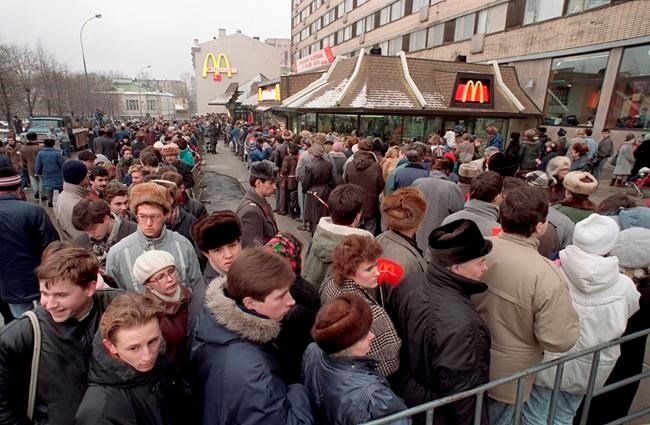
FILE - Hundreds of Muscovites line up outside the first McDonald's restaurant in the Soviet Union on its opening day, in Moscow, Wednesday, Jan. 31, 1990. Two months after the Berlin Wall fell, another powerful symbol opened its doors in the middle of Moscow: a gleaming new McDonald’s. It was the first American fast-food restaurant to enter the Soviet Union. But now, McDonald's is temporarily closing its 850 restaurants in Russia in response to the Ukraine invasion. (AP Photo, File)

So it was all the more poignant for Vexler when McDonald’s announced it would temporarily close that store and nearly 850 others in response to Russia’s invasion of Ukraine. McDonald’s Russian website on Monday read: “Due to operational, technical and logistical difficulties, McDonald’s will temporarily suspend service at its network enterprises from March 14.”

“That McDonald’s is a sign of optimism that in the end didn’t materialize,” said Vexler, a political philosopher and author who now lives in London. “Now that Russia is entering the period of contraction, isolation and impoverishment, you look back at these openings and think about what might have been.”

McDonald’s said in a statement that “at this juncture, it’s impossible to predict when we might be able to reopen our restaurants in Russia.” But it is continuing to pay its 62,500 Russian employees. The company said this week that it expects the closure to cost around $50 million per month.

Outside a McDonald’s in Moscow last week, student Lev Shalpo bemoaned the closure.

“It’s wrong because it was the only affordable place for me where I could eat,” he said.

Just as McDonald’s paved the way for other brands to enter the Soviet market, its exit led to a cascade of similar announcements from other U.S. brands. Starbucks closed its 130 outlets in Russia. Yum Brands closed its 70 company-owned KFC restaurants and was negotiating the closure of 50 Pizza Huts that are owned by franchisees.

McDonald’s entry into the Soviet Union began with a chance meeting. In 1976, McDonald’s loaned some buses to organizers of the 1980 Moscow Olympics who were touring Olympic venues in Montreal, Canada. George Cohon, then the head of McDonald’s in Canada, took the visitors to McDonald’s as part of the tour. That same night, the group began discussing ways to open a McDonald’s in the Soviet Union.

Fourteen years later, after Soviet laws loosened and McDonald’s built relationships with local farmers, the first McDonald’s opened in downtown Moscow. It was a sensation.

On its opening day, the restaurant’s 27 cash registers rang up 30,000 meals. Vexler and his grandmother waited in a line with thousands of others to enter the 700-seat store, entertained by traditional Russian musicians and costumed characters like Mickey Mouse.

“The feeling was, ‘Let’s go and see how Westerners do things better. Let’s go and see what a healthy society has to offer,’” Vexler said.

Vexler saved money for weeks to buy his first McDonald’s meal: a cheeseburger, fries and a Coca-Cola. The food had a “plasticky goodness” he had never experienced before, he said.

Eileen Kane visited the original McDonald’s often in 1991 and 1992 when she was an exchange student at Moscow State University. She found it a striking contrast from the rest of the country, which was suffering frequent food shortages as the Soviet Union collapsed.

“McDonald’s was bright and colorful and they never ran out of anything. It was like a party atmosphere,” said Kane, who is now a history professor at Connecticut College in New London, Connecticut.
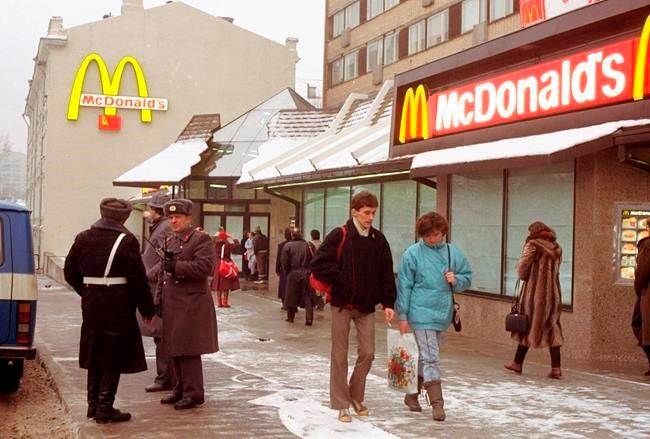
FILE - People walk past Moscow's first McDonalds a day before its opening, in Moscow's Pushkin Square, Jan. 30, 1990. Two months after the Berlin Wall fell, McDonald’s opened its doors in the middle of Moscow. It was the first American fast-food restaurant to enter the Soviet Union. But now, McDonald's is temporarily closing its 850 restaurants in Russia in response to the Ukraine invasion. (AP Photo/Vicktor Yurchenko, File)

McDonald’s entry into the Soviet Union was so groundbreaking it gave rise to a political theory. The Golden Arches Theory holds that two countries that both have McDonald’s in them won’t go to war, because the presence of a McDonald’s is an indicator of the countries’ level of inter-dependence and their alignment with U.S. laws, said Bernd Kaussler, a political science professor at James Madison University in Harrisonburg, Virginia.

That theory held until 2014, when Russia annexed Crimea, Kaussler said.

Kaussler said the number of countries now withdrawing from Russia, and the speed with which they acted, is unprecedented. He thinks some __ including McDonald’s __ might calculate that it’s unwise to reopen, which would leave Russia more isolated and the world less secure.

“As the Russian economy is becoming less inter-dependent with the U.S. and Europe, we basically have fewer domestic economic factors that could mitigate current aggressive policies,” Kaussler said.

Vexler said the admiration for the West that caused Russians to embrace McDonald’s three decades ago has also shifted. Russians now tend to be more anti-Western, he said.

Anastasia Chubina visited a McDonald’s in Moscow last week because her child wanted one last meal there. But she was indifferent about its closure, suggesting Russians will get healthier if they stop eating fast food.

“I think we lived without it before and will live further,” she said.

Entrepreneur Yekaterina Kochergina said the closure could be a good opportunity for Russian fast-food brands to enter the market.

“It is sad, but it’s not a big deal. We’ll survive without McDonald’s,” she said.
Report Error Submit a Tip

More Stories

Person killed in workplace accident at Fairmont construction site

Morgan Modjeski 3 minute read Preview

Person killed in workplace accident at Fairmont construction site

Morgan Modjeski 3 minute read Friday, Oct. 9, 2026

Emergency responders were on scene and Manitoba Workplace Safety and Health is investigating after a worker died following an incident at a Winnipeg construction site Thursday.

Little information about the worker killed was provided, but the fatal incident happened at the Fairmont Winnipeg, located at 2 Lombard Place, with police responding around 5 p.m.

The hotel is currently closed and is an active construction site. The person killed has not been identified by name.

Information from a provincial spokesperson said the deceased was working for Kepsco Construction when they were fatally injured after a “portion of an overhead canopy collapsed during asbestos abatement work.”

Read
Friday, Oct. 9, 2026

Puppies, stocks — ‘zoomies’ abound

Andrew Froese 4 minute read Yesterday at 2:01 AM CDT

This spring, I adopted a three-month-old rescued German Shepherd mix. To say she is easily excitable is an understatement.

It is not really her fault. A puppy’s frontal cortex, the part of the brain that helps with decision-making and impulse control, is still developing. When an older dog, or a human, gets tired, we generally understand we should rest. Puppies have not quite figured that out. They often interpret tiredness as a signal something is wrong, which makes them more alert, more reactive and harder to settle.

That creates a feedback loop. The puppy gets tired, which makes her frantic, which makes her more tired, which makes her even more frantic. Eventually, this becomes what people call the “zoomies”: frantic sprinting, biting, jumping and general chaos.

From the outside, it looks like the puppy has too much energy. In reality, the opposite is true. The zoomies are not a sign of excess energy. They are a sign the puppy is overtired and does not know it yet.

Phoneless concert a beautiful chance to bask in moment

Jen Zoratti 5 minute read Preview

Phoneless concert a beautiful chance to bask in moment

Jen Zoratti 5 minute read Yesterday at 2:01 AM CDT

Outside the Scotiabank Arena in Toronto, digital billboards flashed fans their singular photo op for the night: “I took this photo before I saw Phoebe Bridgers: The Lost Tour 2026.”

It is, as it is for so many other people, my only documentation of a concert by one of my favourite artists. The American singer-songwriter — who I discovered at the Winnipeg Folk Festival in 2018 — has had a meteoric rise in the past few years, winning three Grammys in 2024 as one third of Boygenius, the indie-rock supergroup rounded out by Lucy Dacus and Julien Baker, and opening for Taylor Swift on select dates of her titanic Eras Tour.

Now, Bridgers is touring in support of Lost Weekend, her third album and first since 2020’s Punisher. It’s a feat of a record, a richly textured meditation on loss and grief, written in the aftermath of the death of her dad, with whom she had a complicated relationship.

So she is in a position to not only play multiple sold-out arena shows, but also insist that those shows be phone-free.

Read
Yesterday at 2:01 AM CDT

Chopped trees will leave a ‘blight’ on Windsor Park

Kelly-Anne Riess 3 minute read Preview

Chopped trees will leave a ‘blight’ on Windsor Park

Kelly-Anne Riess 3 minute read Friday, Oct. 9, 2026

Robert Gordon has watched the trees grow along a popular Windsor Park walking path for nearly six decades.

Now, as Manitoba Hydro cuts them down to protect nearby power lines, he says a familiar part of his childhood neighbourhood is disappearing.

Although he no longer lives in the area, Gordon regularly returns to walk or cycle along the tree-lined path, which runs parallel to Archibald Street.

He was concerned when he recently spotted crews clearing vegetation near the entrance to the path, but initially assumed they were removing brush. When he returned, he discovered the clearing had extended farther along the corridor.

Read
Friday, Oct. 9, 2026

Jets encouraged by play through first five games

Mike McIntyre 6 minute read Preview

Jets encouraged by play through first five games

Mike McIntyre 6 minute read Yesterday at 4:21 PM CDT

Turkey. Stuffing. And a heaping helping of rest and recovery.

The Winnipeg Jets have plenty to be thankful for this holiday weekend, including a solid 3-1-1 start to the NHL campaign. Players and coaches are also counting their blessings at finally getting a breather after a busy stretch of five games in eight days.

“We don’t have another (break like this) until a week before Christmas. So we’re going to take advantage of it,” head coach Scott Arniel said following the club’s first regulation loss, a 5-1 stinker on Friday night against the visiting Anaheim Ducks.

To borrow a funny old Thanksgiving-related phrase from former defenceman Nate Schmidt, the hockey club was “leaking gravy.” They looked like a group that could use a timeout — which they’ll get since they don’t play again until hosting the Minnesota Wild on Tuesday night.

Read
Yesterday at 4:21 PM CDT

Stuart-Stevenson tandem gives Jets time for best Hellebuyck trade deal

Mike McIntyre and Ken Wiebe 8 minute read Preview

Stuart-Stevenson tandem gives Jets time for best Hellebuyck trade deal

Mike McIntyre and Ken Wiebe 8 minute read Friday, Oct. 9, 2026

A weekly lap around the NHL by Free Press hockey writers Ken Wiebe and Mike McIntyre

The New York Islanders are first-overall. The Calgary Flames are in the league basement.

We’re talking about goaltending, specifically the metric of “goals against above expected” as tracked by the Money Puck website which factors in shot quality and location and is a much better measure than traditional numbers such as goals-against-average and even save percentage, which can be heavily influenced by team factors.

In a nutshell, you want to be as high as possible on this list, suggesting your masked men are doing their job by stopping everything they should — and hopefully a few more. The lower you are in the 32-team league, the more likely you have a leaky crease.

Read
Friday, Oct. 9, 2026