UK easing COVID-19 testing, monitoring despite case uptick
Advertisement
Read this article for free:
or
Already have an account? Log in here »
To continue reading, please subscribe:
Digital Subscription
One year of digital access for only $1.44 a week*
- Enjoy unlimited reading on winnipegfreepress.com
- Read the E-Edition, our digital replica newspaper
- Access News Break, our award-winning app
- Play interactive puzzles
*Billed as $5.77 plus GST every four weeks. After 52 weeks, price increases to the regular rate of $19.95 plus GST every four weeks. Offer available to new and qualified returning subscribers only. Cancel any time.
To continue reading, please subscribe:
Add Free Press access to your Brandon Sun subscription for only an additional
$1 for the first 4 weeks*
- Enjoy unlimited reading on winnipegfreepress.com
- Read the E-Edition, our digital replica newspaper
- Access News Break, our award-winning app
- Play interactive puzzles
*Your next Brandon Sun subscription payment will increase by $1.00 and you will be charged $17.95 plus GST for four weeks. After four weeks, your payment will increase to $24.95 plus GST every four weeks.
Read unlimited articles for free today:
or
Already have an account? Log in here »
Hey there, time traveller!
This article was published 16/03/2022 (1677 days ago), so information in it may no longer be current.
LONDON (AP) — After dropping nearly all coronavirus restrictions last month, Britain is now ending some of its most widespread COVID-19 testing and monitoring programs, a move some scientists fear will complicate efforts to track the virus and detect worrisome new variants.
Officials have largely dismissed those concerns, despite a recent uptick in cases across Europe, insisting that high immunization rates will help dampen future waves of disease.
Based on how quickly new variants have arisen, some experts suggest the next one could arrive as early as May. They warn that U.K. authorities should be using the time to prepare, rather than winding down their pandemic defenses.
Mark Woolhouse, an epidemiologist at the University of Edinburgh, called it “an unfortunate pattern” that has been seen repeatedly throughout the outbreak.
“Every time one wave of COVID passes, the government acts as if it’s the end of the pandemic,” he said.
Without testing and monitoring, new clusters or signs that the virus is evolving could be missed, Woolhouse said.
“I do not understand why governments are not learning this lesson,” he said.
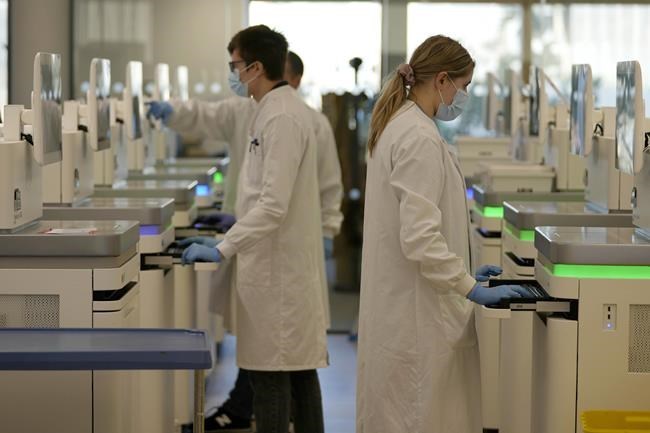
Last week, the U.K. announced it was suspending funding for one of the world’s biggest and most comprehensive coronavirus monitoring programs, in addition to ditching research that tracks in real time symptoms and infections in health workers. And as of April, free COVID-19 tests for most people in England will also end.
As most COVID-19 restrictions are relaxed across Europe, including Austria, Britain, Denmark, Germany and France, the numbers of infections have inched higher in recent days. The uptick is driven in part by the slightly more infectious omicron descendant BA.2 and by people largely abandoning masks and gathering in bigger groups.
In the last two weeks, COVID-19 hospitalizations and deaths have both risen slightly in Britain.
British Health Secretary Sajid Javid described the increase as “expected” and the country as “in a very good position.”
Numerous health leaders in the U.K. have questioned the wisdom of abandoning free testing and measures like stopping financial support for people with infections who are isolating.
“The government cannot wave a magic wand and pretend the threat has disappeared entirely,” said Matthew Taylor, chief executive of Britain’s National Health Service.
Other officials, however, have pointed out that the testing and monitoring programs are enormously pricey. Last month, Swedish authorities halted wide-scale testing, saying that the cost and relevance was no longer justifiable.
“If we were to have extensive testing adapted to everyone who has COVID-19, that would mean half a billion kronor a week (about $55 million) and 2 billion a month ($220 million),” said Swedish Public Health Agency chief Karin Tegmark Wisell last month, when their testing programs were shelved.
U.K. officials have now apparently made the same calculation.
“The question is whether we can afford to keep using these expensive tools if it appears that COVID is becoming endemic,” said Julian Tang, a virologist at the University of Leicester.
He said it was likely the virus was evolving into a more transmissible and less dangerous form, but acknowledged that process could take years — and that we would probably face sporadic surges until that happens.
Salim Abdool Karim, an infectious diseases epidemiologist at the University of KwaZulu-Natal who previously advised the South African government, said there were clues in COVID-19’s track record that allow for an “educated guess.” As the country that first detected omicron and where it spread first, South Africa has been closely monitored by many European and other public health scientists to see what might come next in the pandemic.
Karim predicts the next big surge of disease could come within weeks, noting that South Africa had been hit with COVID-19 surges every three months, meaning the next wave could start in May.
Dr. Paul Hunter, a professor of medicine at Britain’s University of East Anglia, said we would likely see another variant or two every year, based on how rapidly coronaviruses mutate.
Still, many experts don’t think future waves of COVID-19 will be as brutal as the past.
“We’re in a different place, because we have vaccines and we know what works,” said Dr. Wafaa El-Sadr, chair of global health at Columbia University.
“In the meantime, it is the wrong time to dismantle the strong public health systems we’ve relied on throughout the pandemic,” El-Sadr said.
____
The Associated Press Health and Science Department receives support from the Howard Hughes Medical Institute’s Department of Science Education. The AP is solely responsible for all content.
___
Follow AP’s coverage of the pandemic at https://apnews.com/hub/coronavirus-pandemic