Experts weigh in on how the more infectious Omicron subvariant could shape the spring

Advertisement

Advertise with us

As several countries report an uptick in COVID-19 cases partly blamed on a more contagious version of the Omicron variant, the question becomes whether Canada's next wave will be a surge or a ripple.

Read this article for free:


or

Already have an account? Log in here »

To continue reading, please subscribe:

Subscribe and receive a limited-edition Free Press branded hat or tote.

Digital Subscription

One year of digital access for only $205*

  • Enjoy unlimited reading on winnipegfreepress.com
  • Read the E-Edition, our digital replica newspaper
  • Access News Break, our award-winning app
  • Play interactive puzzles

*First annual payment billed as $205.00 + GST for one year. This annual subscription will automatically renew at $233.00 + GST every 52 weeks (10% off the regular annual price of $259.35). Offer available to new and qualified returning subscribers only. Cancel any time.

To continue reading, please subscribe:

Add Free Press access to your Brandon Sun subscription for only an additional

$1 for the first 4 weeks*

  • Enjoy unlimited reading on winnipegfreepress.com
  • Read the E-Edition, our digital replica newspaper
  • Access News Break, our award-winning app
  • Play interactive puzzles
Start now

*Your next Brandon Sun subscription payment will increase by $1.00 and you will be charged $17.95 plus GST for four weeks. After four weeks, your payment will increase to $24.95 plus GST every four weeks.

Hey there, time traveller!
This article was published 22/03/2022 (1607 days ago), so information in it may no longer be current.

As several countries report an uptick in COVID-19 cases partly blamed on a more contagious version of the Omicron variant, the question becomes whether Canada’s next wave will be a surge or a ripple.

The confluence of easing COVID-19 protocols and the rise of BA.2, a sublineage of the Omicron variant, is complicating the epidemiological forecast for spring, experts say.

While most agree that Canada’s immunization rates should blunt the impacts of the so-called “stealth” subvariant, some worry that decreased public health vigilance could clear a path for BA.2 to drive up infections and hospitalizations.

Chief Public Health Officer of Canada Dr. Theresa Tam speaks during a news conference on the COVID-19 pandemic in Ottawa on Tuesday, Dec. 22, 2020. As several countries report an uptick in COVID-19 cases that has been partly blamed on a more contagious version of the Omicron variant, the question becomes whether Canada's next wave will be a surge or a ripple. THE CANADIAN PRESS/Justin Tang

Canada’s chief public health officer suggested last week that the country should be shielded from the worst of the COVID-19 resurgence that’s roiling regions abroad, instead predicting a spring “blip” as public health measures are lifted.

While evidence suggests that BA.2 is more transmissible than its Omicron predecessor, the subvariant is spreading at a relatively slow rate in Canada, said Dr. Theresa Tam.

It doesn’t appear to to cause more severe illness than other variants, she said, but international data suggests BA.2 targets people who aren’t protected by vaccination or previous exposure to the Omicron variant.

That means Canada’s high immunization uptake — with 81 per cent of the population considered fully vaccinated — should keep hospitalizations at manageable levels even if cases rise, said Tam.

But Dr. Lynora Saxinger, an infectious disease specialist at the University of Alberta, warned that the risks of BA.2 could be unevenly distributed across Canada.

Omicron reinfection appears to be rare, Saxinger said, so regions that were hit hard by the BA.1 surge may fare better than those where the variant hasn’t been circulating.

“I think it will be very variable between even cities, communities and provinces, and overall across the country,” she said. “In places where they haven’t had a lot of infection recently, I think there is a bit more risk that this highly transmissible variant could make a bigger wave.”

Another factor to consider is uptake of third vaccine doses, which do a lot “heavy lifting” in protecting against severe outcomes from Omicron infection, said Saxinger. Federal numbers suggest that roughly 46 per cent of the population has received a booster shot.

What’s less clear to Saxinger is whether reimposing COVID-19 rules would do much to curb BA.2’s spread, noting that the subvariant has gained steam in places with strict public health measures.

“I think there’s a wide playing field in between giving up, which I don’t think is the right answer, and doing some sort of draconian lockdown on an early signal.”

Caroline Colijn, a mathematician and epidemiologist at Simon Fraser University, isn’t convinced that BA.2 will register as just a “blip” in Canada’s COVID-19 trajectory.

The Canada 150 Research Chair in Mathematics for Evolution, Infection and Public Health said her modelling suggests that Canada is well positioned to weather an uptick in transmission driven by either BA.2 or relaxing COVID-19 restrictions independently, but the combination of the two could cause problems.

“We can be very resilient to a rise in transmission, and BA.2 will give us a rise in transmission. But reducing our measures and removing our protections will also give us another rise in transmission at the same time,” Colijn said.

“I think we are resilient to some increase in transmission. But I think we will probably see a surge from these two increases in transmission arriving at the same time.”

Of particular concern to Colijn is how BA.2 could affect those who are most vulnerable to severe COVID-19 outcomes, such as people who are older or immunocompromised.

These groups were prioritized for early boosters in many parts of the country, Colijn noted, and so the immunity provided by these doses are more likely to have waned in the months since.

As many provinces have restricted access to testing, Colijn said, we may not have the data we need to measure to increased COVID-19 transmission before hospitalizations tick up, at which point, it’ll be too late to contain the situation.

“I think we should be going into this with our eyes open and watching carefully,” she said.

This report by The Canadian Press was first published March 22, 2022.

Report Error Submit a Tip

More Stories

Rise of social media reflects rise of self-promotion — to the detriment of genuine storytelling

Reviewed by Matt Henderson 5 minute read Preview

Rise of social media reflects rise of self-promotion — to the detriment of genuine storytelling

Reviewed by Matt Henderson 5 minute read 3:00 AM CDT

A conversation is overheard between two people; one congratulates the other on their success, evident through countless posts on LinkedIn, but the other confesses the prolific aggrandizement is due to slumping success.

A young man on an airplane spends three hours poring over selfies taken on a vacation, zooming in on his biceps and using AI to retouch photos before posting on Instagram.

Anonymous and cowardly trolls on Reddit attempt to end another person’s career.

All this “storytelling” was observed in one day by this reviewer.

Read
3:00 AM CDT

Trailblazing Western Scrap Metals heavy-equipment operator relishes role at massive crane’s control

David Sanderson 7 minute read Preview

Trailblazing Western Scrap Metals heavy-equipment operator relishes role at massive crane’s control

David Sanderson 7 minute read Yesterday at 10:15 AM CDT

Less than five per cent of heavy-equipment operators in the country are women but that number is trending upward, according to a study conducted by trade magazine Crane & Hoist Canada.

It was reported that in Ontario roughly eight per cent of jobs in the transport and heavy-equipment field are currently held by women. Furthermore, in 2024 almost 20 per cent of graduates at an Edmonton-based heavy-equipment operator training school were female, the article stated.

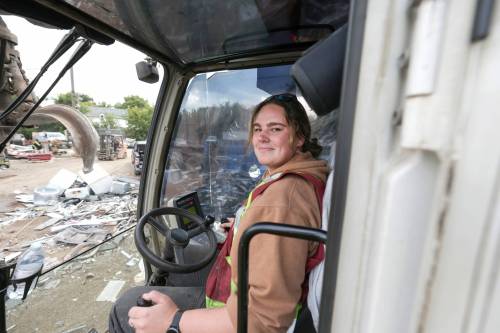
That brings us to Harmony Guspodarchuk, the first female crane operator in the 70-year history of Western Scrap Metals, a family-owned business at 18 Sutherland Ave.

Three years ago, Guspodarchuk literally stepped into the driver’s seat of a 27,500-kilogram, Liebherr C 924 Heavy Lift Litronic crane. The 29-year-old hasn’t looked back much since.

Read
Yesterday at 10:15 AM CDT

Proposed Transcona development — which could add 20,000 people — gets thumbs down from residents

Joyanne Pursaga 5 minute read Preview

Proposed Transcona development — which could add 20,000 people — gets thumbs down from residents

Joyanne Pursaga 5 minute read Yesterday at 6:15 PM CDT

Dozens of Winnipeggers fear plans to make way for up to 20,000 more people to live in south Transcona would dramatically alter their neighbourhood and tie hefty fees for new services to their property titles.

If city council adopts the proposed South Transcona secondary plan, all future development applications would need to conform to its goals. The affected area is located south of Dugald Road, north of St. Boniface Road, east of Plessis Road and west of Murdock Road.

Homeowner Virginia Page Jähne fears the plan could add a massive tab to the title of her 4.3-acre property to cover services required for the development.

“My main concern is that they are wanting to put $1.4 million onto my title to pay for this. Now, they say that I will not have to pay it unless I subdivide. But if a person comes by and wants to buy from me … and they see that $1.4 million … what’s the first thing (they’re) going to do?” said Page Jähne, in an interview.

Read
Yesterday at 6:15 PM CDT

Meetings accomplish something that an email never could while respecting people’s time, building relationships

Tory McNally 7 minute read Preview

Meetings accomplish something that an email never could while respecting people’s time, building relationships

Tory McNally 7 minute read 3:00 AM CDT

There are few workplace experiences that unite employees quite like complaining about meetings. Ask almost anyone what frustrates them at work, and somewhere on the list will be the meeting that could have been an email. We’ve all been there. Thirty minutes scheduled for a simple update somehow turns into an hour. Half the attendees don’t need to be there. Someone shares their screen for ten minutes trying to find the right document. The meeting ends with everyone wondering what was actually decided.

It’s no surprise that organizations are looking for ways to reduce meeting fatigue. Every hour spent in a meeting is an hour that isn’t spent serving customers, solving problems, writing reports, or completing projects. As calendars become increasingly crowded, employees often find themselves working longer days simply to catch up on the work they couldn’t accomplish because they were in meetings.

The obvious solution seems simple: hold fewer meetings. In many cases, that’s exactly the right answer. Routine updates, policy reminders, project status reports, and information that doesn’t require discussion can often be shared through email and chat platforms. Not every piece of information deserves everyone’s calendar.

But eliminating meetings altogether would create a different problem, especially as more organizations embrace hybrid and remote work.

Read
3:00 AM CDT

Puzzles Palace

1 minute read Monday, Jul. 27, 2026

To solve our puzzles, please subscribe with this special offer: |

Big Loser’s latest a winning mix of country, folk

Ben Waldman 5 minute read Preview

Big Loser’s latest a winning mix of country, folk

Ben Waldman 5 minute read 6:00 AM CDT

The yellow trucker hat for sale on Facebook Marketplace said “Selkirk Lumber,” so Adam Wayne Brown knew he had to hammer home a deal.

Like the other millennial members of Winnipeg folk-country band Big Loser, the bassist has an affinity for the nostalgic, taking every opportunity — through music, through lyrics and through wardrobe — to recall the unique circumstances of growing up in a changing Interlake.

“I remember the matte yellow trucks driving around — the lumber trucks — and so I’ve had this strange memory of something disappearing from my youth and then persisting,” says Brown, who, like the band’s frontman Alex Paradoski, moved to Winnipeg more than a decade ago.

“I have a photo of the Lockport Bridge in my dining room,” chimes in Paradoski, whose first job as a teenager was bunning wieners and chopping fries at Skinner’s, a drive-in mainstay since 1929 along Highway 44.

Read
6:00 AM CDT