As NY preps pot market, sales grow on Native American land

Advertisement

Advertise with us

ST. REGIS MOHAWK RESERVATION, N.Y. (AP) — As New York inches toward launching a retail marijuana market, sales of buds and edibles are already flourishing on some Native American land around the state.

Read this article for free:


or

Already have an account? Log in here »

To continue reading, please subscribe:

Subscribe and receive a limited-edition Free Press branded hat or tote.

Digital Subscription

One year of digital access for only $205*

  • Enjoy unlimited reading on winnipegfreepress.com
  • Read the E-Edition, our digital replica newspaper
  • Access News Break, our award-winning app
  • Play interactive puzzles

*First annual payment billed as $205.00 + GST for one year. This annual subscription will automatically renew at $233.00 + GST every 52 weeks (10% off the regular annual price of $259.35). Offer available to new and qualified returning subscribers only. Cancel any time.

To continue reading, please subscribe:

Add Free Press access to your Brandon Sun subscription for only an additional

$1 for the first 4 weeks*

  • Enjoy unlimited reading on winnipegfreepress.com
  • Read the E-Edition, our digital replica newspaper
  • Access News Break, our award-winning app
  • Play interactive puzzles
Start now

*Your next Brandon Sun subscription payment will increase by $1.00 and you will be charged $17.95 plus GST for four weeks. After four weeks, your payment will increase to $24.95 plus GST every four weeks.

Hey there, time traveller!
This article was published 25/03/2022 (1633 days ago), so information in it may no longer be current.

ST. REGIS MOHAWK RESERVATION, N.Y. (AP) — As New York inches toward launching a retail marijuana market, sales of buds and edibles are already flourishing on some Native American land around the state.

Shops dot the main road through the U.S. side of Mohawk territory straddling the Canadian border. In the Finger Lakes, the Cayuga Nation is selling marijuana at two stores. Native Americans have opened more stores in western New York on Seneca territory.

Many of these shops are small and far from big cities, and there’s an internal dispute over the legality of about a dozen operations on the St. Regis Mohawk Reservation. But the sales show how Native Americans have been able to tap early into what is expected to be a multibillion-dollar statewide market. Native Americans call it an expression of their sovereignty and a way to bring much-needed economic activity to their territory.
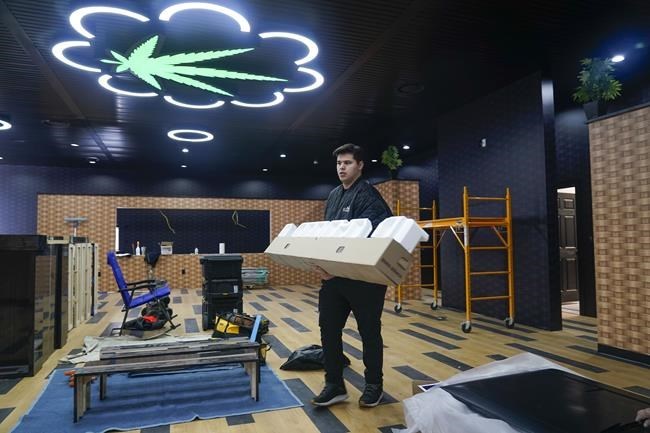
Otto Thomas, owner of the cannabis store Budders, gets rid of garbage from the store which is under construction on the reservation Mohawks call Akwesasne, Tuesday, March 15, 2022, in St. Regis, N.Y. Budders, a new “superstore,
Otto Thomas, owner of the cannabis store Budders, gets rid of garbage from the store which is under construction on the reservation Mohawks call Akwesasne, Tuesday, March 15, 2022, in St. Regis, N.Y. Budders, a new “superstore," is set to open along the main strip in April with the expectation of getting a tribal retail license. (AP Photo/Seth Wenig)

“I think this is a relief valve for our visitors, our friends, our families,” said William Roger Jock, a partner in Good Leaf Dispensary on the land the Mohawks call Akwesasne. “We have been stepped on for so long and to have something like this happen, it’s almost liberating.”

Jock stood by Good Leaf’s counter on a recent afternoon as customers eyed glass jars of Master Kush and Bubblehead. He called products “100% Native.”

New York legalized adult recreational marijuana a year ago, although statewide retail sales appear months off. State officials say initial sales could begin by the end of the year under a program providing the first licenses to people affected by marijuana-related convictions. Regulations for the entire adult-use market are expected this summer.

In contrast, the Saint Regis Mohawk Tribal Council, which governs on the American side of Akwesasne, adopted an adult-use marijuana ordinance last June that allows business licenses to go to tribal members. The council said in a prepared statement that “there is a short window of time for tribally-licensed cannabis businesses to open ahead of other areas in New York state.”

But shops began opening last year without licenses from the tribal government. Jock and others say their operations are approved by the longhouse, a traditional community, political and spiritual institution.

The reservation’s main road now boasts marijuana shops near others selling low-cost cigarettes and gasoline. The new businesses attract customers like Nick Brooks, who recently purchased gummies while heading back from a trip to Home Depot.

“It’s been in my head for two months, ‘Where can I get gummies?’ And I didn’t know where to go, but we just passed by,” he said.

The tribal government last year tried unsuccessfully in court to close seven dispensaries they say opened illegally. This month, they issued cease-and-desist orders against six more operations, though at least some of the stores appeared to be still open this week.

Dispensaries on the Canadian side of the Mohawk territory are separately regulated.

Marijuana remains illegal at the federal level, although New York and 17 others states have legalized recreational marijuana. The Mohawks, like tribes in Michigan and other states, set up their own regulations. New York officials say the dispensaries are legal if they’re on federally recognized, sovereign tribal land.

“It is legal in the same way that it is legal in states,” said Heather Trela, a marijuana policy expert at the Rockefeller Institute of Government in Albany. “It’s still federally, obviously, illegal and they do have to make sure not to run amok of federal regulators.”

It’s not clear how many Native American cannabis operations have opened statewide or how they source their product. The overwhelming majority of operators declined to answer questions from The Associated Press.

Cars travel along the main road and over the St. Regis River, left, through the reservation Mohawks call Akwesasne, Tuesday, March 15, 2022.in St. Regis, N.Y. As New York inches toward launching an adult marijuana market, sales are flourishing on some Native American territory in the state. Shops selling buds and edibles dot the main road through the U.S. side of St. Regis Mohawk Reservation by the Canadian border. (AP Photo/Seth Wenig)

But it’s clear that more are on the way.

A gleaming new “superstore” called Budders is on track to open along the Mohawk reservation’s main strip in mid-April — with a tribal license. CEO Ryan White seemed unfazed by the existing competition, saying the store’s size and selection of regulated, locally grown products will help give them a long-term advantage.

“We know that there’s a big market for cannabis,” White said. “We see people as far as 50 miles away coming in. They come in for gas and for tobacco products, and we’re going to be targeting them too.”

The Cayuga Nation, which already sells marijuana at two of its stores in the Finger Lakes, plans to open a cultivation facility before the year ends. The cannabis business “is the next step in expanding and diversifying the Cayuga Nation’s economic opportunities,” they said in a prepared statement.

And near the eastern tip of Long Island, the Shinnecock Indian Nation is working with two outside companies on a cultivation facility and dispensary. Phoenix-based TILT Holdings will provide management services and up to $18 million for the operation along the main highway to the Hamptons, about 70 miles (113 kilometers) east of New York City.

Already approved for sales of medical marijuana, the tribe’s cannabis business, Little Beach Harvest, will seek a recreational sales license from tribal regulators.

Chenae Bullock, a nation member and managing director of Little Beach Harvest, said the operation will provide needed revenue and jobs for people on the territory — many of whom live in poverty in an area synonymous with wealth.

“The ultimate goal is to sustain the people who have been oppressed for 400 years,” she said.

Report Error Submit a Tip

More Stories

Bjorck ready to rock Prospect Challenge

Mike McIntyre 6 minute read Preview

Bjorck ready to rock Prospect Challenge

Mike McIntyre 6 minute read Yesterday at 5:48 PM CDT

Viggo Bjorck isn’t getting ahead of himself, nor is he taking anything for granted.

A spot in the opening night lineup for the Winnipeg Jets?

Whoa, there.

The 18-year-old apparently isn’t even assuming he has an invitation to the NHL team’s main training camp when it starts next week.

Read
Yesterday at 5:48 PM CDT

Retired sportscaster Scott Oake determined as fundraising for women's addictions treatment facility enters home stretch

Melissa Martin 5 minute read Preview

Retired sportscaster Scott Oake determined as fundraising for women's addictions treatment facility enters home stretch

Melissa Martin 5 minute read Thursday, Sep. 10, 2026

For now, the patch of land just east of the Victoria Hospital doesn’t look like much: just a field of rocks, mounded dirt, and concrete piles driven into the earth. Yet when Scott Oake looks over the site, he can already imagine how it will look in just over a year’s time, when the new Anne Oake Family Recovery Centre is expected to open.

It’s easier to picture this time around. In 2020, when the recently-retired CBC sportscaster and his late wife, Anne, were building their first labour of intermingled grief and love, the Bruce Oake Recovery Centre for men, it was hard for him to wrap his mind around how a raw construction site could transform into a welcoming addictions treatment facility.

When that centre opened in 2021, Oake found it looked “almost identical” to the architect’s renderings. So it’s easy to hope the Anne Oake Centre will be the same. It will be the first facility of its kind, its founders believe, not only in Canada but in North America: a place where 50 to 70 women can pursue sobriety while staying with their children.

“At Bruce Oake there’s a culture of love, and most of all a culture of hope,” Oake said, speaking at the site Thursday after a media conference to announce the final push of the centre’s fundraising campaign. “I can feel it every time I walk into that building. And I know it will be the same here.”

Read
Thursday, Sep. 10, 2026

Goodness alive, well in N.L.-set musical

Jen Zoratti 4 minute read Preview

Goodness alive, well in N.L.-set musical

Jen Zoratti 4 minute read 2:01 AM CDT

I first saw Come From Away — the true-story musical about the incredible efforts of the residents of Gander, N.L. on Sept. 11, 2001, who welcomed nearly 7,000 travellers diverted to their remote town after the attacks on the World Trade Center and the Pentagon — in 2022, when Broadway Across Canada brought it to the Centennial Concert Hall.

I went in cold, but with blunted expectations; it seemed, on premise alone, like it could tilt too far into shmaltzy sentimentality, that it would be too earnest in its goodness.

So, when I wept until my face was as wet and salty as though it had been slapped by the waves of the North Atlantic, I was pleasantly surprised. I loved it. It’s emotional, yes. It’s sentimental, yes. But you can’t help but feel both buoyed — and, dare I say, patriotic — by the end of it.

Written by Canadians Irene Sankoff and David Hein, Come From Away seemed an unlikely hit when it opened on Broadway in 2017. But there was, by then, an appetite for it.

Read
2:01 AM CDT

A life's story: ‘Ivor the Driver’ found his calling in the ranching life

Aaron Epp 7 minute read Preview

A life's story: ‘Ivor the Driver’ found his calling in the ranching life

Aaron Epp 7 minute read Updated: 9:59 AM CDT

Ivor Asham’s family couldn’t have picked a better image to accompany his obituary. There he is, riding Flash, his beloved brown and white quarter horse, a black cowboy hat on his head and a drink in his hand.

Asham owned and operated Birds Hill Park Ranch for nearly 35 years, where he shared his lifelong passion for horses with thousands of visitors. He moved hay, harnessed horses and drove the wagons, introducing himself as “Ivor the Driver.”

Over the years, Asham built a reputation as the quintessential cowboy.

There’s a restaurant at the ranch filled with memorabilia that he collected over the years. Calgary Stampede posters, cowboy boot-shaped shot glasses, a child’s rocking horse, a wagon wheel and numerous photos of legendary actor John Wayne are just some of the items that line the walls.

Read
Updated: 9:59 AM CDT

Injuries reported after police pursuit on Broadway

Free Press staff 2 minute read Preview

Injuries reported after police pursuit on Broadway

Free Press staff 2 minute read Updated: Yesterday at 6:12 PM CDT

Winnipeg police are investigating a “serious incident” in which people were injured following a police pursuit near Broadway and Young Street Friday afternoon.

Police said the scene would remain secured as officers investigate. No details about the number or severity of injuries were released.

Broadway was closed between Furby and Young streets until further notice and motorists were asked to avoid the area.

Shaelyn Desmarais McLeod, whose car sustained minor damage, said she witnessed the end of the police pursuit.

Read
Updated: Yesterday at 6:12 PM CDT

Sex assault charges against basketball referee stayed

Dean Pritchard 3 minute read Preview

Sex assault charges against basketball referee stayed

Dean Pritchard 3 minute read Yesterday at 6:09 PM CDT

A Winnipeg basketball referee accused of sexual offences involving three men has had criminal charges against him stayed.

Michael Shane Maryk, 45, had been set to stand trial July 20 on five counts of sexual assault and two counts of committing an indecent act, but instead agreed to a one-year peace bond prohibiting him from having any contact with the three men.

Maryk was employed by the Manitoba Association of Basketball Officials at the time the offences were alleged to have occurred.

The peace bond requires that Maryk not come within 200 metres of the men’s homes, schools or places of worship and have no contact with their families.

Read
Yesterday at 6:09 PM CDT