For climate migrants in Bangladesh, town offers new life
Advertisement
Read this article for free:
or
Already have an account? Log in here »
To continue reading, please subscribe:

Digital Subscription
One year of digital access for only $205*
- Enjoy unlimited reading on winnipegfreepress.com
- Read the E-Edition, our digital replica newspaper
- Access News Break, our award-winning app
- Play interactive puzzles
*First annual payment billed as $205.00 + GST for one year. This annual subscription will automatically renew at $233.00 + GST every 52 weeks (10% off the regular annual price of $259.35). Offer available to new and qualified returning subscribers only. Cancel any time.
To continue reading, please subscribe:
Add Free Press access to your Brandon Sun subscription for only an additional
$1 for the first 4 weeks*
- Enjoy unlimited reading on winnipegfreepress.com
- Read the E-Edition, our digital replica newspaper
- Access News Break, our award-winning app
- Play interactive puzzles
*Your next Brandon Sun subscription payment will increase by $1.00 and you will be charged $17.95 plus GST for four weeks. After four weeks, your payment will increase to $24.95 plus GST every four weeks.
Read unlimited articles for free today:
or
Already have an account? Log in here »
Hey there, time traveller!
This article was published 30/03/2022 (1635 days ago), so information in it may no longer be current.
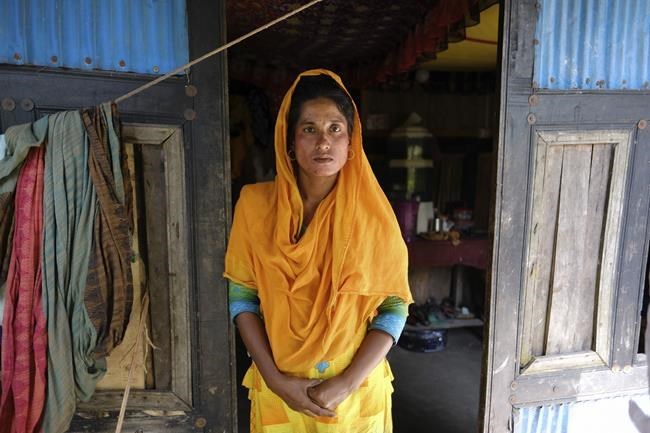
MONGLA, Bangladesh (AP) — The 29-year-old Monira Khatun was devastated after her husband abandoned her suddenly. She returned to her father only to face another blow: He died soon after, leaving her to shoulder three other family members’ care. Without any work, she was worried about how she would feed them.
“I lost everything. There was darkness all around,” Khatun said. “My parents’ home was gone to the river for erosion, we had no land to cultivate.”
She ended up working at a factory in a special economic zone that employs thousands of climate refugees — like Khatun — in the southwestern town of Mongla, where Bangladesh’s second-largest seaport is located.

These refugees from climate-impacted areas within Bangladesh lost their homes, land and livelihood, but found a new life in the riverside coastal town about 50 kilometers (30 miles) inland from the Bay of Bengal.
Some 150,000 people now live in Mongla — many of whom moved from villages near the Sundarbans forest, the world’s largest mangrove forest which straddles the border of Bangladesh and India and harbors endangered Bengal tigers.
Being forced by climate change to move, within borders or beyond, is a growing reality expected to accelerate in the decades ahead. Over the next 30 years, 143 million people are likely to be uprooted by rising seas, drought, searing temperatures and other climate catastrophes, according to an Intergovernmental Panel on Climate Change report published last month by the United Nations. Leaders in Asia, already one of the hardest-hit continents, are scrambling to confront major changes taking place.
Climate scientists like Saleemul Huq, director of the Dhaka-based International Centre for Climate Change and Development, are branding Mongla as a climate-resilient town for the refugees.
“When it comes to adaptation, Mongla is a success story. Changes are coming there as an example of how climate refugees could transform their life through new opportunities, through a new approach of adaptation,” said Huq, whose institute conducts environmental research.
“Mongla has offered new opportunities to them. With its seaport and an export processing zone and climate-resilient infrastructure, Mongla town has become a different story,” Huq said.
“Now, we expect to replicate the Mongla model to at least two dozen other coastal towns across Bangladesh as safe home for climate refugees,” he said. “Currently, we are talking to mayors and officials of almost half a dozen municipalities about the success in Mongla.”
Huq said more than a dozen satellite towns, all adjacent to economic hubs such as sea and river ports, have already been identified as potential migrant-friendly locations.
“These are all secondary towns with populations of up to half a million, which can shelter up to another half a million climate migrants each,” said Huq. “Thus we can offer alternatives to at least 10 million climate migrants over next one decade.”
Climate scientists say low-lying Bangladesh is extremely vulnerable to the impacts of climate change and millions are at the risk of being displaced — becoming climate refugees because of sea level rise, river erosion, cyclonic storms and intrusion of saline water. The World Bank in a new report said last year that Bangladesh will have more than 19 million internal climate refugees by 2050, almost half the projected number for the entire South Asia region.
Huq said by an approach of transformative adaptation in about two dozen small coastal towns including Mongla, at least 10 million climate refugees could be resettled, rather than forcing them to move to slums in big cities like Dhaka, the nation’s capital.
“The trend is that climate migrants move to places where there are economic activities for them. We can’t stop displacement, we can only offer alternatives that they will accept,” he said.
The vision of transformative adaption is to create opportunities for climate migrants to live and work in an environment where the host population accepts them.
He said the incremental adjustments, such as introducing salinity-tolerant rice varieties, have been taking place in Bangladesh for years, helping climate refugees cope with the impacts of climate change where they are living today.
“But we will not able to do it forever. So we need to go for transformative adaptation, which is to enable them to move somewhere else and be better off,” Huq said.
In recent years, the Bangladesh government has spent millions of Bangladeshi taka (tens of thousands of dollars) to protect the Mongla town with climate-resilient infrastructure, drawing at-risk people from the remotest villages.
Investments — mostly foreign — have doubled at the Mongla Export Processing Zone over last four years, creating new jobs in its factories for the climate refugees from the region. The funds, which come from the United States, Japan, South Korea and China, among others, have prevented the refugees from moving to big cities.
Nazma Binte Alamgir, spokesperson for the government regulator Bangladesh Export Processing Zones Authority, said about 10 more factories are in the pipeline to start production soon in Mongla, adding thousands of jobs.
“This is a good news for the people who are suffering in the region. They will have a chance to survive in a different way,” she said.
To become resilient, Mongla raised an 11-kilometer (7-mile) embankment along a newly built marine drive designed to stop flooding, two flood-control gates, a better drainage system, a water reservoir and a water treatment plant, said Sheikh Abdur Rahman, mayor of Mongla since January.
“We need more investment to protect Mongla town from erosion and high tides. People feel safer now, but we need to do more,” he said.
Rahman said the government is building new infrastructure in the seaport and dredging the Mongla river to widen its channel, allowing for big ships, while more investment is coming to the export processing zone, or EPZ. He said a new rail line is being constructed to connect the town with a major land port across the border with neighboring India.
“There was only about 2,600 workers in the Mongla EPZ in 2018, but now there are about 9,000 workers employed in different factories,” he said. “The changes are visible.”
Reshma Begum, 28, is one of them.

Begum used to catch fish in the river that swallowed her home, making her three-member family homeless. Now she lives temporarily on another man’s land and works at a factory in the EPZ.
“Now I earn a good amount of money each month to support my family,” she said, adding that her husband is a day laborer and contributes to the family’s income.
“Maybe we will build a new house in the future by saving some money,” she said.
___
Associated Press climate and environmental coverage receives support from several private foundations. See more about AP’s climate initiative here. The AP is solely responsible for all content.