

Italian premier says Algeria to boost natural gas exports
Advertisement
Read this article for free:
or
Already have an account? Log in here »
To continue reading, please subscribe:

Digital Subscription
One year of digital access for only $205*
- Enjoy unlimited reading on winnipegfreepress.com
- Read the E-Edition, our digital replica newspaper
- Access News Break, our award-winning app
- Play interactive puzzles
*First annual payment billed as $205.00 + GST for one year. This annual subscription will automatically renew at $233.00 + GST every 52 weeks (10% off the regular annual price of $259.35). Offer available to new and qualified returning subscribers only. Cancel any time.
To continue reading, please subscribe:
Add Free Press access to your Brandon Sun subscription for only an additional
$1 for the first 4 weeks*
- Enjoy unlimited reading on winnipegfreepress.com
- Read the E-Edition, our digital replica newspaper
- Access News Break, our award-winning app
- Play interactive puzzles
*Your next Brandon Sun subscription payment will increase by $1.00 and you will be charged $17.95 plus GST for four weeks. After four weeks, your payment will increase to $24.95 plus GST every four weeks.
Read unlimited articles for free today:
or
Already have an account? Log in here »
Hey there, time traveller!
This article was published 11/04/2022 (1630 days ago), so information in it may no longer be current.
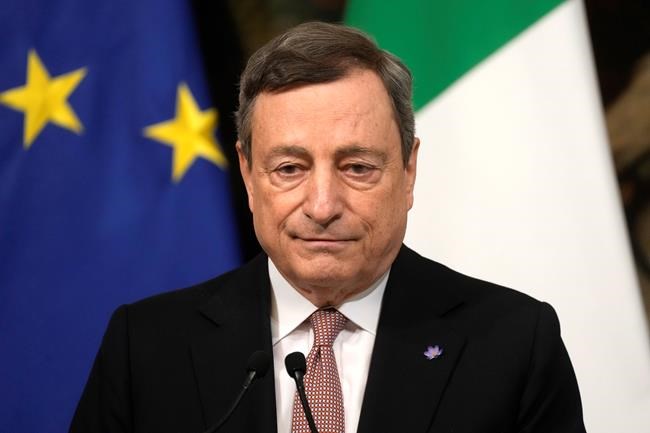
MILAN (AP) — Italian Premier Mario Draghi secured a deal Monday for more natural gas imports across a Mediterranean pipeline from Algeria, marking the latest push by a European Union nation to reduce dependence on Russian energy following its invasion of Ukraine.
After meeting with President Abdelmadjid Tebboune, Draghi told reporters in the Algerian capital of Algiers that an agreement to intensify bilateral cooperation in the energy sector along with the deal to export more gas to Italy “are a significant response to the strategic goal” of quickly replacing Russian energy.
“Others will follow,” Draghi said.
Russia is Italy’s biggest supplier of natural gas, representing 40% of total imports, followed by Algeria, which provides some 21 billion cubic meters of gas via the Trans-Mediterranean pipeline.
The new deal between Italian energy company Eni and Algeria’s Sonatrach would add up to 9 billion cubic meters of gas from Algeria by 2023-24, just eclipsing Russia’s current 29 billion cubic meters a year. The increased flows will start in the fall, Eni said in a statement.
Europe is trying to cut its reliance on Russian natural gas imports quickly, with leaders recognizing that their payments help fund Moscow’s war. At the same time, there is concern Russia might turn off the taps in reprisal for sanctions, a threat that would have devastating effects on the European economy. Natural gas is used to generate electricity, heat and cool homes, and power industry.
Russian President Vladimir Putin has already sought to have gas payments be made in rubles, in an apparent bid shore up the currency. A loophole allows countries to pay a designated Russian bank in dollars and euros as set out in contracts.
The tiny Baltic state of Lithuania, a former Soviet republic, recently cut itself off entirely from Russian gas imports, the first of the European Union’s 27 nations using Russian gas to break its energy dependence on Moscow.
Lithuania has been planning that move for years, and the task is more difficult for economic powers like Germany and Italy, which have gotten most of their natural gas from Russia.
The EU plans to reduce Russian gas imports by two-thirds by the end of the year and eliminate them before 2030 through steps like conservation, wind and solar development, and alternative sources. The 27-nation bloc has reached a deal with the United States to receive more boatloads of liquefied natural gas, or LNG.

Germany, which gets about 40% of its gas from Russia, has announced plans to quickly build two LNG terminals and reached an agreement with Qatar for LNG supplies. Poland is expanding an LNG terminal to receive deliveries from Qatar, the U.S., Norway and others. It has been reducing dependence on Russian oil through contracts with Saudi Arabia, the U.S. and Norway.
Germany and Italy also are pushing for more renewable energy.
The deal between Italy and Algeria is the first concrete result of missions by Italy’s foreign minister to energy-producing nations to secure alternate sources, also including Azerbaijan, Qatar, Congo, Angola and Mozambique.
Draghi is traveling with Foreign Minister Luigi Di Maio, the energy transition minister, Roberto Cingolani, and the CEO of Italian energy company Eni, Claudio Descalzi.
Eni announced a significant oil and gas discovery in Algeria last month and said it would work with Algerian partner Sonatrach to fast-track its development for the third quarter of this year. Eni has operated in Algeria for more than 40 years.