Heat wave scorches India’s wheat crop, snags export plans

Advertisement

Advertise with us

NEW DELHI (AP) — An unusually early, record-shattering heat wave in India has reduced wheat yields, raising questions about how the country will balance its domestic needs with ambitions to increase exports and make up for shortfalls due to Russia's war in Ukraine.

Read this article for free:


or

Already have an account? Log in here »

To continue reading, please subscribe:

Subscribe and receive a limited-edition Free Press branded hat or tote.

Digital Subscription

One year of digital access for only $205*

  • Enjoy unlimited reading on winnipegfreepress.com
  • Read the E-Edition, our digital replica newspaper
  • Access News Break, our award-winning app
  • Play interactive puzzles

*First annual payment billed as $205.00 + GST for one year. This annual subscription will automatically renew at $233.00 + GST every 52 weeks (10% off the regular annual price of $259.35). Offer available to new and qualified returning subscribers only. Cancel any time.

To continue reading, please subscribe:

Add Free Press access to your Brandon Sun subscription for only an additional

$1 for the first 4 weeks*

  • Enjoy unlimited reading on winnipegfreepress.com
  • Read the E-Edition, our digital replica newspaper
  • Access News Break, our award-winning app
  • Play interactive puzzles
Start now

*Your next Brandon Sun subscription payment will increase by $1.00 and you will be charged $17.95 plus GST for four weeks. After four weeks, your payment will increase to $24.95 plus GST every four weeks.

Hey there, time traveller!
This article was published 28/04/2022 (1602 days ago), so information in it may no longer be current.

NEW DELHI (AP) — An unusually early, record-shattering heat wave in India has reduced wheat yields, raising questions about how the country will balance its domestic needs with ambitions to increase exports and make up for shortfalls due to Russia’s war in Ukraine.

Gigantic landfills in India’s capital New Delhi have caught fire in recent weeks. Schools in eastern Indian state Odisha have been shut for a week and in neighboring West Bengal, schools are stocking up on oral rehydration salts for kids. On Tuesday, Rajgarh, a city of over 1.5 million people in central India, was the country’s hottest, with daytime temperatures peaking at 46.5 degrees Celsius (114.08 Fahrenheit). Temperatures breached the 45 C (113 F) mark in nine other cities.

But it was the heat in March — the hottest in India since records first started being kept in 1901 — that stunted crops. Wheat is very sensitive to heat, especially during the final stage when its kernels mature and ripen. Indian farmers time their planting so that this stage coincides with India’s usually cooler spring.
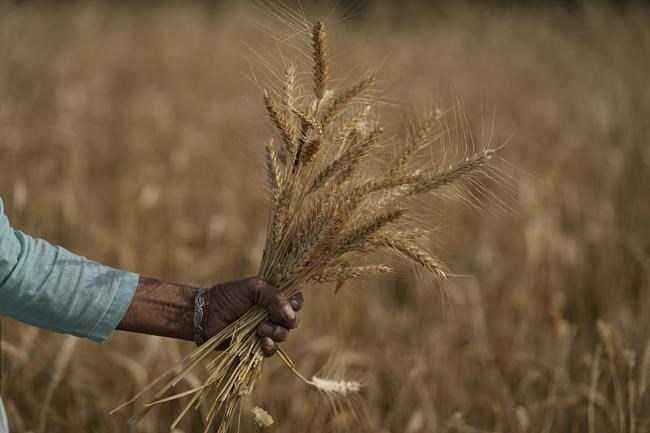
A woman harvests wheat on the outskirts of Jammu, India, Thursday, April 28, 2022. An unusually early, record-shattering heat wave in India has reduced wheat yields, raising questions about how the country will balance its domestic needs with ambitions to increase exports and make up for shortfalls due to Russia's war in Ukraine. (AP Photo/Channi Anand)

Climate change has made India’s heat wave hotter, said Friederike Otto, a climate scientist at the Imperial College of London. She said that before human activities increased global temperatures, heat waves like this year’s would have struck India once in about half a century.

“But now it is a much more common event — we can expect such high temperatures about once in every four years,” she said.

India’s vulnerability to extreme heat increased 15% from 1990 to 2019, according to a 2021 report by the medical journal The Lancet. It is among the top five countries where vulnerable people, like the old and the poor, have the highest exposure to heat. It and Brazil have the the highest heat-related mortality in the world, the report said.

Farm workers like Baldev Singh are among the most vulnerable. Singh, a farmer in Sangrur in northern India’s Punjab state, watched his crop shrivel before his eyes as an usually cool spring quickly shifted to unrelenting heat. He lost about a fifth of his yield. Others lost more.

“I am afraid the worst is yet to come,” Singh said.

Punjab is India’s “grain bowl” and the government has encouraged cultivation of wheat and rice here since the 1960s. It is typically the biggest contributor to India’s national reserves and the government had hoped to buy about a third of this year’s stock from the region. But government assessments predict lower yields this year, and Devinder Sharma, an agriculture policy expert in northern Chandigarh city. said he expected to get 25% less.

The story is the same in other major wheat-producing states like Uttar Pradesh and Madhya Pradesh.

Overall, India purchased over 43 million metric tons (47.3 million U.S. tons) of wheat in 2021. Sharma estimates it will instead get 20% to nearly 50% less.

Even though it is the world’s second-largest producer of wheat, India exports only a small fraction of its harvest. It had been looking to capitalize on the global disruption to wheat supplies from Russia’s war in Ukraine and find new markets for its wheat in Europe, Africa, and Asia.

That looks uncertain given the tricky balance the government must maintain between demand and supply. It needs about 25 million tons (27.5 million U.S. tons) of wheat for the vast food welfare program that usually feeds more than 80 million people.

Before the pandemic, India had vast stocks that far exceeded its domestic needs — a buffer against the risk of famine.
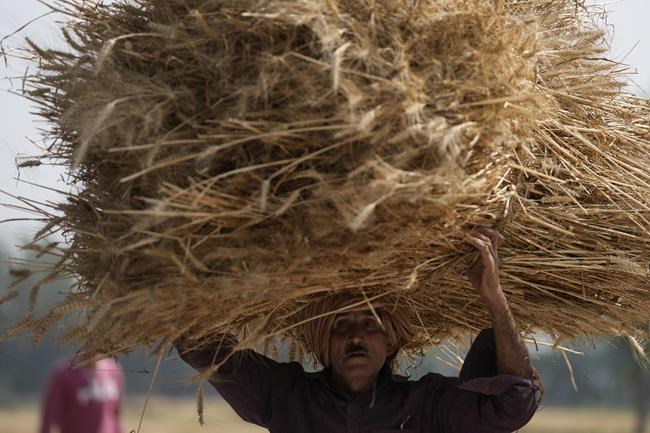
A farmer carries wheat crop after harvested on the outskirts of Jammu, India, Thursday, April 28, 2022. An unusually early, record-shattering heat wave in India has reduced wheat yields, raising questions about how the country will balance its domestic needs with ambitions to increase exports and make up for shortfalls due to Russia's war in Ukraine. (AP Photo/Channi Anand)

Those reserves have been strained, Sharma said, by distribution of free grain during the pandemic to about 800 million people — vulnerable groups like migrant workers. The program was extended until September but it’s unclear if it will continue beyond then.

“We are no longer with that kind of a surplus . . . with exports now picking up, there would be a lot of pressure on the domestic availability of wheat,” Sharma said.

India’s federal agriculture and commerce ministries didn’t respond to questions sent to them via email.

Beyond India, other countries are also grappling with poor harvests that hinder their ability to help offset the potential shortfall of supplies from Russia and Ukraine, normally the world’s largest and fifth-largest exporters of wheat.

China’s agriculture minister, Tang Renjian, said last month that the winter wheat harvest was likely to be poor, hindered by flooding and by delays in planting.

___

The Associated Press Health and Science Department receives support from the Howard Hughes Medical Institute’s Department of Science Education. The AP is solely responsible for all content.

Report Error Submit a Tip

More Stories

Son found guilty in hatchet slaying of his mother

Tessa Adamski 3 minute read Yesterday at 2:01 AM CDT

A Brandon man has been found guilty of killing his 71-year-old mother with a hatchet in the fall of 2023 after his lawyers argued he should be held not criminally responsible.

Manitoba’s police watchdog is investigating after a man was found dead eight days after officers were unable to locate him following a 911 call from Canupawakpa Dakota First Nation in 2024.

The Independent Investigation Unit said the call came in just after midnight on Nov. 22, 2024, with a disturbance audible in the background. GPS coordinates traced it to the First Nation, 305 kilometres west of Winnipeg, prompting Manitoba First Nations Police Service officers to search the area.

Officers could not find the caller, whom they believed to be a local man. Eight days later, on Nov. 30, MFNPS conducted another search and found a man dead.

The death was initially referred to RCMP Major Crime Services as suspicious. The RCMP later returned the case to MFNPS for possible referral to the IIU because of concerns about the eight-day delay in locating the man. MFNPS notified the IIU on Sept. 15, 2026 — nearly two years after the incident.

Alert-system operator asks CRTC to consider ‘device-based geofencing’ to avoid unnecessary weather warnings

Malak Abas 4 minute read Preview

Alert-system operator asks CRTC to consider ‘device-based geofencing’ to avoid unnecessary weather warnings

Malak Abas 4 minute read Updated: Yesterday at 6:10 PM CDT

The Weather Network’s parent company wants Canada to consider changes to how it warns the public about dangerous weather after Manitobans received a landslide of emergency alerts in the midst of a massive June thunderstorm.

Read
Updated: Yesterday at 6:10 PM CDT

Canadian manufacturers look to North

Aaron Epp 4 minute read Yesterday at 7:58 PM CDT

Canadian manufacturers should be “big players” in building major projects in Canada, the leader of an advocacy group representing small- and medium-sized sector members said Monday evening at a national policy conference in Winnipeg.

Catherine Swift, president of the Coalition of Concerned Manufacturers and Businesses of Canada, spoke during the opening panel at the conference, organized by the Frontier Centre for Public Policy, a think tank headquartered in the Manitoba capital.

The conference, which continued throughout the day on Tuesday, brought together leaders and experts from defence, Indigenous communities, energy, transportation, business and public policy to explore what it would take to move northern strategic utility corridors from proposal to construction.

“The fact that we’ve struggled as a country with building major projects such as utility corridors in the North has been particularly punitive to manufacturing because, naturally, they should be big players in any such project,” said Swift, who was a senior economist at TD Bank before serving as chief executive at the Canadian Federation of Independent Business from 1987 to 2012.

Trade war fuelling spike in city costs

Joyanne Pursaga 4 minute read Preview

Trade war fuelling spike in city costs

Joyanne Pursaga 4 minute read Yesterday at 2:01 AM CDT

A trade war between the U.S. and Canada could cost the City of Winnipeg millions of dollars more than was anticipated during the budget process for this year’s expenditures and beyond.

Read
Yesterday at 2:01 AM CDT

Manitoba mineral production set to triple, premier says

Carol Sanders 5 minute read Preview

Manitoba mineral production set to triple, premier says

Carol Sanders 5 minute read Updated: Yesterday at 5:19 PM CDT

Premier Wab Kinew said Tuesday Manitoba plans to triple mineral production in the next five years “to unlock a new era of wealth creation and growth.”

“We’re going to make sure that opportunity is spread throughout the province,” he told a news conference at the Canada investment summit in Toronto.

The province is working with industry and Indigenous governments to send a message to investors that “we’re going to do mining right in Manitoba,” the premier said.

For too long, Manitoba has lagged behind neighbouring provinces, Kinew said.

Read
Updated: Yesterday at 5:19 PM CDT