

COVID-19 infections to rise, wastewater shows
Advertisement
Read this article for free:
or
Already have an account? Log in here »
To continue reading, please subscribe:
Digital Subscription
One year of digital access for only $1.44 a week*
- Enjoy unlimited reading on winnipegfreepress.com
- Read the E-Edition, our digital replica newspaper
- Access News Break, our award-winning app
- Play interactive puzzles
*Billed as $5.77 plus GST every four weeks. After 52 weeks, price increases to the regular rate of $19.95 plus GST every four weeks. Offer available to new and qualified returning subscribers only. Cancel any time.
To continue reading, please subscribe:
Add Free Press access to your Brandon Sun subscription for only an additional
$1 for the first 4 weeks*
- Enjoy unlimited reading on winnipegfreepress.com
- Read the E-Edition, our digital replica newspaper
- Access News Break, our award-winning app
- Play interactive puzzles
*Your next Brandon Sun subscription payment will increase by $1.00 and you will be charged $17.95 plus GST for four weeks. After four weeks, your payment will increase to $24.95 plus GST every four weeks.
Read unlimited articles for free today:
or
Already have an account? Log in here »
Hey there, time traveller!
This article was published 29/04/2022 (1642 days ago), so information in it may no longer be current.
The number of COVID-19 cases in Winnipeg is about to jump.
Wastewater modelling predicts there will be 3,000 new daily cases by mid-May.
“The modelling forecast, based on both clinical and wastewater data, suggests an increasing trend in the number of cases for the next few weeks,” reads the latest report from the Public Health Agency of Canada and Statistics Canada.
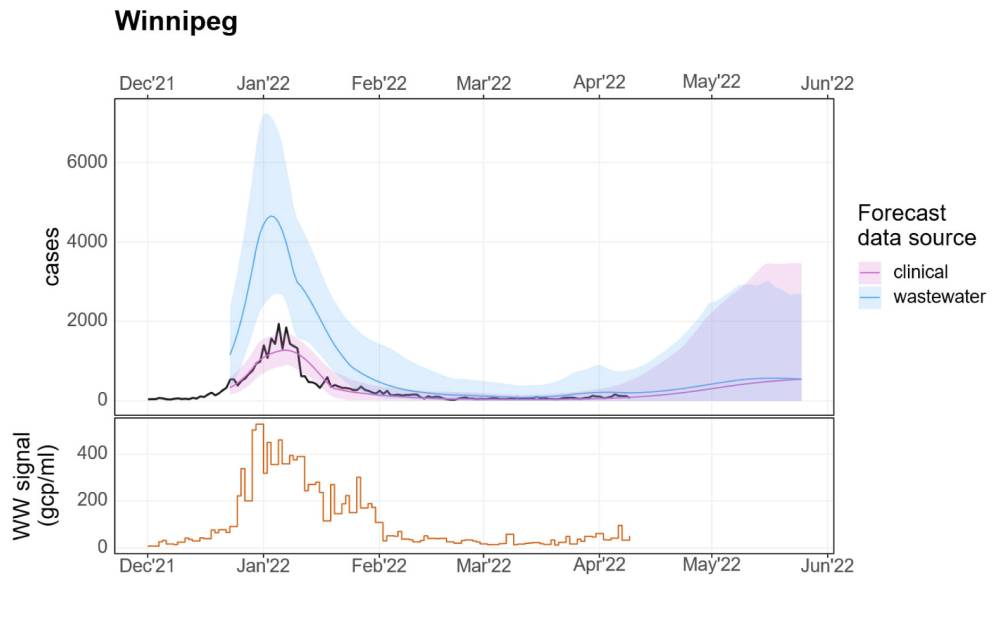
The federal agencies have been using a modelling formula that considers how much of the coronavirus has been detected in sewage systems in most Canadian cities, along with trends in the small number of PCR tests that are being conducted.
Using testing data up until April 13, and sewage samples up to April 11, the modelling forecasts a rise in cases that would put Winnipeg trends on par with case numbers experienced in mid-January, which is lower than the Christmas peak caused by the Omicron variant, but higher than any earlier point in the pandemic.
Wastewater samples from three spots across the city suggest a slight recent uptick in cases.
In the city’s west and south, coronavirus particles seemed to have temporarily dipped since the start of the month before rebounding, according to several-day trends using samples up to April 21.

In the northern part of the city, cases seem to have shot up since mid-March. There was a sharp increase at the start of April, and then a more gradual rise.
Epidemiologists say wastewater testing is useful for tracking COVID-19 spread in a community, but is not as precise as widespread laboratory testing. Manitoba and other provinces drastically scaled back testing during the Omicron wave because infection rates were widespread.
Humans often excrete the coronavirus before they have symptoms, meaning a rise in viral particles can help detect an increase in cases before they affect hospitalization rates.
However, wastewater sampling can be influenced by multiple factors, such as more snowmelt diluting the viral loads in city sewers.
fpcity@freepress.mb.ca