WHO: Nearly 15 million deaths associated with COVID-19

Advertisement

Advertise with us

LONDON (AP) — The World Health Organization estimates that nearly 15 million people were killed either by coronavirus or by its impact on overwhelmed health systems during the first two years of the pandemic, more than double the current official death toll of over 6 million.

Read this article for free:


or

Already have an account? Log in here »

To continue reading, please subscribe:

Subscribe and receive a limited-edition Free Press branded hat or tote.

Digital Subscription

One year of digital access for only $205*

  • Enjoy unlimited reading on winnipegfreepress.com
  • Read the E-Edition, our digital replica newspaper
  • Access News Break, our award-winning app
  • Play interactive puzzles

*First annual payment billed as $205.00 + GST for one year. This annual subscription will automatically renew at $233.00 + GST every 52 weeks (10% off the regular annual price of $259.35). Offer available to new and qualified returning subscribers only. Cancel any time.

To continue reading, please subscribe:

Add Free Press access to your Brandon Sun subscription for only an additional

$1 for the first 4 weeks*

  • Enjoy unlimited reading on winnipegfreepress.com
  • Read the E-Edition, our digital replica newspaper
  • Access News Break, our award-winning app
  • Play interactive puzzles
Start now

*Your next Brandon Sun subscription payment will increase by $1.00 and you will be charged $17.95 plus GST for four weeks. After four weeks, your payment will increase to $24.95 plus GST every four weeks.

Hey there, time traveller!
This article was published 05/05/2022 (1567 days ago), so information in it may no longer be current.

LONDON (AP) — The World Health Organization estimates that nearly 15 million people were killed either by coronavirus or by its impact on overwhelmed health systems during the first two years of the pandemic, more than double the current official death toll of over 6 million.

Most of the deaths occurred in Southeast Asia, Europe and the Americas, according to a WHO report issued Thursday.

The U.N. health agency’s director-general, Tedros Adhanom Ghebreyesus, described the newly calculated figure as “sobering,” saying it should prompt countries to invest more in their capacities to quell future health emergencies.

FILE - A worker in a protective suit swabs a man's throat for a COVID-19 test at a testing site in an office complex in Beijing, Friday, April 29, 2022. The World Health Organization on Thursday, May 5, 2022 is estimating that nearly 15 million people were killed either by the coronavirus or by its impact on overwhelmed health systems in the past two years, more than double the official death toll of 6 million. (AP Photo/Mark Schiefelbein, File)

WHO tasked scientists with determining the actual number of COVID-19 deaths between January 2020 and the end of last year. They estimated that between 13.3 million and 16.6 million people died either due to the coronavirus directly or because of factors somehow attributed to the pandemic’s impact on health systems, such as cancer patients who were unable to seek treatment when hospitals were full of COVID patients.

Based on that range, the scientists came up with an approximated total of 14.9 million.

The estimate was based on country-reported data and statistical modeling, but only about half of countries provided information. WHO said it wasn’t yet able to break down the data to distinguish between direct deaths from COVID-19 and those related to effects of the pandemic, but the agency plans a future project examining death certificates.

“This may seem like just a bean-counting exercise, but having these WHO numbers is so critical to understanding how we should combat future pandemics and continue to respond to this one,” said Dr. Albert Ko, an infectious diseases specialist at the Yale School of Public Health who was not linked to the WHO research.

For example, Ko said, South Korea’s decision to invest heavily in public health after it suffered a severe outbreak of MERS allowed it to escape COVID-19 with a per-capita death rate around a 20th of the one in the United States.

Accurately counting COVID-19 deaths has been problematic throughout the pandemic, as reports of confirmed cases represent only a fraction of the devastation wrought by the virus, largely because of limited testing. Government figures reported to WHO and a separate tally kept by Johns Hopkins University show more than 6.2 million reported virus deaths to date.

Scientists at the Institute of Health Metrics and Evaluation at the University of Washington calculated for a recent study published in the journal Lancet that there were more than 18 million COVID deaths from January 2020 to December 2021.

A team led by Canadian researchers estimated there were more than 3 million uncounted coronavirus deaths in India alone. WHO’s new analysis estimated that missed deaths in India alone ranged between 3.3 million to 6.5 million.

In a statement following the release of WHO’s data, India disputed the U.N. agency’s methodology. India’s Health and Family Welfare Ministry called the analysis and data collection methods “questionable” and complained that the new death estimates were released “without adequately addressing India’s concerns.”

FILE - World Health Organisation (WHO) director-general Dr. Tedros Adhanom Ghebreyesus speaks at a news conference in Cape Town, South Africa, Friday, Feb. 11, 2022. The World Health Organization on Thursday, May 5, 2022 is estimating that nearly 15 million people were killed either by the coronavirus or by its impact on overwhelmed health systems in the past two years, more than double the official death toll of 6 million. (AP Photo/Nardus Engelbrecht, File)

Samira Asma, a senior WHO director, acknowledged that “numbers are sometimes controversial” and that all estimates are only an approximation of the virus’ catastrophic effects.

“It has become very obvious during the entire course of the pandemic, there have been data that is missing,” Asma told reporters during a press briefing on Thursday. “Basically, all of us were caught unprepared.”

Ko said the new figures from WHO might also explain some lingering mysteries about the pandemic, like why Africa appears to have been one of the least affected by the virus, despite its fragile health systems and low vaccination rates.

“Were the mortality rates so low because we couldn’t count the deaths, or was there some other factor to explain that?” he asked, citing the far higher mortality rates in the U.S. and Europe.

Dr. Bharat Pankhania, a public health specialist at Britain’s University of Exeter, said the world may never get close to measuring the true toll of COVID-19, particularly in poor countries.

“When you have a massive outbreak where people are dying in the streets because of a lack of oxygen, bodies were abandoned or people had to be cremated quickly because of cultural beliefs, we end up never knowing just how many people died,” he explained.

Pankhania said that while the estimated COVID-19 death toll still pales in comparison to the 1918 Spanish flu pandemic, which experts estimate caused up to 100 million deaths, the fact that so many people died despite the advances of modern medicine, including vaccines, is shameful.

He also warned that the cost of COVID-19 could be far more damaging in the long term, given the increasing burden of caring for people with long COVID.

“With the Spanish flu, there was the flu and then there were some (lung) illnesses people suffered, but that was it,” he said. “There was not an enduring immunological condition that we’re seeing right now with COVID.”
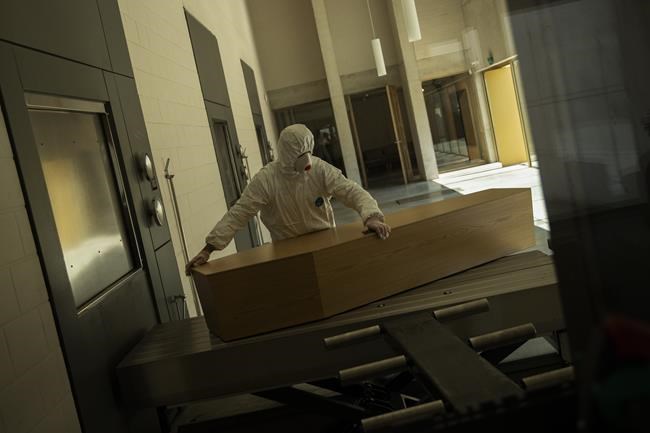
FILE - A worker, wearing full protective gear, moves the casket of a victim of COVID-19 to be cremated during a partial lockdown to prevent the spread of coronavirus at the Pontes crematorium center in Lommel, Belgium, Thursday, April 16, 2020. The World Health Organization is estimating that nearly 15 million people were killed either by the coronavirus or by its impact on overwhelmed health systems in the past two years. That is more than double its official death toll. The U.N. health agency says most of the fatalities were in Southeast Asia, Europe and the Americas. In a report released Thursday, May 5, 2022 WHO chief Tedros Adhanom Ghebreyesus describes the figure as “sobering.
FILE - A worker, wearing full protective gear, moves the casket of a victim of COVID-19 to be cremated during a partial lockdown to prevent the spread of coronavirus at the Pontes crematorium center in Lommel, Belgium, Thursday, April 16, 2020. The World Health Organization is estimating that nearly 15 million people were killed either by the coronavirus or by its impact on overwhelmed health systems in the past two years. That is more than double its official death toll. The U.N. health agency says most of the fatalities were in Southeast Asia, Europe and the Americas. In a report released Thursday, May 5, 2022 WHO chief Tedros Adhanom Ghebreyesus describes the figure as “sobering." (AP Photo/Francisco Seco, File)

“We do not know the extent to which people with long COVID will have their lives cut short and if they will have repeated infections that will cause them even more problems,” Pankhania said.

____

Krutika Pathi and Ashok Sharma in New Delhi contributed to this report.

___

Follow AP’s coverage of the pandemic at https://apnews.com/hub/coronavirus-pandemic

Report Error Submit a Tip

More Stories

The common abuse of ‘common sense’

Alex Passey 5 minute read 2:00 AM CDT

If you spend any amount of time having deep conversations on sensitive subject matters, you will undoubtedly encounter patterns of thought and speech peppered into the discourse as if certain people were helpless but to utter them.

Perhaps you are trying to get to the heart of a complicated matter and the disagreement with your conversational partner starts to get a little heated. Often somebody will dust off the old diplomatic gem of “let’s agree to disagree” to extinguish further argument.

Or perhaps you are trying to console a grief-stricken person who has gone through a traumatic event. People in such a state will often rail against the state of the universe with powerful philosophical sentiments, demanding to know how such injustice could be permitted. You would not be the first person to misguidedly try to soothe them with something like “everything happens for a reason.” Or, less secularly, “God works in mysterious ways.”

These are known as thought-terminating clichés. Pithy little sayings that sound like folksy wisdom but serve mostly to sever a train of thinking, often because it is either uncomfortable or more complicated than the person is willing to engage. Admittedly, they often come from a good-natured place of keeping the peace, though it could easily be argued that they mostly serve to preserve to comfort or indulge the intellectual laziness of those who speak them.

Liquor authority fines True North $12K after minors with fake ID served at Jets White Out party

Nicole Buffie 5 minute read Preview

Liquor authority fines True North $12K after minors with fake ID served at Jets White Out party

Nicole Buffie 5 minute read Monday, Aug. 17, 2026

True North Sports and Entertainment was hit with a $12,000 fine for serving minors with fake IDs during a Winnipeg Jets White Out street party in 2025.

Read
Monday, Aug. 17, 2026

Transit driver, supervisor assaulted in separate incidents

Free Press staff 2 minute read Preview

Transit driver, supervisor assaulted in separate incidents

Free Press staff 2 minute read 2:15 PM CDT

Two people are facing charges for allegedly assaulting Winnipeg Transit employees in separate incidents within a 10-hour span Tuesday.

A 51-year-old man is accused of randomly throwing a beer can at a driver while exiting a bus at Dunkirk Avenue and Kingston Row at about 6 a.m.

The man bit the driver, who was trying to restrain him, police said. He was charged with assault and held in custody.

At about 3:40 p.m., a 31-year-old woman who refused to pay bus fare at Main Street and Pioneer Avenue punched a supervisor in the face, police said.

Read
2:15 PM CDT

City rescinds Balmoral Street property owner’s order to clean up encampment

Scott Billeck 3 minute read Preview

City rescinds Balmoral Street property owner’s order to clean up encampment

Scott Billeck 3 minute read Yesterday at 5:35 PM CDT

A West Broadway landlord is off the hook for clearing a large riverbank encampment after the City of Winnipeg rescinded an order threatening to stick him with the cleanup bill.

Marvin Sharp, CEO of Astroid Management Ltd., which operates the Pen-Eve Apartments at 35 Balmoral St., said he received a call from the city Tuesday letting him know the order has been cancelled.

In a statement from the city, an official said the order was shelved due to an existing and active easement on the property.

“We have been communicating with the property owner throughout this process and they have been informed of this development,” a spokesperson said.

Read
Yesterday at 5:35 PM CDT

Men accused in commercial break-in spree were wearing ankle bracelets

Erik Pindera 5 minute read Preview

Men accused in commercial break-in spree were wearing ankle bracelets

Erik Pindera 5 minute read Monday, Aug. 17, 2026

Two men in electric ankle bracelets who were being monitored by justice officials have been accused in a two-month spree of commercial break-ins, vehicle thefts and other property crimes.

City police have charged one of the suspects and are searching for the second.

About $140,000 worth of property, including trailers, lawn equipment, motorcycles and bicycles, was reported stolen in 13 incidents in Winnipeg and the Rural Municipality of Headingley between April 20 and June 28, the Winnipeg Police Service said.

Both suspects were wearing electronic monitoring bracelets during that time.

Read
Monday, Aug. 17, 2026

Elevate things between you by breaking ice

Maureen Scurfield 5 minute read 2:00 AM CDT

DEAR MISS LONELYHEARTS: I work in a high rise downtown and every day I come to work at the same time. I often ride the elevator up with this new guy working a few floors under me. I always feel a little disappointed when he has to get off, and I continue up into the sky.

I’ve worked my way up to speaking pleasantries about the weather, and he responds with cute remarks about the clouds. The good news? He’s not wearing a ring. I also found out his first name from hearing other people say hello to him. Now what?

— Feeling Frustrated! Downtown

Dear Frustrated: Next time you’re on the elevator ride together, say “Hi! My name is such-and-such and I work at such-and-such. Where do you work up here in the clouds?” That should make him smile and break the ice. Then you could consider asking if he might like to join you for a coffee on a work break, if you can co-ordinate it.