
WHO: COVID origins unclear but lab leak theory needs study

Advertisement

Advertise with us

GENEVA (AP) — Over two years after the coronavirus was first detected in China, and after at least 6.3 million deaths have been counted worldwide from the pandemic, the World Health Organization is recommending in its strongest terms yet that a deeper probe is required into whether a lab accident may be to blame.

Read this article for free:


By clicking the button above, an account will be created and you will begin to receive some of our recommended newsletters. You may opt out of any newsletter by visiting your Email and Communication Preferences page or by clicking "unsubscribe" at the bottom of any email.

or

Already have an account? Log in here »

To continue reading, please subscribe:

Digital Subscription

One year of digital access for only $1.44 a week*

  • Enjoy unlimited reading on winnipegfreepress.com
  • Read the E-Edition, our digital replica newspaper
  • Access News Break, our award-winning app
  • Play interactive puzzles

*Billed as $5.77 plus GST every four weeks. After 52 weeks, price increases to the regular rate of $19.95 plus GST every four weeks. Offer available to new and qualified returning subscribers only. Cancel any time.

To continue reading, please subscribe:

Add Free Press access to your Brandon Sun subscription for only an additional

$1 for the first 4 weeks*

  • Enjoy unlimited reading on winnipegfreepress.com
  • Read the E-Edition, our digital replica newspaper
  • Access News Break, our award-winning app
  • Play interactive puzzles
Start now

*Your next Brandon Sun subscription payment will increase by $1.00 and you will be charged $17.95 plus GST for four weeks. After four weeks, your payment will increase to $24.95 plus GST every four weeks.

Hey there, time traveller!
This article was published 09/06/2022 (1601 days ago), so information in it may no longer be current.

GENEVA (AP) — Over two years after the coronavirus was first detected in China, and after at least 6.3 million deaths have been counted worldwide from the pandemic, the World Health Organization is recommending in its strongest terms yet that a deeper probe is required into whether a lab accident may be to blame.

That stance marks a sharp reversal of the U.N. health agency’s initial assessment of the pandemic’s origins, and comes after many critics accused WHO of being too quick to dismiss or underplay a lab-leak theory that put Chinese officials on the defensive.

WHO concluded last year that it was “extremely unlikely” COVID-19 might have spilled into humans in the city of Wuhan from a lab. Many scientists suspect the coronavirus jumped into people from bats, possibly via another animal.
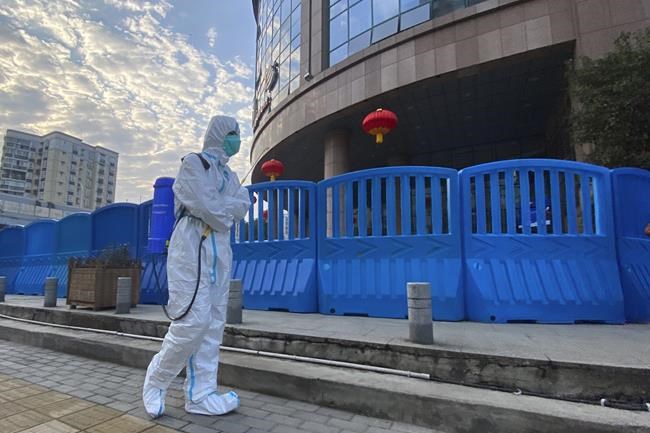
FILE - A worker in protectively overalls and carrying disinfecting equipment walks outside the Wuhan Central Hospital, China on Feb. 6, 2021. Experts drafted by the World Health Organization to help investigate the origins of the coronavirus pandemic say further research is needed to determine how COVID-19 first began. They say they need a more detailed analysis of the possibility it was a laboratory accident. (AP Photo/Ng Han Guan, File)

Yet in a report released Thursday, WHO’s expert group said “key pieces of data” to explain how the pandemic began were still missing. The scientists said the group would “remain open to any and all scientific evidence that becomes available in the future to allow for comprehensive testing of all reasonable hypotheses.”

Identifying a disease’s source in animals typically takes years. It took more than a decade for scientists to pinpoint the species of bats that were the natural reservoir for SARS, a relative of COVID-19.

WHO’s expert group also noted that since lab accidents in the past have triggered some outbreaks, the highly politicized theory could not be discounted.

Jean-Claude Manuguerra, a co-chair of the 27-member international advisory group, acknowledged that some scientists might be “allergic” to the idea of investigating the lab leak theory, but said they needed to be “open-minded” enough to examine it.

The report could revive accusations that WHO initially was too accepting of Chinese government explanations early in the outbreak, which ultimately killed millions of people, sickened millions more, forced dozens of countries into lockdown and upended the world economy.

Investigations by The Associated Press found that some top WHO insiders were frustrated by China during the initial outbreak even as WHO heaped praise on Chinese President Xi Jinping. They were also upset over how China sought to clamp down on research into the origins of COVID-19.

Former U.S. President Donald Trump speculated repeatedly — without evidence — that COVID-19 was started in a Chinese lab. He also accused WHO of “ colluding” with China to cover up the initial outbreak, citing the U.N. health agency’s continued public praise of the country despite China’s refusal to share crucial data.

WHO’s expert group said WHO Director-General Tedros Adhanom Ghebreyesus sent two letters to senior Chinese government officials in February requesting information, including details about the earliest human cases of COVID-19 in the city of Wuhan. It’s unclear whether the Chinese responded.

The experts said no studies were provided to WHO that assessed the possibility of COVID-19 resulting from a laboratory leak.

Jamie Metzl, who sits on an unrelated WHO advisory group, has suggested that the Group of Seven industrialized nations set up their own COVID origins probe, saying WHO lacks the political authority, expertise and independence to conduct such a critical evaluation.

Metzl welcomed WHO’s call for a further investigation into the lab leak possibility but said it was insufficient.

“Tragically, the Chinese government is still refusing to share essential raw data and will not allow the necessary, full audit of the Wuhan labs,” he said. “Gaining access to this information is critical to both understanding how this pandemic began and preventing future pandemics.”

In Washington, a Republican-led subcommittee in the House of Representatives on the COVID-19 pandemic tweeted: “Americans were smeared as ‘conspiracy theorists’ for asking whether #COVID19 came from a lab leak. Now, the WHO is asking the same questions.”

“WE NEED ANSWERS,” added the committee, which is headed by Rep. Steve Scalise of Louisiana.

WHO’s expert scientists said numerous avenues of research were needed, including studies evaluating the role of wild animals, and environmental studies in places where the virus might have first spread, like the Huanan seafood market in Wuhan.
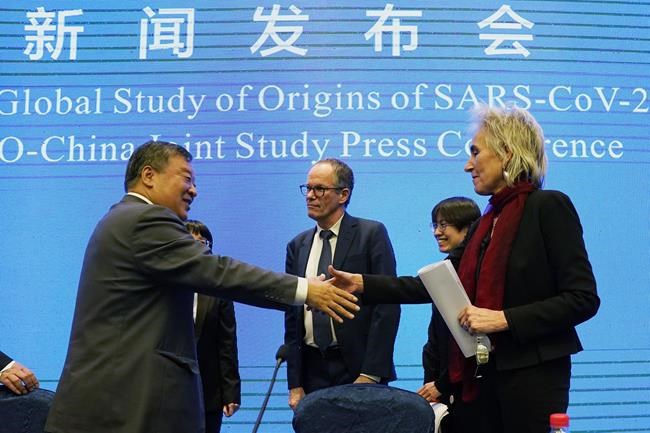
FILE - Marion Koopmans, right, and Peter Ben Embarek, center, of the World Health Organization team say farewell to their Chinese counterpart Liang Wannian, left, after a WHO-China Joint Study Press Conference at the end of the WHO mission in Wuhan, China on Feb. 9, 2021. Experts drafted by the World Health Organization to help investigate the origins of the coronavirus pandemic say further research is needed to determine how COVID-19 first began. They say they need a more detailed analysis of the possibility it was a laboratory accident. (AP Photo/Ng Han Guan, File)

In March 2021, WHO released a report about COVID-19’s origins following a highly choreographed visit by international scientists to China. The report concluded that the disease most likely jumped into humans from bats and that there was no evidence to suggest there was a connection to a laboratory.

Yet after considerable criticism, including from some scientists on WHO’s team, the agency’s director acknowledged that it was “ premature ” to rule out a lab leak.

In its new report, WHO said the experts were given access to data that included unpublished blood samples from more than 40,000 people in Wuhan in 2019. The samples were tested for COVID-19 antibodies. None were found, suggesting the virus was not spreading widely before it was first identified in late December that year.

WHO’s experts called for numerous studies to be done, including testing wild animals to find which species might host COVID-19. They also said the “cold chain” supply theory should be probed. China has previously advanced the idea that traces of COVID-19 on frozen packaging was causing outbreaks rather than any domestic source, a theory widely panned by outside scientists.

To investigate whether COVID-19 might have been the result of a lab accident, WHO’s experts said interviews should be conducted “with the staff in the laboratories tasked with managing and implementing biosafety and biosecurity.”

China has called the suggestion that COVID-19 began in a laboratory “ baseless ” and countered that the virus originated in American facilities, which were also known to be researching coronaviruses in animals. The Chinese government has said it supports the search for the pandemic’s origins, but that other countries should be the focus.

In a footnote to the report, WHO’s group noted that three of its own experts — scientists from China, Brazil and Russia — disagreed with the call to investigate the possibility of COVID-19 being sparked by a lab accident.

Scientists connected to WHO lamented in August 2021 that the search for the pandemic’s origins had stalled and that the window of opportunity was “closing fast.” They warned that collecting data that was now at least two years old was increasingly difficult.

___

Cheng reported from London.

___

Follow AP’s coverage of the pandemic at https://apnews.com/hub/coronavirus-pandemic
Report Error Submit a Tip

More Stories

Express the merry widow you truly are

Maureen Scurfield 4 minute read 2:00 AM CDT

DEAR MISS LONELYHEARTS: My husband died a while back, and I don’t miss him! He had grown old in a strange and cranky way, and I’m a cheerful person by nature. It was hard to hear him shoot down every idea I had to go out and do things together.

He wasn’t physically ill — just finished with having any fun. He had gotten depressed and wouldn’t take anti-depressants, although he was fine with getting drunk and critical towards me.

He was particularly negative about seeing friends and relatives, and living the active way we used to — always the first to get tickets to concerts and encouraging other friends to go with us for dinners at new restaurants. We also went to a lot of sports games, and visited friends and relatives. We arrive with lots of good food and drink.

So now when people ask me in that pitying voice used for widows, “Poor darling, how are you doing?” I respond, “He was miserable towards the end, and it was a relief when he died.” They look shocked, but it’s the truth, and they know it.

Opportunity knocks, and we must answer

Adrian Deer 5 minute read 2:00 AM CDT

Imagine being a young athlete who loves volleyball but attends a school without a net or even a ball.

For many students in Winnipeg, access to basic sporting equipment is something they rarely think about.

However, during my visit to Red Sucker Lake First Nation in northern Manitoba, I witnessed a very different reality. The local school did not have volleyball nets or balls. As someone who has had the opportunity to compete in volleyball across Canada and internationally, this experience made me realize how easily we take these opportunities for granted.

How can we expect young Indigenous athletes to discover their potential when they don’t even have the basic equipment needed to play? Talent and determination can exist in every community but without access to opportunities, that potential may never be realized.

Pharmacist fined for dispensing incorrect dosage

Erik Pindera 4 minute read Preview

Pharmacist fined for dispensing incorrect dosage

Erik Pindera 4 minute read Sunday, Oct. 25, 2026

A Winnipeg pharmacist has been fined for misconduct after dispensing a mistakenly high dose of an anti-psychotic, harming her patient.

Rumina Ishani was fined $3,500 and ordered to pay $5,000 in costs by the College of Pharmacists of Manitoba earlier this month, after pleading guilty to professional misconduct.

The college, in a written disciplinary decision, said the incident occurred on Aug. 12, 2025, at the Marion Street Shoppers Drug Mart where Ishani worked at the time.

She filled an aripiprazole prescription for a patient that day. The patient had first been given the anti-psychotic at that pharmacy in November 2023 at two milligrams a day for 30 days, and was again prescribed the drug in February 2025 at one mg/day, which was increased to two mg/day in March.

Read
Sunday, Oct. 25, 2026

Cabinet minister guilty of ethics violation may have buyer for family business two years after offering to sell

Carol Sanders 3 minute read Preview

Cabinet minister guilty of ethics violation may have buyer for family business two years after offering to sell

Carol Sanders 3 minute read Yesterday at 6:46 PM CDT

Natural Resources and Indigenous Futures Minister Ian Bushie has a potential buyer for Grandpa George’s gas and convenience store at Hollow Water First Nation after offering it to sell it two years ago when he was found guilty of an ethics violation.

“Grandpa George’s is currently in negotiations with a buyer and that process is ongoing,” Bushie’s press secretary Caedmon Malowany said in a prepared statement Monday.

Bushie held a news conference in 2024 to say he would voluntarily sell the business after he violated provincial ethics rules.

The MLA for Keewatinook, who was not available for an interview Monday, was not required to sell the gas bar after former ethics commissioner Jeffrey Schnoor ruled in September 2024 that Bushie inadvertently violated the new Conflict of Interest (Members and Ministers) Act.

Read
Yesterday at 6:46 PM CDT

Police probe Perimeter Highway collision

1 minute read Yesterday at 3:22 PM CDT

Traffic investigators are probing a collision between two eastbound semi-trucks on the south Perimeter Highway at Provincial Road 330 on Sunday morning.

The Winnipeg Police Service was called to the collision at about 7:30 a.m., where Winnipeg Fire Paramedic Service personnel were already on the scene.

Traffic investigators met with the drivers and learned that one of the trucks was safely pulled over on the shoulder, waiting for mechanical assistance, when a second semi ran into the parked semi. The trailer of the parked vehicle was damaged and the driver was left with minor injuries.

The driver of the second semi remained at the scene.

‘Exciting’ turn for mayoral candidate Noah Redden as election race enters final stretch

Erik Pindera 5 minute read Preview

‘Exciting’ turn for mayoral candidate Noah Redden as election race enters final stretch

Erik Pindera 5 minute read Sunday, Oct. 25, 2026

A small but steady stream of voters arrived at a Portage Avenue diner Sunday to meet Noah Redden, just two days after a new poll suggested the 27-year-old has emerged as a player in Winnipeg’s race for mayor.

Once a low-polling candidate, the software developer is now in third place with 14 per cent support, tied with candidate Mike Vogiatzakis, an Abacus Data survey released Friday shows.

Incumbent Scott Gillingham remains in the lead with the support of 36 per cent of decided voters — 19 percentage points lower than a September survey conducted by Abacus for the Free Press.

The new data placed former city councillor and Progressive Conservative cabinet minister Kevin Klein in second place with 19 per cent support — a drop of four percentage points since September.

Read
Sunday, Oct. 25, 2026