

Press to join U.S.-led Indo-Pacific economic framework, business leaders urge Ottawa
Advertisement
Read this article for free:
or
Already have an account? Log in here »
To continue reading, please subscribe:

Digital Subscription
One year of digital access for only $205*
- Enjoy unlimited reading on winnipegfreepress.com
- Read the E-Edition, our digital replica newspaper
- Access News Break, our award-winning app
- Play interactive puzzles
*First annual payment billed as $205.00 + GST for one year. This annual subscription will automatically renew at $233.00 + GST every 52 weeks (10% off the regular annual price of $259.35). Offer available to new and qualified returning subscribers only. Cancel any time.
To continue reading, please subscribe:
Add Free Press access to your Brandon Sun subscription for only an additional
$1 for the first 4 weeks*
- Enjoy unlimited reading on winnipegfreepress.com
- Read the E-Edition, our digital replica newspaper
- Access News Break, our award-winning app
- Play interactive puzzles
*Your next Brandon Sun subscription payment will increase by $1.00 and you will be charged $17.95 plus GST for four weeks. After four weeks, your payment will increase to $24.95 plus GST every four weeks.
Read unlimited articles for free today:
or
Already have an account? Log in here »
Hey there, time traveller!
This article was published 15/06/2022 (1581 days ago), so information in it may no longer be current.
WASHINGTON – There’s a four-letter F-word American leaders don’t much use these days when they talk about international trade: “free.”
Instead, President Joe Biden’s newest economic relationships in the Americas and the Indo-Pacific are described as “partnerships” and “frameworks” — an illustration of how politically toxic free trade has become in the U.S.
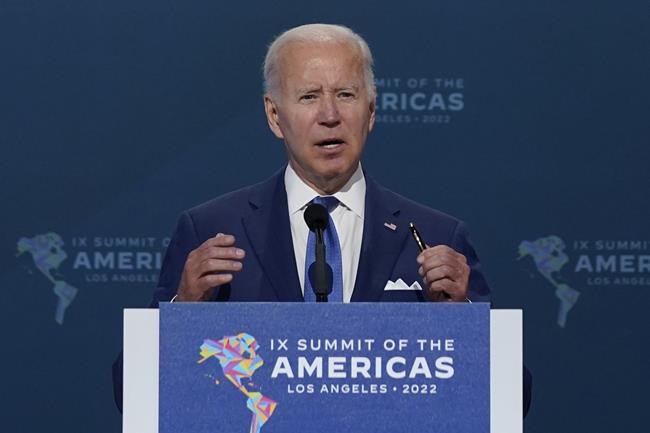
The latest is the Americas Partnership for Economic Prosperity, which Biden announced last week as he kicked off the Summit of the Americas, where leaders from 21 countries across the Western Hemisphere gathered, including Prime Minister Justin Trudeau.
It was seen by some as a consolation prize of sorts following Biden’s unveiling in May of the Indo-Pacific Economic Framework for Prosperity, with some heavy hitters among its 13 founding partners, including India, Japan and Australia — together totalling some 40 per cent of global GDP.
Its architects have gone to some lengths to point out that it’s not a free trade deal, but rather a potential foundation for future agreements.
“The fact that this is not a traditional free trade agreement is a feature of IPEF, not a bug,” National Security Adviser Jake Sullivan said when the framework was unveiled last month.
“The new landscape and the new challenges we face need a new approach, and we will shape the substance of this effort together with our partners.”
Though the administration won’t say so, that new approach includes framing agreements as non-trade related, to avoid the politically difficult hurdle of requiring congressional approval.
The IPEF is the U.S. answer to the 11-country Comprehensive and Progressive Trans-Pacific Partnership trade deal, or CPTPP, which includes Canada and which former president Donald Trump abandoned back in 2017.
Business advocates in Canada say the federal government should be aggressively trying to secure membership in the Indo-Pacific framework, which represents the U.S. economic strategy in the Asia-Pacific.
Its members also include Brunei, Indonesia, Korea, Malaysia, New Zealand, the Philippines, Singapore, Thailand, and Vietnam — and now Fiji, which was added shortly after the original announcement.
“When Fiji can complain and be added in 24 hours, there’s no reason” the federal government couldn’t do the same, said Goldy Hyder, president and CEO of the Business Council of Canada.
“These are not either-or; it’s not like, ‘You’re part of TPP and you’re not part of this.’ This is something coming together, and these frameworks are America’s response to wanting to stay away from trade agreements, clearly. So it’s best to be in the room than on the outside looking in.”
As the Summit of the Americas wrapped up last week, Trudeau — whose own liberal use of free trade rhetoric reflects a different political reality in Canada — would not expressly say whether those efforts are underway.
“Canada is the only G7 country that has free trade deals with every other G7 country; we have extensive free trade deals with Central and South America, (and) we have extensive deals with Asia through the CPTPP,” he said.
Having chosen to exit that latter agreement, the U.S. clearly has to negotiate new partnerships with countries in the Asia-Pacific, he said, adding that Canada is in “full discussions” with the U.S. about the Americas partnership.
“But those conversations about how we work together — how we strengthen institutions, how we deepen trade ties, how we support each other through greater resilience in our communities, in our countries — that has been at the heart of the hard work done through the summit, and will continue to be.”
Mark Agnew, vice-president of policy for the Canadian Chamber of Commerce, sounded skeptical Tuesday about the prospects of the Americas partnership bearing much in the way of fruit.
“I really get the sense that the Indo-Pacific framework just has more meat on the bones, frankly, in terms of what’s in there … things that have a bit of crunchiness to them,” Agnew said.
The White House vision for IPEF includes “high-standard rules of the road” for the digital economy, including on the flow of data across borders, e-commerce standards and concerns about online privacy, he noted — all issues that are top of mind for Canadian businesses.
“Canada has to be looking at both regions,” Agnew said. “But when I look at which one holds more potential for Canada and Canadian interests, the Indo-Pacific one is where I think there’s more there for Canada to focus on.”

Both frameworks reflect a concerted effort on the Biden administration’s part to inject progressive, labour-friendly values into the international trade landscape, and to counter the grassroots, working-class disdain for globalization.
Those values — and the growing political urgency for Democrats, who face challenging midterms in November — were on clear display Tuesday when Biden spoke to more than 2,000 labour leaders and union members at the AFL-CIO convention in Philadelphia.
“We need an economy built from the middle out and the bottom up, not the top down,” said Biden, who was introduced as “the most pro-union president in the history of the United States.”
“When the middle class does well, everybody does — the wealthy do very well, they’re never hurt. But I also know too often we’ve had an economy where the wealthy do better and better while the middle class gets left behind.”
This report by The Canadian Press was first published June 15, 2022.


