

Total football, indeed
Netherlands, naturally, ground zero for innovation in the Beautiful Game
Advertisement
Read this article for free:
or
Already have an account? Log in here »
To continue reading, please subscribe:

Digital Subscription
One year of digital access for only $205*
- Enjoy unlimited reading on winnipegfreepress.com
- Read the E-Edition, our digital replica newspaper
- Access News Break, our award-winning app
- Play interactive puzzles
*First annual payment billed as $205.00 + GST for one year. This annual subscription will automatically renew at $233.00 + GST every 52 weeks (10% off the regular annual price of $259.35). Offer available to new and qualified returning subscribers only. Cancel any time.
To continue reading, please subscribe:
Add Free Press access to your Brandon Sun subscription for only an additional
$1 for the first 4 weeks*
- Enjoy unlimited reading on winnipegfreepress.com
- Read the E-Edition, our digital replica newspaper
- Access News Break, our award-winning app
- Play interactive puzzles
*Your next Brandon Sun subscription payment will increase by $1.00 and you will be charged $17.95 plus GST for four weeks. After four weeks, your payment will increase to $24.95 plus GST every four weeks.
Read unlimited articles for free today:
or
Already have an account? Log in here »
Hey there, time traveller!
This article was published 17/06/2022 (1520 days ago), so information in it may no longer be current.
In his book Brilliant Orange: The Neurotic Genius of Dutch Football, David Winner explains how the Netherlands’ post-war experience, psyche and, in particular, history of innovation helped revolutionize the sport through the introduction of “Totaalvoetbal,” or Total Football.
“The Dutch think innovatively, creatively and abstractly about space in their football,” he writes, “because for centuries they have had to think innovatively about space in every other area of their lives.”
Picture the country’s network of drainage and dikes that protects a dense, low-lying population to get a sense of what he means. Even beyond football, you could argue the results of a necessary, national imagination have included the invention of atmosphere in painting and development of the capital markets that make up our contemporary economic system.
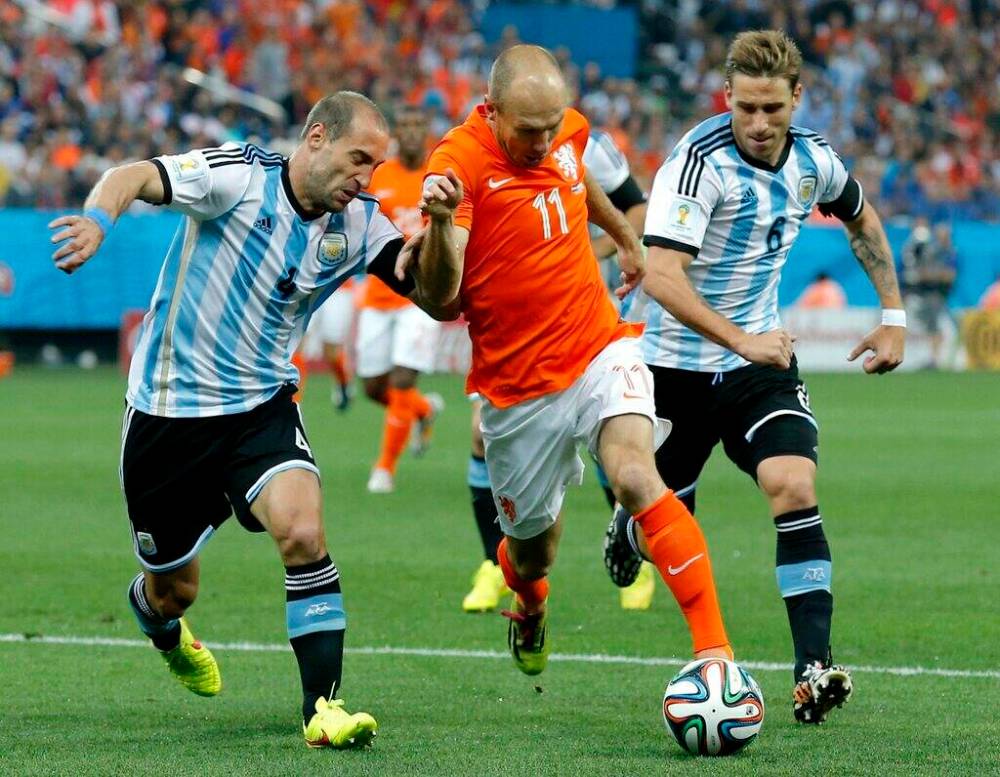
So, it should come as no surprise that football’s next revolution will likely be Dutch-driven, with Amsterdam at its centre. But this time around, the transformation stands to be more technical than stylistic — and therein lies its controversy.
In a recent article posted to the official website of the Royal Dutch Football Association (KNVB), Jan Dirk van der Zee, the organization’s director of amateur football, proposed five alterations that would radically change how matches are played, officiated and watched. His premise: “Will football be played the same way in 2050 as it was in 2022? Or do our (grand)children play it differently? With new rules?”
Assuming the later, he put forward that throw-ins could be taken as kick-ins or dribble-ins, dribbling on free-kicks, five-minute sin bin sentences for cautions, unlimited in-play substitutions and a reduction in the length of a half from 45 minutes to 30.
That his motivation for each involves time is no coincidence.
“Because,” he writes, “if we want to compete with the temptations of the screen and the free individual sports, more is needed than sticking to tradition and nostalgia.”
And that’s where his argument runs into trouble.
Yes, nostalgia’s inherent pitfalls are as deep as they are obvious, as even a casual study of real-world events lays plain. But do van der Zee’s ideas — and it’s worth pointing out that he’s hardly alone in them and has at least the partial backing of Arsene Wenger, for example — endeavour to responsibly manage football’s future, perhaps even remake it, or create a different game altogether?
He does, to be fair, make a valid point regarding the cost of participation, which continues to be extended out of reach for many families. It’s also not a problem specific to football.
The rationale of screen-time as competition for football, however, simply has no basis in reality. “Fear-of-screen” as a genre dates back decades. It’s not even worth getting into.
Now, there is certainly a discussion to be had about football accommodating the screen. (A useful rabbit hole to follow here involves FIFA delicensing the popular EA Sports franchise of games.) And in this regard van der Zee would seem to be onto something, as his theme of playing time suggests.
From baseball to hockey to cricket, professional sports are rightfully obsessed with shortening the amount of time required to play a game. Van der Zee points out that throw-ins, kick-offs, corners and goal-kicks take at least 15 minutes from the present 90. Free-kicks, according to his measurements, account for about 11 per cent of a match.
He and other lobbyists make the case that reducing those non-played minutes would make football fairer (less time-wasting) and more watchable as a spectacle (more ball in-play). They’re not necessarily wrong, although there are counterpoints to consider.
Fans take a certain thrill from awaiting the delivery of a free-kick or corner — the tension before the act. If excitement is at least a partial objective, elements already containing it should be dealt with cautiously. And then there is the matter of player safety. Those pauses provide important recovery periods, which are becoming more and more important as climate change affects conditions.
Van der Zee would introduce unlimited, on-the-fly substitutions to prevent player exhaustion, but by then he’d be dealing with a sport intrinsically different from football. Ditto the sin bin. This isn’t rugby. But conditions are what they are, and will become what they become, so it follows that something like shortened periods will someday be considered.
All that said, and agree or disagree with what he’s put forward, the KNVB’s amateur football chief has at least indulged in an exercise in foresight, in imagination, and he’s also demonstrated the courage to present his well-intended concepts to a football establishment that is inherently conservative.
In doing so, he is quite literally fulfilling the KNVB’s mandates “to experiment with rules that make the game more attractive” and “to make football future proof, for today’s and tomorrow’s generation of players.”
Naturally, those five points have generated considerable discussion within the Netherlands — not all of it constructive.
Referring to van der Zee as a “federation bobo who sees himself as an innovative pioneer,” a Monday column in Rotterdam-based Algemeen Dagblad indicated the lower-level leagues, where the changes may be tested, hadn’t been consulted, and revelled in the fact that Marianne van Leeuwen, the KNVB’s professional football director, had reigned in her amateur colleague.
Changes, whether now or later, and whether van der Zee’s version or someone else’s, or a hybrid, are coming, and players and fans will like them and not like them — who knows how it’ll all play out.

It shouldn’t be surprising that the initial brainstorm is happening in the Netherlands, that the trial balloon is being launched from a place where adapting is part of living.
The Dutch influence already informs the way football is played, which is better for it. It may soon be reflected in the rulebook as well.
Total football, indeed.
Twitter @JerradPeters
Our newsroom depends on a growing audience of readers to power our journalism. If you are not a paid reader, please consider becoming a subscriber.
Our newsroom depends on its audience of readers to power our journalism. Thank you for your support.
Our newsroom depends on a growing audience of readers to power our journalism. If you are not a paid reader, please consider becoming a subscriber.
Our newsroom depends on its audience of readers to power our journalism. Thank you for your support.
Related Articles
A beer and a chat: Man U's CEO meets with disgruntled fans

Advertisement Advertise With Us
Advertisement Advertise With Us