Delay equals deterioration

Advertisement
Read this article for free:
or
Already have an account? Log in here »
To continue reading, please subscribe:

Digital Subscription
One year of digital access for only $205*
- Enjoy unlimited reading on winnipegfreepress.com
- Read the E-Edition, our digital replica newspaper
- Access News Break, our award-winning app
- Play interactive puzzles
*First annual payment billed as $205.00 + GST for one year. This annual subscription will automatically renew at $233.00 + GST every 52 weeks (10% off the regular annual price of $259.35). Offer available to new and qualified returning subscribers only. Cancel any time.
To continue reading, please subscribe:
Add Free Press access to your Brandon Sun subscription for only an additional
$1 for the first 4 weeks*
- Enjoy unlimited reading on winnipegfreepress.com
- Read the E-Edition, our digital replica newspaper
- Access News Break, our award-winning app
- Play interactive puzzles
*Your next Brandon Sun subscription payment will increase by $1.00 and you will be charged $17.95 plus GST for four weeks. After four weeks, your payment will increase to $24.95 plus GST every four weeks.
Read unlimited articles for free today:
or
Already have an account? Log in here »
Hey there, time traveller!
This article was published 24/06/2022 (1549 days ago), so information in it may no longer be current.
The longer people wait for medically necessary procedures such as surgery and diagnostic tests, the worse their conditions usually get. They tend to become sicker and often suffer from increased bouts of anxiety and emotional stress. Eventually, many end up at the emergency department because they can no longer stand the pain and anguish.
Dr. Kristjan Thompson, an emergency room physician at St. Boniface Hospital, says he’s seeing more patients showing up with conditions directly related to long waits for surgery and diagnostic tests.
“In the last two years, absolutely we’ve seen more patients coming in requiring band-aid solutions for problems that require definitive care (such as) surgeries,” said Thompson, past-president of Doctors Manitoba. “Patients who are in heart failure who need their valves replaced, or patients who are having frequent gall bladder attacks and need their gall bladders removed, absolutely, we are seeing more of that.”

Patients are not only seeing a deterioration in their physical health because of long waits for surgeries and diagnostic tests, many are also experiencing severe mental health problems, said Thompson.
“There’s a lot of emotional and mental stress and anxiety and suffering that comes with waiting,” said Thompson. “I’ve seen many patients who are waiting in fear and uncertainty, who are anxious, who are worried.”
In many cases, patients are anxious because they are still waiting for a diagnostic test to assess their condition, he said. People often need an MRI, a CT scan or an ultrasound to find out if they require surgery or if they have a disease, such as cancer. With long waits for diagnostic testing, that’s becoming increasingly difficult to do, he said.
“I understand that fear and suffering because I see it every day and it’s hard to see,” said Thompson.
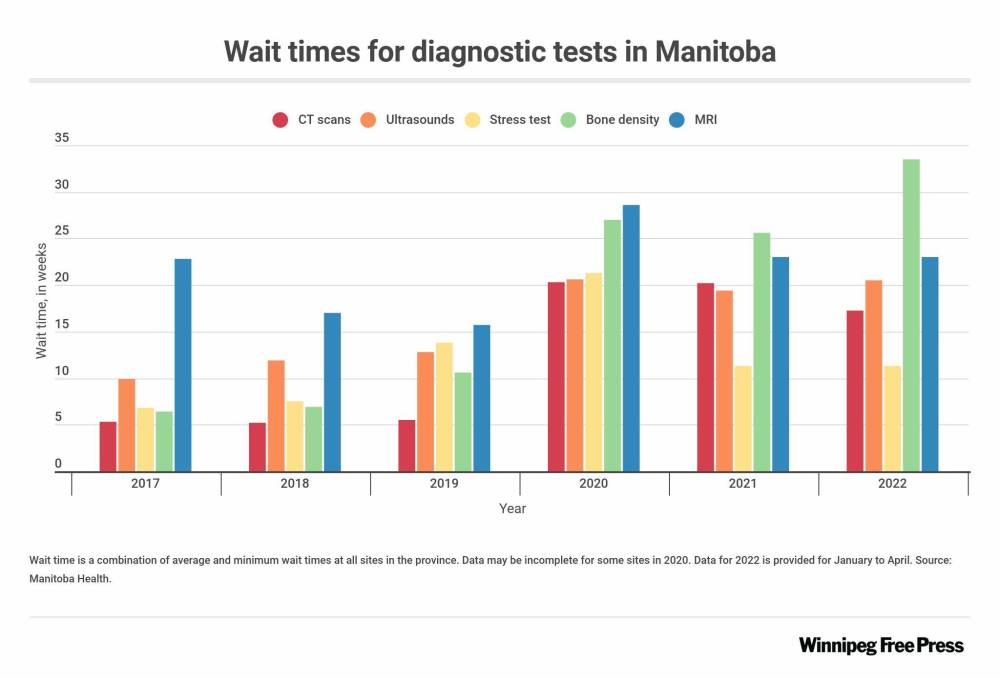
Manitoba lowered wait times for some diagnostic tests in the years leading up to the COVID-19 pandemic. The wait time for MRIs (which produce images of organs and structures inside the body and are used to help physicians diagnose disease or injuries) fell from an average of nearly 23 weeks in 2017 to just under 16 weeks in 2019.
With thousands of tests cancelled during the pandemic, the number of scans fell dramatically in 2020. Those numbers have since returned to pre-pandemic levels, but there’s still a backlog of cases. As a result, wait times remain stubbornly high. The average wait time for an elective MRI in April (the most recent data available from Manitoba Health) was 23 weeks.
John French, executive director of diagnostic imaging at Shared Health, which oversees the province’s diagnostic testing services, told a legislative committee last month between 15 and 16 full-time technologists are needed to bring MRI wait-time numbers down. However, a national shortage of technologists is making it difficult to fill those spots. A Shared Health official said last week the agency is recruiting for those positions but no new staff have been hired.
Meanwhile, Canadian Institute for Health Information data released last month shows Manitoba had the second longest median wait time in the country for MRIs in 2021 and the third longest 90th percentile wait (the longest wait time for nine out 10 patients).
Manitoba had the longest median wait time among the provinces for CT scans (tied with Nova Scotia) and the second longest 90th percentile wait.
Manitoba increased the number of CT scans performed last year to record levels, after volumes dropped off in 2020. The province is on track to perform a similar number this year. However, wait times have still not returned to pre-pandemic levels. The average wait time for an elective CT scan (which produces images of organs, blood vessels, bones, the spinal cord and other areas inside the body) in 2019 was 5.5 weeks. It soared to over 20 weeks during the pandemic and has since fallen to 15 weeks.
Meanwhile, provincial health officials say they plan to change the methodology of how wait times for diagnostic testing are calculated to be more in line with CIHI. What the province publishes and what CIHI releases do not always coincide because each uses different methods of calculating wait times.
Thompson said he’s hopeful, now that most hospitals and health centres are back to pre-pandemic capacity, that the province will begin to clear the backlogs.
There are myriad ways of doing so, including using median waits (the point at which half of patients had longer wait times and half had shorter ones), averages (which can be skewed by a small number of extreme cases), or percentiles (such as the 90th percentile wait time, where nine out of 10 patients experience shorter wait times and one in 10 wait longer). CIHI also calculates what percentage of procedures are performed within medically recommended timelines, called benchmarks, and compares them between provinces.
However wait times are calculated, Thompson said it’s critical government does everything possible to reduce the long delays. He said he’s hopeful, now that most hospitals and health centres are back to pre-pandemic capacity, that the province will begin to clear the backlogs.
“I strongly believe that government gets that and wants to do everything they can to make this happen,” said Thompson. “But we need to start seeing those words translate into actions and we’re starting to see that now.”
Tom Brodbeck is an award-winning author and columnist with over 30 years experience in print media. He joined the Free Press in 2019. Born and raised in Montreal, Tom graduated from the University of Manitoba in 1993 with a Bachelor of Arts degree in economics and commerce. Read more about Tom.
Tom provides commentary and analysis on political and related issues at the municipal, provincial and federal level. His columns are built on research and coverage of local events. The Free Press’s editing team reviews Tom’s columns before they are posted online or published in print – part of the Free Press’s tradition, since 1872, of producing reliable independent journalism. Read more about Free Press’s history and mandate, and learn how our newsroom operates.
Our newsroom depends on a growing audience of readers to power our journalism. If you are not a paid reader, please consider becoming a subscriber.
Our newsroom depends on its audience of readers to power our journalism. Thank you for your support.
Tom Brodbeck is an award-winning author and columnist with over 30 years experience in print media. He joined the Free Press in 2019. Born and raised in Montreal, Tom graduated from the University of Manitoba in 1993 with a Bachelor of Arts degree in economics and commerce. Read more about Tom.
Tom provides commentary and analysis on political and related issues at the municipal, provincial and federal level. His columns are built on research and coverage of local events. The Free Press’s editing team reviews Tom’s columns before they are posted online or published in print – part of the Free Press’s tradition, since 1872, of producing reliable independent journalism. Read more about Free Press’s history and mandate, and learn how our newsroom operates.
Our newsroom depends on a growing audience of readers to power our journalism. If you are not a paid reader, please consider becoming a subscriber.
Our newsroom depends on its audience of readers to power our journalism. Thank you for your support.
Related Articles
Province keeps U.S. spinal surgery price tag under wraps
Advertisement Advertise With Us
Advertisement Advertise With Us