Step by step

MacDonald’s mindful musings mull precarious, precious nature of walking

Advertisement

Advertise with us

This small volume of poetry and prose by Winnipeg-raised, Waterloo-based writer/professor Tanis MacDonald bursts with ideas about moving through space on one’s own terms.

Read this article for free:

or

Already have an account? Log in here »

To continue reading, please subscribe:

Subscribe and receive a limited-edition Free Press branded hat or tote.

Digital Subscription

One year of digital access for only $205*

  • Enjoy unlimited reading on winnipegfreepress.com
  • Read the E-Edition, our digital replica newspaper
  • Access News Break, our award-winning app
  • Play interactive puzzles

*First annual payment billed as $205.00 + GST for one year. This annual subscription will automatically renew at $233.00 + GST every 52 weeks (10% off the regular annual price of $259.35). Offer available to new and qualified returning subscribers only. Cancel any time.

To continue reading, please subscribe:

Add Free Press access to your Brandon Sun subscription for only an additional

$1 for the first 4 weeks*

  • Enjoy unlimited reading on winnipegfreepress.com
  • Read the E-Edition, our digital replica newspaper
  • Access News Break, our award-winning app
  • Play interactive puzzles
Start now

*Your next Brandon Sun subscription payment will increase by $1.00 and you will be charged $17.95 plus GST for four weeks. After four weeks, your payment will increase to $24.95 plus GST every four weeks.

Hey there, time traveller!
This article was published 25/06/2022 (1489 days ago), so information in it may no longer be current.

This small volume of poetry and prose by Winnipeg-raised, Waterloo-based writer/professor Tanis MacDonald bursts with ideas about moving through space on one’s own terms.

In 33 short pieces, 10 re-published here and originally appearing elsewhere, MacDonald wanders through wilderness (parks and managed forests, she confesses), cityscapes and time. She ponders the risks and dangers from nature and humankind, the pain and physical limitations that challenge her body, and the trauma she experiences as an assault survivor, soothed by walking. Alongside the discomfort, the collection offers beauty, awe, defiance and even humour.

But MacDonald’s central observation, what unites many of these compositions, is that for women, people of colour, disabled people, First Nations peoples and wildlife (what she terms our “non-human neighbours”), movement through space is precarious. There are stares, catcalls and stalking. She reminds us there can be worse, as for members of the Muslim Pakistani-Canadian Afzaal family, mowed down by a racist driver while on a stroll last June in London, Ont.

John Roscoe photo
Author Tanis MacDonald acknowledges that for many groups, moving through space can be precarious.
John Roscoe photo Author Tanis MacDonald acknowledges that for many groups, moving through space can be precarious.

The similarity of the title’s “straggle” to “struggle” is likely no coincidence.

The word, as an idea, appears just once in the text as “straggler,” juxtaposed against the “speed-obsessed 21st century.” Implying more than just tardiness, it speaks of separation from the group. MacDonald’s experiences in these pieces are largely from the perspective of solitude and anonymity. While they are personal, they are frequently supported by references from a broad range of insightful, contemporary writers and artists, many from Canada. This is a feminist account. And a humane one.

It is also elegant. MacDonald tells us that prose and poetry are cousins, and that one informs the other. This refers to craft, but it is also delightful when her ideas are expressed in parallel through these related forms.

In the essay We, Megafauna, MacDonald notes that deer learn to manipulate a vanishing point when encountering humans in the woods. “[D]eer would coalesce to solidity from a mix of branches and leaves and a patch of sunlight, and then just as quickly melt out of view as though their molecules had seeped into the undergrowth,” she writes. This creaturely skill is evident in the short lyrical item The Deer in the Painting (in reference to a canvas by Winnipeg artist Clarence Tillenius), where a doe “slips like smoke between the trees, an appearing act… slight of hoof, sleight of hand.”

Similarly, MacDonald articulates the pain of sciatica in two essays and a poem: “the lit match of sciatica flaring down my thigh” (We, Megafauna); “the bark of my sciatica” (Ricochet: An Arcade); and “…The glass in/my right hip is sciatica/shattered like Attica” (This Limp Goes to Eleven). She muses, “…I know Long John Silver takes/no wasted steps.”

Winnipeggers will respond to local references. Who cannot smile at the vision of Jubilee Ave., “where the Bridge Drive-Inn still stands” or of a white snowy owl above Corydon and Waverley, “an optical illusion emerging from the light snow being driven by the wind across the wide street”?

Not all scenes are positive. There is a “serial masturbator” in the Assiniboine Forest. In the same woods, a woman successfully fights back and foils a male attacker. Readers may recall these incidents (still, the forest remains a joy). As another somber observation, MacDonald notes that the Assiniboine Park Zoo’s bison enclosure displays “animals who would be numerous on the very land that the zoo occupies if colonialism hadn’t destroyed most of the animals and the environment.”
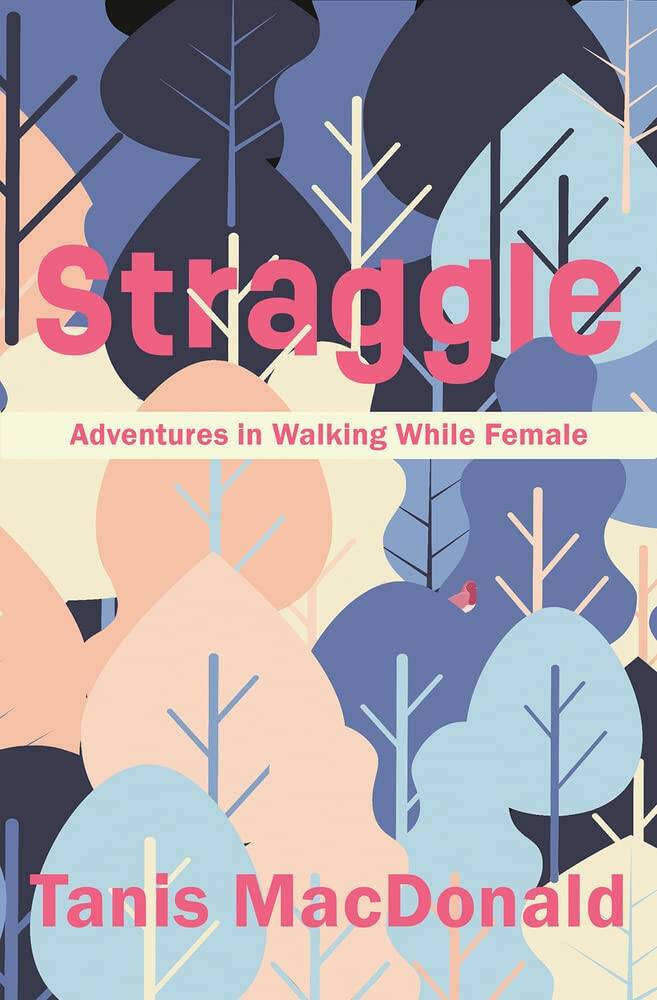
Straggle
Straggle

MacDonald is mindful of being from a settler background and the effects of colonialism on First Nations peoples. She lives near Ose’kowáhne, “a grateful guest on traditional Haudenosaunee territory.” She says in her introduction, “Wherever I walk, I know it’s my responsibility to consider the history of colonization and not just be blinded by the beauty of the land.” Colonization arises in several of the pieces, where MacDonald considers blood and theft and alternative, more respectful, ways of negotiating the world.

This contemplative rendition on walking stands apart from what has come before it — books on fitness, pilgrimage, adventure. It is about walking the best one can in the circumstances. It is relatable and triumphant.

Gail Perry is a long-distance walker who strives to be present.

Report Error Submit a Tip

More Stories

MacDonald’s mindful musings mull precarious, precious nature of walking

Reviewed by Gail Perry 4 minute read Preview

MacDonald’s mindful musings mull precarious, precious nature of walking

Reviewed by Gail Perry 4 minute read Saturday, Jun. 25, 2022

This small volume of poetry and prose by Winnipeg-raised, Waterloo-based writer/professor Tanis MacDonald bursts with ideas about moving through space on one’s own terms.

In 33 short pieces, 10 re-published here and originally appearing elsewhere, MacDonald wanders through wilderness (parks and managed forests, she confesses), cityscapes and time. She ponders the risks and dangers from nature and humankind, the pain and physical limitations that challenge her body, and the trauma she experiences as an assault survivor, soothed by walking. Alongside the discomfort, the collection offers beauty, awe, defiance and even humour.

But MacDonald’s central observation, what unites many of these compositions, is that for women, people of colour, disabled people, First Nations peoples and wildlife (what she terms our “non-human neighbours”), movement through space is precarious. There are stares, catcalls and stalking. She reminds us there can be worse, as for members of the Muslim Pakistani-Canadian Afzaal family, mowed down by a racist driver while on a stroll last June in London, Ont.

The similarity of the title’s “straggle” to “struggle” is likely no coincidence.

Read
Saturday, Jun. 25, 2022

Sea Bears Dance Crew takes athleticism to the next level

Grace Penner 7 minute read Preview

Sea Bears Dance Crew takes athleticism to the next level

Grace Penner 7 minute read Yesterday at 5:22 PM CDT

Many grow up believing dance can only be a hobby and never a career. The Sea Bears Dance Crew defies the notion by showing there can be a professional side of dance in Winnipeg.

Tasha Farmer and Kersey Sarao lead a team of 18 dancers from different backgrounds and styles. Together, they create a high-energy game-day experience — one that encourages everyone in the arena to get up and boogie.

Farmer started dancing at a young age, experimenting in all that was offered.

“I trained in ballet, lyrical, hip hop, musical theatre — every single style you can think of,” she said.

Read
Yesterday at 5:22 PM CDT

Woman pleads guilty to beating teens, injecting them with drugs

Dean Pritchard 4 minute read Preview

Woman pleads guilty to beating teens, injecting them with drugs

Dean Pritchard 4 minute read Monday, Jul. 20, 2026

Two teens who thought they found temporary harbour in a stranger’s apartment after they missed their late-night bus home were instead terrorized, beaten and injected with methamphetamine against their will, a court has heard.

Read
Monday, Jul. 20, 2026

Judge doesn’t buy remorse, sentences man to 5 years for attack on 83-year-old woman

Dean Pritchard 5 minute read Preview

Judge doesn’t buy remorse, sentences man to 5 years for attack on 83-year-old woman

Dean Pritchard 5 minute read 6:00 PM CDT

A mentally ill Winnipeg man who randomly attacked an 83-year-old woman on the street and was on the verge of beating her with her walker when passersby intervened has been sentenced to five years in prison.

“The victim’s age and the fact that she was using a walker made her exceptionally vulnerable, and that vulnerability would have been obvious to anyone who saw her,” provincial court Judge Michelle Bright said at a sentencing hearing Wednesday for 28-year-old Justin Getty.

“One can only imagine the potential outcome had the accused been allowed to continue the assault unimpeded.”

Getty, who has been diagnosed with schizophrenia and is addicted to meth, pleaded guilty last winter to aggravated assault for the February 2025 attack on Victoria Comeau.

Read
6:00 PM CDT

911 service restored after hours-long outage outside Winnipeg

Chris Kitching 6 minute read Preview

911 service restored after hours-long outage outside Winnipeg

Chris Kitching 6 minute read Updated: 6:25 PM CDT

Manitobans outside Winnipeg were unable to get through to 911 to request police, fire or ambulance service for hours Wednesday after a fibre optic line was severed.

Read
Updated: 6:25 PM CDT

Big spike in catalytic converter thefts

Chris Kitching 6 minute read Preview

Big spike in catalytic converter thefts

Chris Kitching 6 minute read Monday, Jul. 20, 2026

Harvey Tschetter didn’t know someone was under his SUV when he was roused by the sounds of a power saw cutting metal and took a look around the vehicle outside his North Kildonan condo.

After finding nothing untoward and going back inside, he heard repeated hammer strikes and saw a vehicle idling next to his Mitsubishi RVR, which he’d purchased two days earlier. Someone was trying to steal the SUV’s catalytic converter.

“I ran out there and I screamed at them, ‘What the F do you think you’re doing?’ They crawled out from under my car, held the hammer up like, don’t come near me, and drove off,” Tschetter said of the June 8 incident. “It was 5 a.m. and completely light out. I can’t believe how brazen they were. They showed no fear.”

The incident happened amid a sharp year-over-year increase in reports of catalytic converter thefts or attempted thefts to Manitoba Public Insurance, after record highs in 2021 and 2022 led to increased enforcement, provincial anti-theft legislation and a period of significant decline.

Read
Monday, Jul. 20, 2026