Valuable oral history of great native leader
Advertisement
Read this article for free:
or
Already have an account? Log in here »
To continue reading, please subscribe:

Digital Subscription
One year of digital access for only $205*
- Enjoy unlimited reading on winnipegfreepress.com
- Read the E-Edition, our digital replica newspaper
- Access News Break, our award-winning app
- Play interactive puzzles
*First annual payment billed as $205.00 + GST for one year. This annual subscription will automatically renew at $233.00 + GST every 52 weeks (10% off the regular annual price of $259.35). Offer available to new and qualified returning subscribers only. Cancel any time.
To continue reading, please subscribe:
Add Free Press access to your Brandon Sun subscription for only an additional
$1 for the first 4 weeks*
- Enjoy unlimited reading on winnipegfreepress.com
- Read the E-Edition, our digital replica newspaper
- Access News Break, our award-winning app
- Play interactive puzzles
*Your next Brandon Sun subscription payment will increase by $1.00 and you will be charged $17.95 plus GST for four weeks. After four weeks, your payment will increase to $24.95 plus GST every four weeks.
Read unlimited articles for free today:
or
Already have an account? Log in here »
Hey there, time traveller!
This article was published 20/09/2009 (6215 days ago), so information in it may no longer be current.
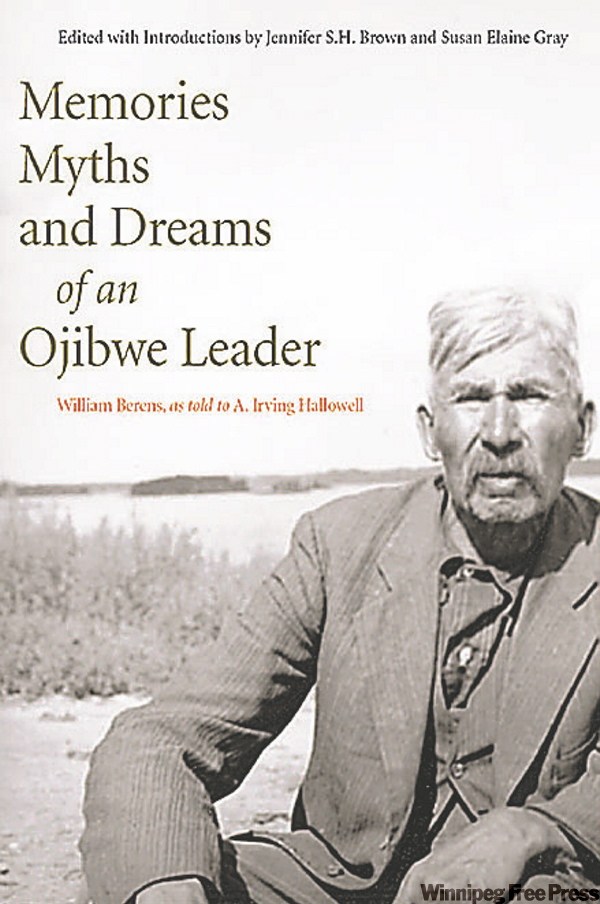
Memories, Myths, and Dreams of an Ojibwe Leader
By William Berens, as told to A. Irving Hallowell
Edited by Jennifer S.H. Brown and Susan Elaine Gray
McGill-Queen’s University Press, 261 pages, $30
THIS valuable oral historical presents the stories of a great Manitoba leader who lived through many hardships (some a result of his own actions), led his community for 30 years and navigated in two vastly diverse cosmologies.
William Berens was born in 1866 and served as chief of Berens River reserve from 1917 until his death in 1947.
In this volume, readers journey with Berens across the length and breadth of Lake Winnipeg and along Berens River into Northwestern Ontario in pursuit of a livelihood — before the advent of snowmobiles.
The Ojibwe community and river were named after Joseph Berens, a governor of Hudson’s Bay Company. William’s grandfather, Bear, adopted Berens for a surname and his descendants, including William himself, kept the name.
Berens takes us into the world of "dibaajimowinan," the stories of real events that are often connected to dream experiences, blessings, curses, warnings and the use of one’s mental powers.
Aadizookaanag, another type of narrative about which Berens speaks, are the "myths" that are strongly associated with dreams.
In Ojibwe society they functioned not only to educate but to entertain and provide a connection with non-human beings.
Seventeen of these narratives are included in this book. Some are benign and suggest lessons. South Wind Enters a Contest with His Brother, North Wind is a case in point.
Others are quite shocking and frightful. They contain a good deal of violence, even though these acts are not described in great detail.
The Origin of Summer, on the other hand, is an example of pure entertainment that provides an explanation for why "the toad has such a big mouth now" and why there are "just five months of winter."
Berens was willing to share these stories because he wanted to help others better understand his people.
He had developed a close friendship with anthropologist A. Irving Hallowell, who visited northern Manitoba for several summers from 1930 to 1940 in order to carry out his fieldwork.
As the chief spoke, the anthropologist wrote.
Unlike so many ethnographers of the day, Hallowell retained the voice of his collaborator largely unfiltered. No translation was necessary because Berens spoke excellent English.
The editors, Jennifer Brown and Susan Gray of the University of Winnipeg, underscore Hallowell’s caution that "myths and tales … must be sought … in the structure of the behavioural world to which the narrated events have reference."
They explain that for those who read them, they provide much information that hints at the "tellers’ society, world view, and values."
For the Ojibwe people themselves, "the telling of myths kept alive and reinforced their history and worldview." The editors also suggest for readers to keep in mind that the Western view is not the only way to make sense of the world and the universe.

They concur with Hallowell that presenting "as fully as possible" the voice of Berens" will "deepen our understanding of Ojibwe perspectives and their frameworks of observation and interpretation."
The preface, introduction, notes and annotations all facilitate that understanding.
This collection of Berens’ memories is now part of the Rupert’s Land Record Society Series at the University of Winnipeg, assuring it the attention it deserves.
Winnipeg writer Helen Agger is the author of Following Nimishoomis: The Oral History of Dedibaayaanimanook, published in 2008 by Theytus Books.