Census data shows linguistic diversity on the rise in Canada

Advertisement

Advertise with us

OTTAWA - A growing number of new immigrants to Canada are bringing with them increasingly diverse languages, setting a record for the number of Canadians whose mother tongue is neither English nor French, new 2021 census data reveals.

Read this article for free:


or

Already have an account? Log in here »

To continue reading, please subscribe:

Subscribe and receive a limited-edition Free Press branded hat or tote.

Digital Subscription

One year of digital access for only $205*

  • Enjoy unlimited reading on winnipegfreepress.com
  • Read the E-Edition, our digital replica newspaper
  • Access News Break, our award-winning app
  • Play interactive puzzles

*First annual payment billed as $205.00 + GST for one year. This annual subscription will automatically renew at $233.00 + GST every 52 weeks (10% off the regular annual price of $259.35). Offer available to new and qualified returning subscribers only. Cancel any time.

To continue reading, please subscribe:

Add Free Press access to your Brandon Sun subscription for only an additional

$1 for the first 4 weeks*

  • Enjoy unlimited reading on winnipegfreepress.com
  • Read the E-Edition, our digital replica newspaper
  • Access News Break, our award-winning app
  • Play interactive puzzles
Start now

*Your next Brandon Sun subscription payment will increase by $1.00 and you will be charged $17.95 plus GST for four weeks. After four weeks, your payment will increase to $24.95 plus GST every four weeks.

Hey there, time traveller!
This article was published 17/08/2022 (1498 days ago), so information in it may no longer be current.

OTTAWA – A growing number of new immigrants to Canada are bringing with them increasingly diverse languages, setting a record for the number of Canadians whose mother tongue is neither English nor French, new 2021 census data reveals.

One in four people in Canada have a mother tongue other than English or French, and about 12 per cent of people predominantly speak a non-official language at home as of last year.

Proficiency in those languages tends to fade after a generation or two, however, Statistics Canada’s deputy head of the Centre for Demography said Wednesday.

The latest census figures show a record high number of people in Canada now have a mother tongue other than French or English. People shop in Chinatown in Vancouver, Friday, February 5, 2021. THE CANADIAN PRESS/Jonathan Hayward

The latest census figures show a record high number of people in Canada now have a mother tongue other than French or English. People shop in Chinatown in Vancouver, Friday, February 5, 2021. THE CANADIAN PRESS/Jonathan Hayward

“From 2016 to 2021, the number of Canadians who predominantly speak languages other than English and French at home grew significantly,” said Éric Caron-Malenfant at a media briefing.

The trend is mainly driven by immigration, and continued even during the pandemic when immigration slowed considerably due to COVID-19 health restrictions and related backlogs, Caron-Malenfant said.

The average age of new immigrants is typically between 25 and 35, he said.

“After that, when you have children in Canada, often more and more English and French will be spoken at home,” he said.

British Columbia speech-language pathologist June Cheung noticed that phenomenon play out in her own Cantonese-speaking family and community when she was growing up in Edmonton.

“My parents were the ones who originally immigrated here from Hong Kong whereas my siblings and I, we were all born here,” Cheung said in an interview.
“My parents would speak to my older brothers and myself in Chinese but often we would reply in English.”

The generational language shift inspired her masters thesis, which further showed how “heritage” language proficiency fades with each generation.

“By the time the second generation has kids, it’s very unlikely that they’ll choose to use a heritage language,” she said.

The trend was also true for French-speaking families outside of Quebec in most provinces, the census data shows.

The proportion of Canadians living outside Quebec whose first official language spoken is French was down to 3.3 per cent in 2021 from 3.6 per cent in 2016.
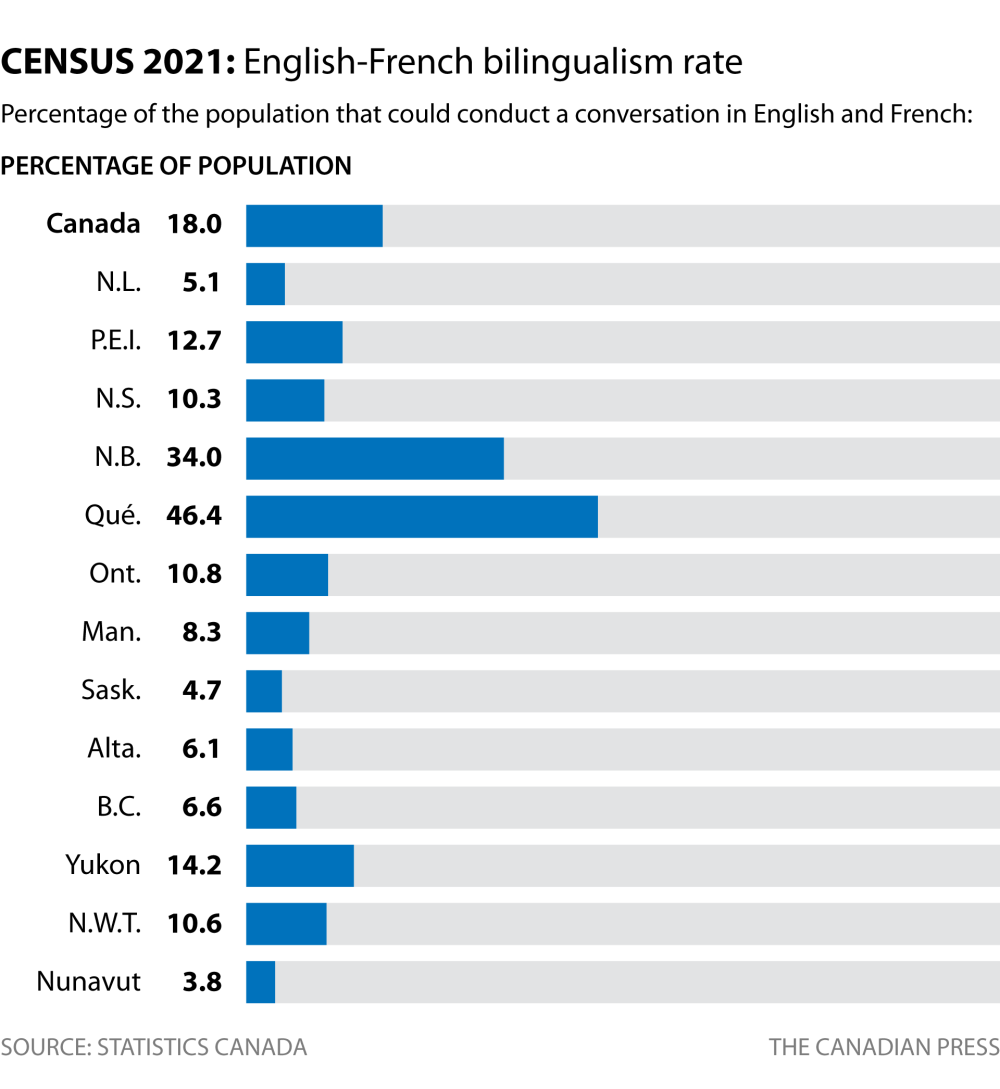
Statistics Canada attributes the decline to the fact that people whose first official language is French tend to be older, and haven’t consistently passed the language on to the next generation. Sometimes other languages can take over inside the home.

Cheung, who says she’s reinvested in her Cantonese-speaking skills, says fading language proficiency can create intergenerational divides.

“I can ask you where the bathroom is, versus being able to talk about your hopes and fears, your dreams,” she said. “It’s a lot harder to have those conversations sometimes if there is that language barrier.”

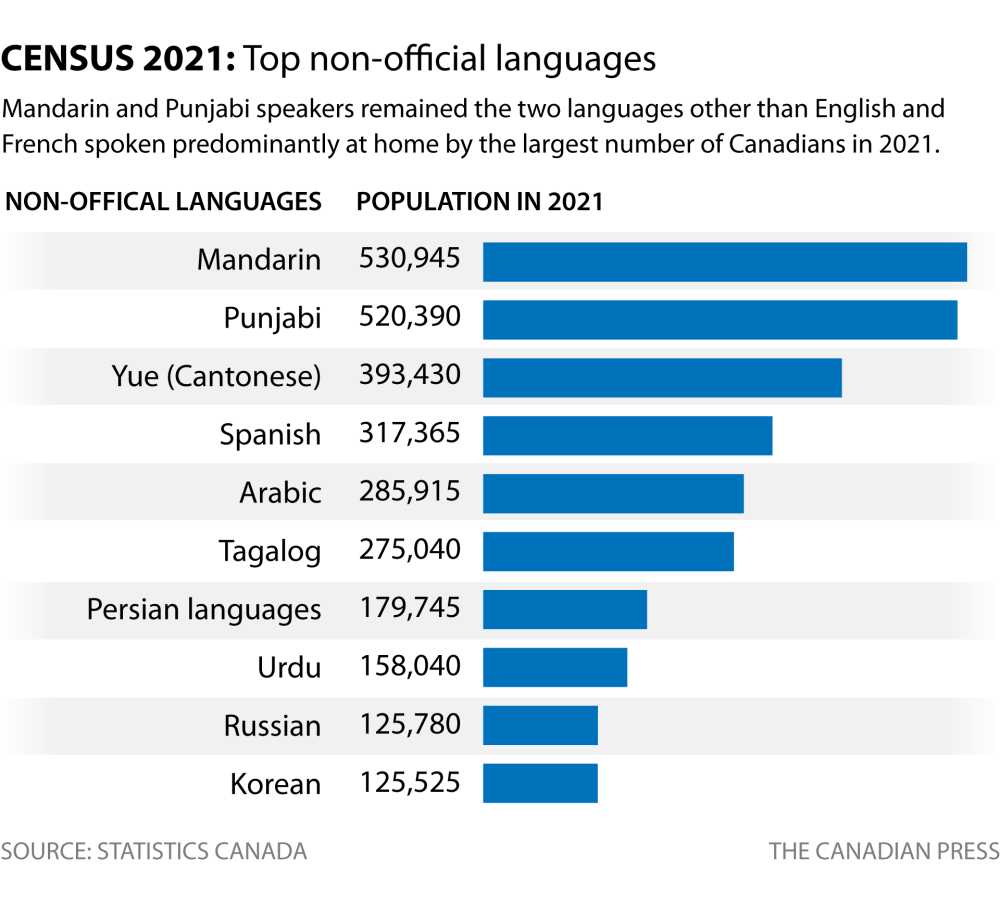
Mandarin and Punjabi are the most common non-official languages, with more than a million people predominantly speaking one of the two languages.

Statistics Canada noted a large increase in the growth of the number of Canadians who predominantly speak South Asian languages such as Punjabi, Gujarati, Hindi or Malayalam since the last census in 2016, a rise which was fuelled by immigration.

The growth rate of the population speaking South Asian languages was at least eight times greater than that of the overall Canadian population during the same period.

June Cheung, third from right, poses with her family members Gabriel, left to right, Eden, Victor, Lena and Bruce in Edmonton in this 2019 handout photo. A growing number of new immigrants to Canada are bringing with them increasingly diverse languages, setting a record for the number of Canadians whose mother tongue is neither English or French, new 2021 census data reveals. Proficiency in those languages tend to fade after a generation or two though, Statistics Canada's deputy head of the Centre for Demography says. British Columbia speech-language pathologist June Cheung noticed that phenomenon play out in her own Cantonese-speaking family and community when she was growing up in Edmonton. THE CANADIAN PRESS/HO - June Cheung

The massive increase in the growth of South Asian languages closely aligns with immigration trends from those countries.

At the same time, European languages like Italian, Polish and Greek are fading in Canada.

“This decline is primarily linked to the speakers of these languages aging, a significant proportion of whom emigrated to Canada before 1980,” Caron-Malenfant said.

Relatively few recent immigrants from those countries have recently landed in Canada, he said.

Regardless of their mother tongue, most people in Canada access services in one of the two official languages.

English and French are still by far the most common languages spoken in Canada and 90 per cent of Canadians speak at least one of the official languages.

This report by The Canadian Press was first published Aug. 17, 2022.
Report Error Submit a Tip

More Stories

Break spell before it hexes your marriage

Maureen Scurfield 4 minute read Yesterday at 2:00 AM CDT

DEAR MISS LONELYHEARTS: I have an itch that needs to be scratched every couple of days. I sneak home with a new young woman from my workplace, who is a witch, and spend an hour or more with her, learning some things my wife doesn’t know anything about. It’s not really sexual with this new person yet, but I’m feeling intrigued by her witchy-ness — and more.

I’m fascinated and want to learn whatever she’s willing to teach me as we go along. This is especially cool now my “magic woman” has told me she’s interested by the darkness in me. Whatever that means. Nobody’s ever noticed that before.

I feel my wife really doesn’t need to know I’m into this stuff. It would only hurt her, and it may lead to nothing. But how do you keep a secret from your partner for any length of time when they know your every mood and can almost smell your secrets?

— Feeling Insecure, West End

‘Wild, wild summer’: storms produce all-time number of damage claims at MPI

Nicole Buffie 5 minute read Preview

‘Wild, wild summer’: storms produce all-time number of damage claims at MPI

Nicole Buffie 5 minute read 6:34 PM CDT

More than 40,000 storm-related claims have been opened with Manitoba Public Insurance stemming from summer storms, marking a historic high.

The June 9 storm in Winnipeg and the surrounding area drove a record-setting volume, making it the largest single claim event in MPI’s history.

The data is still rolling in, but the losses from the weather are likely in the hundreds of millions of dollars, according to MPI’s vice-president and chief claims officer John Bowering.

“In my career here a storm in 5,000 to 10,000 (claims) was considered a major storm… so to have a single storm at 34,000 and a summer where we’re going to exceed 40,000 is monumental and quite hard to wrap my head around,” he said Tuesday.

Read
6:34 PM CDT

Census data shows linguistic diversity on the rise in Canada

Laura Osman, The Canadian Press 5 minute read Preview

Census data shows linguistic diversity on the rise in Canada

Laura Osman, The Canadian Press 5 minute read Wednesday, Aug. 17, 2022

OTTAWA - A growing number of new immigrants to Canada are bringing with them increasingly diverse languages, setting a record for the number of Canadians whose mother tongue is neither English nor French, new 2021 census data reveals.

One in four people in Canada have a mother tongue other than English or French, and about 12 per cent of people predominantly speak a non-official language at home as of last year.

Proficiency in those languages tends to fade after a generation or two, however, Statistics Canada's deputy head of the Centre for Demography said Wednesday.

"From 2016 to 2021, the number of Canadians who predominantly speak languages other than English and French at home grew significantly," said Éric Caron-Malenfant at a media briefing.

Read
Wednesday, Aug. 17, 2022

Kinew ‘open to everything’ after Bell’s 911 failures

Chris Kitching 4 minute read Preview

Kinew ‘open to everything’ after Bell’s 911 failures

Chris Kitching 4 minute read 4:32 PM CDT

Premier Wab Kinew signalled Tuesday he’s open to all potential options, including switching 911 providers, if feasible, after a series of outages in Manitoba.

Kinew, who’s spoken to Bell Canada CEO Mirko Bibic and Prime Minister Mark Carney about Manitoba’s 911 service, said the government and the telecom continue to have a “back and forth.”

“At this stage, we’re open to everything,” Kinew said of potential steps to ensure the service is reliable. “The No. 1, I think, baseline is that when you dial 911, you’re going to get through to the help you need, whether that’s an ambulance or fire truck or police.”

Kinew said he’s looking forward to receiving Bell’s draft report to learn the cause of the most recent outage, which occurred Thursday and affected five other provinces where the telecom provides 911 service.

Read
4:32 PM CDT

AC/DC leaves Winnipeg crowd thunderstruck

Rob Williams 5 minute read Preview

AC/DC leaves Winnipeg crowd thunderstruck

Rob Williams 5 minute read Yesterday at 12:11 AM CDT

AC/DC proved once again that rock ‘n’ roll ain’t noise pollution.

A rowdy stadium of about 35,000 people at Princess Auto Stadium couldn’t agree more as the Australian rock legends made their first trip to the city since 2015 on their PWR/UP tour, cranking out two hours and 20 minutes of raw and raunchy high-voltage material, a mix of blues, crunchy power chords, melodic riffs and double entendres that spanned five decades.

Their wide-ranging appeal was apparent in the demographic makeup of the crowd, which ranged from young children to seniors, many clad in $30 glowing devil horns from the well-stocked merch booth that also offered posters, banners, beer koozies, lanyards, tour books and T-shirts.

There is no one in music quite like guitar god Angus Young. He is 71, but onstage he is ageless, a hyperactive teenager dressed in his signature blue schoolboy uniform and yellow and blue cap, running around, duck-walking and leaping in the air while cranking out riff after riff and extended solos on his trusty black Gibson SG.

Read
Yesterday at 12:11 AM CDT

Serious crash at West Kildonan intersection known for collisions

Nicole Buffie 3 minute read Preview

Serious crash at West Kildonan intersection known for collisions

Nicole Buffie 3 minute read Sunday, Sep. 20, 2026

Residents in West Kildonan say an intersection that was the site of a serious car crash Sunday morning is notoriously dangerous.

Rob Lick heard a loud bang around 7 a.m. and rushed out of his home on Leila to see what the commotion was. He saw two crushed SUVs, a white and black one, in the intersection. Police vehicles arrived shortly after.

“It sounded like when (garbage trucks) drop a big dumpster,” he said. “I heard somebody crying or wailing, they were standing by the vehicle so I don’t know who exactly it was or if someone was injured.”

The sound of sirens followed shortly after when emergency crews came to the scene. The intersection was immediately blocked off.

Read
Sunday, Sep. 20, 2026