Now hiring: US offshore wind ramps up, workers taught safety
Advertisement
Read this article for free:
or
Already have an account? Log in here »
To continue reading, please subscribe:

Digital Subscription
One year of digital access for only $205*
- Enjoy unlimited reading on winnipegfreepress.com
- Read the E-Edition, our digital replica newspaper
- Access News Break, our award-winning app
- Play interactive puzzles
*First annual payment billed as $205.00 + GST for one year. This annual subscription will automatically renew at $233.00 + GST every 52 weeks (10% off the regular annual price of $259.35). Offer available to new and qualified returning subscribers only. Cancel any time.
To continue reading, please subscribe:
Add Free Press access to your Brandon Sun subscription for only an additional
$1 for the first 4 weeks*
- Enjoy unlimited reading on winnipegfreepress.com
- Read the E-Edition, our digital replica newspaper
- Access News Break, our award-winning app
- Play interactive puzzles
*Your next Brandon Sun subscription payment will increase by $1.00 and you will be charged $17.95 plus GST for four weeks. After four weeks, your payment will increase to $24.95 plus GST every four weeks.
Read unlimited articles for free today:
or
Already have an account? Log in here »
Hey there, time traveller!
This article was published 04/09/2022 (1497 days ago), so information in it may no longer be current.
At a 131-year-old maritime academy along Buzzards Bay in Massachusetts, people who will build the nation’s first commercial-scale offshore wind farm are learning the skills to stay safe while working around turbines at sea.
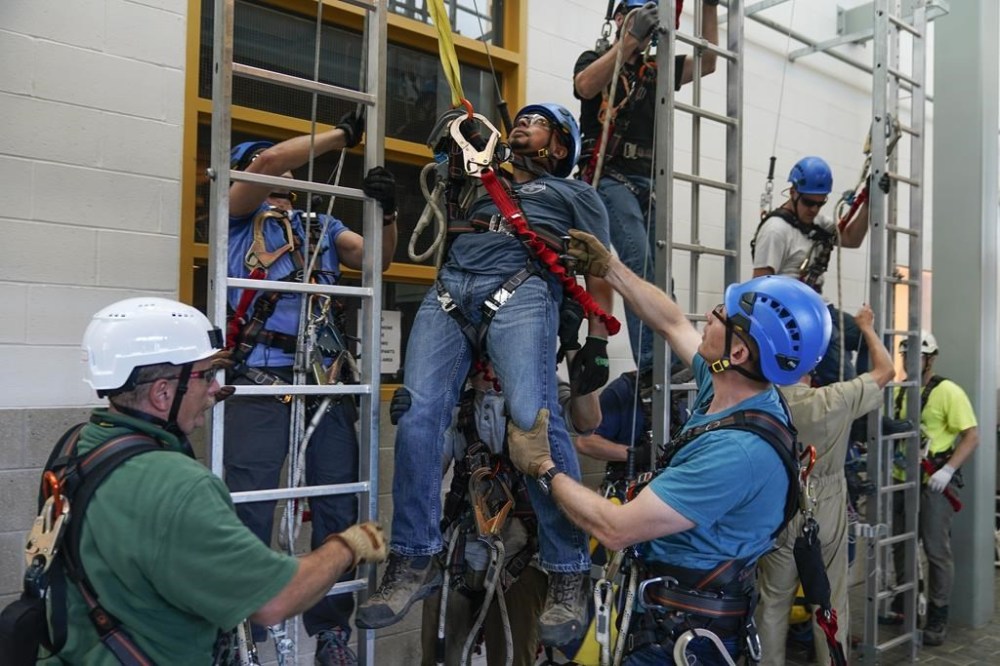
Some take to the tasks fairly easily since they’re veterans of marine fields or construction. For others, it’s totally new to be using fall protection and sea survival equipment, climbing from a boat onto a ladder to get to a turbine and learning how to work hundreds of feet in the air.
Offshore wind developers are hiring, after years of touting the promise of tens of thousands of jobs the industry could create in the United States. To launch this new clean energy industry, they now need plenty of workers with the right training and skills.
“It’s the sheer number of people we’re going to need in the timeframe that we need them,” said Jennifer Cullen, senior manager of labor relations and workforce development at Vineyard Wind in Massachusetts. “We’re combating this sense of, we’ve been talking about it for so long, … is it actually coming? We’re telling people, yes, it’s here, it’s now.
“We’re building the turbines next year and we’re going to be building many more wind farms after this,” she added.
Vineyard Wind is on track to be the first commercial-scale offshore wind farm in the U.S. The development follows the Cape Wind project, which would’ve been closer to the Massachusetts shore but failed after years of litigation and local opposition.
The Massachusetts Maritime Academy is the only place in Massachusetts currently offering the basic safety training designed by a nonprofit founded by wind turbine manufacturers and operators — the Global Wind Organisation — though training is offered in other states. Everyone who will go to a wind farm offshore must complete safety training, and most developers meet the requirement with the GWO program.
The course draws union workers and others eager to work on future wind farms that the Biden administration wants to dot U.S. coastlines to help fight climate change. President Joe Biden set a goal of 30 gigawatts of offshore wind energy by 2030, to power more than 10 million homes and create 80,000 jobs.
The payoff for offshore wind trainees is jobs with an average salary approaching $80,000 a year.
Before arriving at the academy, students complete about six hours of online coursework.
Then, wearing waterproof suits, they practice stepping off a vessel in Buzzards Bay and onto a boarding ladder connected to a turbine — a dangerous part of the job, especially in rough seas.
The students step off the pier into the chilly bay waters to learn how to safely abandon a vessel or the turbine in an emergency. They inflate a life raft, climb in, and right it when it’s upside down.
To prepare for working at heights, they use a harness and fall protection gear to ascend and descend a turbine’s ladder. They practice lowering themselves by ropes from a 20-foot (6.1-meter) platform in case of emergency evacuation. And they rescue a fellow student who feigns being injured.
A day is devoted to first aid basics and CPR, and they put out a small fire with extinguishers.
Many trainees will be headed to work on Vineyard Wind, 15 miles (24 kilometers) off the Massachusetts coast. With 62 turbines, the project is expected to produce 800 megawatts — enough electricity annually to power more than 400,000 homes, beginning in late 2023. Work began onshore late last year.
Daniel Szymkowiak, a 36-year-old engineer, used to work offshore in the oil and gas industry. He took the maritime academy course in August, and now works on wind farm subsea cables for Vineyard Wind.
Szymkowiak changed careers, he said, because working in renewable, wind energy made him feel better about the world’s future.
“It’s up and coming. To be the first commercial project in the states, that’s exciting,” he said. “To make a positive change for our country, to bring across new opportunities, that’s exactly why I’m here.”
The maritime academy, founded in 1891, has historically focused on Coast Guard-approved training for professional mariners. Anticipating needs of the nascent U.S. offshore wind industry, it expanded its courses in support of offshore wind in 2019.
Over 200 people have completed the basic safety training at the academy’s Maritime Center for Responsible Energy, in collaboration with RelyOn Nutec. The center plans to use grant funding to expand its offshore wind courses with basic technical training, enhanced first aid and advanced rescue, said Michael Burns, executive director of the maritime center. The safety course, offered twice a month, is booked through the end of the year.
In the classes, there’s a sense of excitement to work offshore, take on a new challenge and help launch the industry, Burns said. He expects to see more schools and companies offering the training to meet the growing demand.
“We want to do everything in our power to do our part to help ensure these projects are able to go off on their intended timelines,” Burns said.
In neighboring Rhode Island, Danish wind developer Orsted and utility Eversource are partnering with the state, the Community College of Rhode Island and union leaders to start a basic safety training course there too. Orsted and Eversource are planning to build Revolution Wind, a 400-megawatt wind farm south of Martha’s Vineyard, Massachusetts, to provide power for Connecticut and Rhode Island.
The first U.S. offshore wind farm opened off Rhode Island’s Block Island in late 2016. But with five turbines, it’s not commercial scale.
Cullen, of Vineyard Wind, said the role of the training is to qualify people to work for a variety of developers and to ramp up the workforce. Vineyard Wind is also working with a Martha’s Vineyard program to prepare local residents for jobs as technicians.
Tyler Spofford has been working for GE Offshore Wind since January. The 35-year-old left his job as a tugboat captain to spend more time with his family.
Spofford said he’s excited the offshore wind industry is creating jobs, especially for mariners in the Northeast. There were few workboat jobs in the region after he earned his degree and license in 2009 at the Massachusetts Maritime Academy. That led him to the Gulf of Mexico, where he worked in the oil and gas industry.
“Pretty much since I got out of school, offshore wind was always a thing that was kind of being discussed, but nothing was really ever happening that was to scale,” he said.
Then, Spofford said, the “stars aligned.” He now helps assess the Vineyard Wind project’s needs for vessels, assists in sourcing and contracting for the vessels, and will manage them. He took the maritime academy course in August.
“It kind of feels like we’re a part of this startup in a way,” he said. “We’re up against a lot of challenges. It’s kind of fun to think them through and solve them and come up with a product and something that’s going to work, a solution.”
___
Follow Jennifer McDermott on Twitter: @JenMcDermottAP
___
Associated Press climate and environmental coverage receives support from several private foundations. See more about AP’s climate initiative here. The AP is solely responsible for all content.