

Fatal train crash inquest to focus on response, communication

Advertisement
Read this article for free:
or
Already have an account? Log in here »
To continue reading, please subscribe:
Digital Subscription
One year of digital access for only $1.44 a week*
- Enjoy unlimited reading on winnipegfreepress.com
- Read the E-Edition, our digital replica newspaper
- Access News Break, our award-winning app
- Play interactive puzzles
*Billed as $5.77 plus GST every four weeks. After 52 weeks, price increases to the regular rate of $19.95 plus GST every four weeks. Offer available to new and qualified returning subscribers only. Cancel any time.
To continue reading, please subscribe:
Add Free Press access to your Brandon Sun subscription for only an additional
$1 for the first 4 weeks*
- Enjoy unlimited reading on winnipegfreepress.com
- Read the E-Edition, our digital replica newspaper
- Access News Break, our award-winning app
- Play interactive puzzles
*Your next Brandon Sun subscription payment will increase by $1.00 and you will be charged $17.95 plus GST for four weeks. After four weeks, your payment will increase to $24.95 plus GST every four weeks.
Read unlimited articles for free today:
or
Already have an account? Log in here »
Hey there, time traveller!
This article was published 08/09/2022 (1501 days ago), so information in it may no longer be current.
An inquest into a fatal train derailment in a remote part of the North won’t examine whether faster or different medical treatment at the scene could have prevented the death, a Manitoba judge has ruled.
Kevin Anderson, 38, died Sept. 15, 2018, after the Hudson Bay Railway train he was conducting derailed in Ponton, south of Thompson. It had been carrying hazardous goods. He lay pinned while bleeding out, and died after nearly nine hours.
Another crew member was seriously injured but survived after they were extricated by emergency crews.
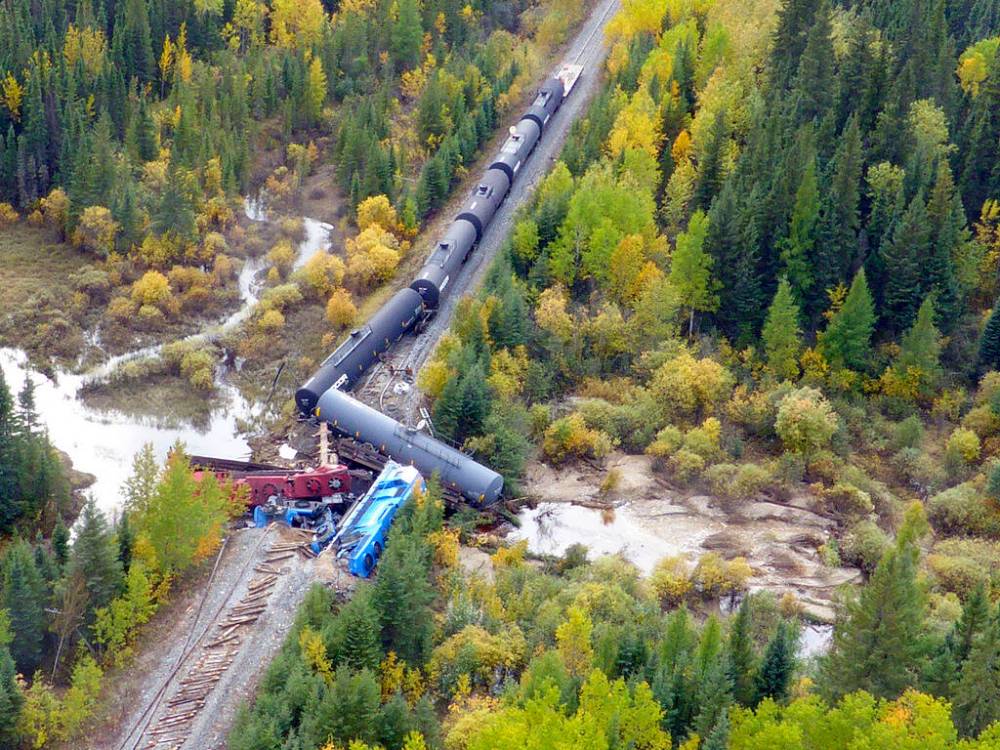
Transportation Safety Board of Canada photo Aerial view of the train derailment near Ponton, Manitoba. Derailment occured September 15. Photo taken September 18, 2018.
The emergency response was delayed as the trapped crew members were unable to reach their dispatch or call for help. The wreck was discovered by chance after a helicopter passing by overhead spotted it two hours later, the Transportation Safety Board found.
The inquest called by Manitoba’s chief medical examiner, Dr. John K. Younes, was adjourned in December, after the doctor’s opinion on whether the conductor could have survived changed.
In his initial letter calling for the inquest, Younes wrote Anderson’s death was due to blood loss, but if an intravenous line had been established, along with other interventions, his chances would have dramatically improved. The injuries came from Anderson being crushed by equipment after the derailment.
Prior to the inquest’s start, Younes said he had based that opinion on a casual conversation with a colleague, and the colleague did not realize their words would be given such weight.
An independent physician was then asked to provide a report, in which he said the injuries were likely fatal regardless.
The City of Thompson and Thompson Fire & Emergency Services filed a motion to modify the scope of the inquest so it would not focus on whether Anderson’s death was preventable.
Instead, it should focus on a review of the co-ordination of multi-agency response to a serious incident in a remote part of the province, and what changes, if any, could be made to the medical system to prevent similar deaths from occurring in such remote settings, the motion said.
Judge Timothy Killeen issued his ruling Wednesday, noting the circumstances and expert opinions do not indicate medical treatment at the scene would have prevented Anderson’s death.

He found the delay in emergency responders arriving to the scene, as well as communication issues, will need to be examined in the inquest.
“It is important to determine what can be done to speed the response,” Killeen wrote.
He also said the issues that caused Anderson’s death need to be considered to address how a life might be saved in a similar incident.
A TSB investigation previously found the track in the area was neglected and susceptible to heavy rain and high water levels.
erik.pindera@freepress.mb.ca
Erik Pindera is a reporter for the Free Press, mostly focusing on crime and justice. The born-and-bred Winnipegger attended Red River College Polytechnic, wrote for the community newspaper in Kenora, Ont. and reported on television and radio in Winnipeg before joining the Free Press in 2020. Read more about Erik.
Every piece of reporting Erik produces is reviewed by an editing team before it is posted online or published in print — part of the Free Press‘s tradition, since 1872, of producing reliable independent journalism. Read more about Free Press’s history and mandate, and learn how our newsroom operates.
Our newsroom depends on a growing audience of readers to power our journalism. If you are not a paid reader, please consider becoming a subscriber.
Our newsroom depends on its audience of readers to power our journalism. Thank you for your support.
Erik Pindera is a reporter for the Free Press, mostly focusing on crime and justice. The born-and-bred Winnipegger attended Red River College Polytechnic, wrote for the community newspaper in Kenora, Ont. and reported on television and radio in Winnipeg before joining the Free Press in 2020. Read more about Erik.
Every piece of reporting Erik produces is reviewed by an editing team before it is posted online or published in print — part of the Free Press‘s tradition, since 1872, of producing reliable independent journalism. Read more about Free Press’s history and mandate, and learn how our newsroom operates.
Our newsroom depends on a growing audience of readers to power our journalism. If you are not a paid reader, please consider becoming a subscriber.
Our newsroom depends on its audience of readers to power our journalism. Thank you for your support.
Advertisement Advertise With Us
Advertisement Advertise With Us