Sperm whales’ clicking dialects are evidence of ‘non-human culture’, say scientists
Advertisement
Read this article for free:
or
Already have an account? Log in here »
To continue reading, please subscribe:
Digital Subscription
One year of digital access for only $1.44 a week*
- Enjoy unlimited reading on winnipegfreepress.com
- Read the E-Edition, our digital replica newspaper
- Access News Break, our award-winning app
- Play interactive puzzles
*Billed as $5.77 plus GST every four weeks. After 52 weeks, price increases to the regular rate of $19.95 plus GST every four weeks. Offer available to new and qualified returning subscribers only. Cancel any time.
To continue reading, please subscribe:
Add Free Press access to your Brandon Sun subscription for only an additional
$1 for the first 4 weeks*
- Enjoy unlimited reading on winnipegfreepress.com
- Read the E-Edition, our digital replica newspaper
- Access News Break, our award-winning app
- Play interactive puzzles
*Your next Brandon Sun subscription payment will increase by $1.00 and you will be charged $17.95 plus GST for four weeks. After four weeks, your payment will increase to $24.95 plus GST every four weeks.
Read unlimited articles for free today:
or
Already have an account? Log in here »
Hey there, time traveller!
This article was published 16/09/2022 (1493 days ago), so information in it may no longer be current.
VANCOUVER – In the dark depths of the Pacific Ocean, there are a lot of conversations going on.
Click-click-click-click-click. That’s the sound of a sperm whale.
Click-click-click-click, pause, click. That’s a sperm whale that lives in the same area but is from a different group.
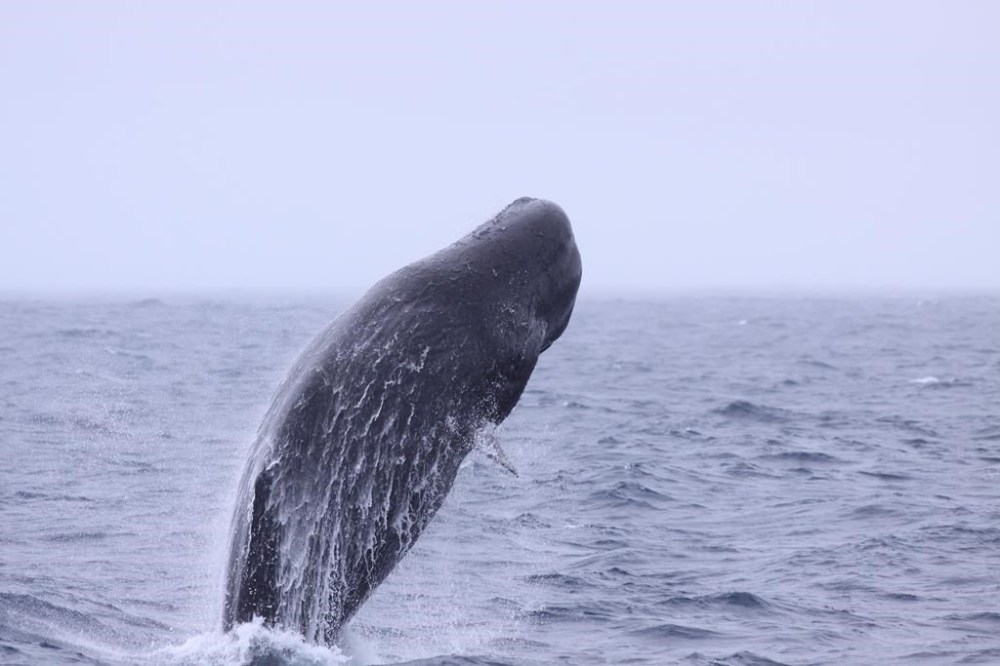
Sperm whales, the largest toothed animal in the world and easily recognized by their huge, rounded foreheads, use series of Morse-code-like clicks, known as “codas,” to communicate.
Scientists now say in a new study that variations in the whales’ clicking dialects are evidence of “non-human culture” and provide a way for whale groups to mark cultural identity when clans overlap, in a similar way to human ethnic groups.
The study published this month in the Proceedings of the National Academy of Sciences involved a team of 27 scientists from Halifax and Nijmegen in the Netherlands.
Dr. Taylor Hersh, the paper’s lead author and PhD graduate from Dalhousie University’s biology department, said in a news release the work “was the culmination of decades of research efforts by individuals working throughout the Pacific Ocean.”
“We decided to share data and work collaboratively, to learn something new about these enigmatic, charismatic and cultural animals,” said Hersh.
To determine if whales’ codas were comparable to dialects in humans, the researchers focused on “identity codas,” which are particular to each clan.
“Whales from different clans never interact with each other, even when they share the same waters,” Hersh said in an interview. “This suggests that the whales have some way of distinguishing ‘us’ versus ‘them,’ and we wanted to know if they do so using identity codas.”
After pooling acoustic data from 23 locations and extracting over 23,000 codas, the team identified seven sperm whale vocal clans across the Pacific, each having a unique dialect.
The research was part of the “Global Coda Dialect Project” led by Hersh, Canadian whale biologist Shane Gero, who is also a scientist-in-residence at Ottawa’s Carleton University, and marine scientist Chris Johnson.
Hersh said researchers have known for years that they could tell different sperm whale clans apart based on their vocal sounds.
But the new research provided “quantitative evidence” that the whales themselves are using those identity codas as a symbolic marker to indicate which cultural group they belong to. When clans overlapped, their dialects became more distinct, the scientists said.
“So, I think a nice analogy with humans is, if you see someone walking around with a necklace that has a cross on it or a Star of David,” said Hersh.
“Even without talking to them or hearing them speak or knowing anything about them, you know something about at least one cultural group that they see themselves belonging to.
“And so, we think it’s something similar with the sperm whales that they use these certain coda types.”
She said the study also revealed more about animal culture.
“It’s just for so long we thought we have the most complex culture, or we have the only culture. And I think it’s become clear over the past 10, 20 years that that’s not true. We find more and more examples of animals with culture. And I think that’s (true) with the sperm whales, ” said Hersh.
Gero, the scientist-in-residence at Carleton University, said in an interview that the work had been painstaking, with researchers spending thousands of hours on small, open boats.
He said some of the scientists had been “living on sailboats sailing across the Pacific,” dragging a hydrophone behind them to constantly record the sounds of the ocean.
For every minute of recording, it could take eight to 12 times as long to extract and label a whale’s coda.
Hersh said the next step is to conserve and protect whales in a way that accounts for their culture.

“Because if these whales are drawing boundaries around their own cultural groups, then I think that should be reflected in management too (and) we should also try and see them in that way and incorporate that into how we manage them,” said Hersh.
She joked that if, one day, a way was found for humans to communicate with sperm whales, she’d ask them if the researchers’ findings were relevant to them.
“It would be great to ask, ‘wait, is that true,'” she said with a laugh.
This report by The Canadian Press was first published Sept. 16, 2022.
This story was produced with the financial assistance of the Meta and Canadian Press News Fellowship.